Executive Overview
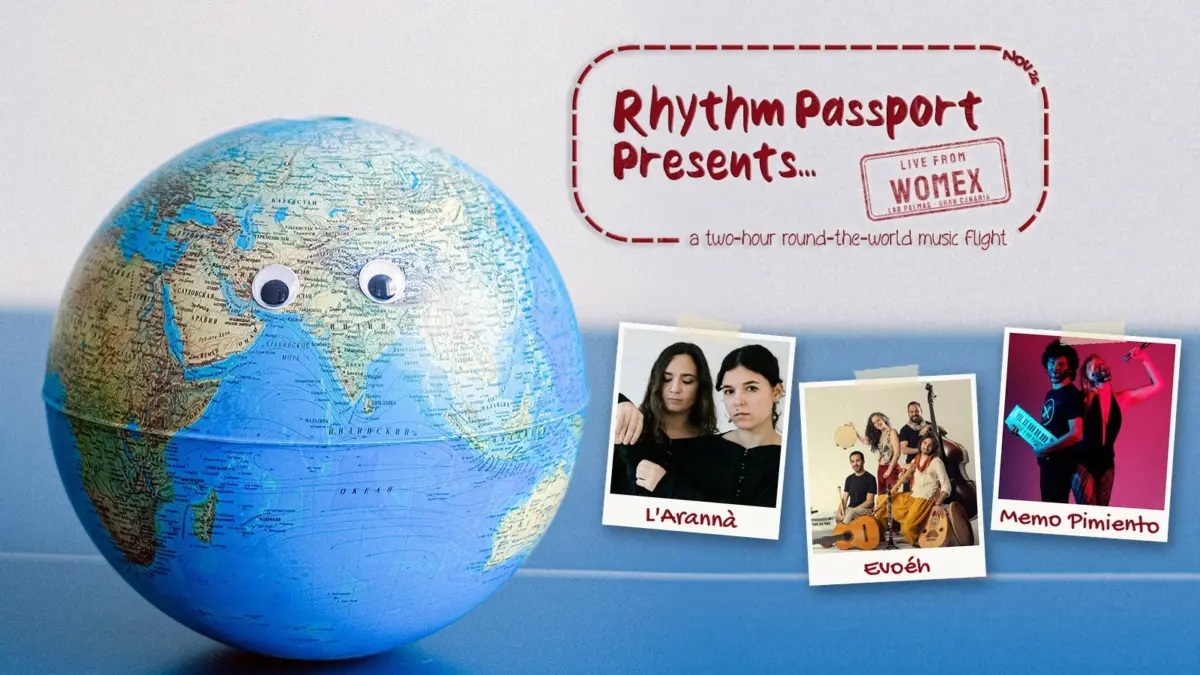
Global music discovery platform Rhythm Passport has officially dropped its latest radio special, capturing the sonic pulse of WOMEX 26 (Worldwide Music Expo). Recorded live from the sunny shores of Las Palmas de Gran Canaria, this special edition radio broadcast serves as an auditory time capsule of one of the planet’s most vital industry gatherings.
Carried back across continents with little more than a subtle Mediterranean tan, a bulging tote bag of freshly minted promotional records, and a master audio recording session, the Rhythm Passport team has synthesized the sprawling, multi-day trade fair into an intimate, curated listening experience.
Broadcast courtesy of the dedicated Radio WOMEX pop-up studio, the newly released episode traverses centuries of musical evolution. It bridges the gap between the archaic, microtonal polyphonies of the Balearic Islands and the slow-motion, psychedelic pulse of contemporary Brussels-based cumbia.
Featuring live in-studio performances, deep-dive artist interviews, and an expansive track list highlighting the festival’s most arresting showcases, this dispatch shines a light on the resilient underground forces reshaping world music today. For global music aficionados, ethnomusicologists, and industry professionals alike, this radio show offers an essential gateway into the creative methodologies defining the post-pandemic global festival circuit.
Detailed Chronology: Inside the Radio WOMEX Studio Sessions
The newly released broadcast is structured as a chronological journey through the Radio WOMEX studio, capturing artists in transitional spaces between their major showcase performances and international touring cycles.
Act I: L’Arannà and the Resurgence of Cant Redoblat
The broadcast opens with an intimate studio session featuring Lara Magrinyà and Anna Sala, the creative force behind L’Arannà. Having arrived at WOMEX 26 on the heels of their critically praised showcase project Turmarí, the duo brought a striking collision of ancient and modern aesthetics into the broadcast booth.
Turmarí is built around cant redoblat—a demanding, highly localized traditional singing style indigenous to the Balearic islands of Ibiza and Formentera. Historically utilized to carry voices across sweeping rural landscapes and rugged coastlines, cant redoblat demands exceptional vocal control, utilizing microtonal shifts and rapid vibratos.
Rather than treating this heritage art form as a museum piece, L’Arannà weaponizes it for the 21st century. In the Radio WOMEX studio, Magrinyà and Sala stripped back the arrangements for a piercing, hypnotic live performance. They paired the ancient vocal cadences with the oscillating hum of analog synthesizers, the sharp wooden percussion of traditional castanets, and the rustic breath of the flaüta (a traditional local pipe).
During their extended interview with the Rhythm Passport team, the duo discussed the logistical and philosophical challenges of carrying centuries-old folk memory onto modern electronic stages without diluting its regional integrity.
Act II: Evoéh and the Trans-Mediterranean Seed
Shifting the geographical focus toward the Iberian Peninsula and the broader Mediterranean basin, the second segment introduces Evoéh. The ensemble was represented in the studio by Ariana Barrabés on vocals and percussion, alongside Jesús Olivares on guitars, oud, and a custom-built African lyre constructed by Olivares’s own hands.
Evoéh’s sonic framework exists at a vibrant crossroads where Iberian folk roots meet the modal complexities of Mediterranean traditions, underpinned by the harmonic freedom of jazz and the rhythmic fire of flamenco. Their music is an ongoing investigation into cultural syncretism.
The duo used their studio time to discuss their latest release, Músicas semilla (Seed Musics). The conceptual album is anchored by a poetic yet rigorous premise: that every musical seed, much like botanical flora, was once a traveler, cast across borders by the winds of migration, trade, and diaspora. Across the album, Evoéh’s songs wander fluidly through more than seven distinct languages.
In the studio, Barrabés and Olivares delivered a masterclass in dynamic restraint. The acoustic warmth of the custom African lyre blended seamlessly with the percussive attack of the oud, creating a transnational sonic dialogue that captivated the Radio WOMEX engineering crew.
Act III: Memo Pimiento and the Analog Cumbia Underground
Breaking the acoustic spell of the first two segments, the broadcast pivots abruptly across the Atlantic and deep into the heart of European migrant-producer culture with Memo Pimiento.
Born in Mexico City and currently operating out of his creative base in Brussels, Memo Pimiento represents the vanguard of transnational bass music. Performing live on a rig of vintage analog synthesizers and drum machines, he specializes in rebajada—a localized offshoot of Colombian cumbia slowed down to a syrupy, hypnotic crawl, drenched in analog tape delays and psychedelic modulation.
The interview segment explores how a Latin American artist navigates the brutalist electronic underground of Western Europe while maintaining a deeply rooted connection to tropical cumbia rhythms.
As a special, unscripted highlight of the broadcast, Evoéh’s Jesús Olivares returned to the studio to join Memo Pimiento for a rare, one-off acoustic-electronic crossover. Together, they forged a spontaneous rendition of the track "Sol y Piel," merging the organic resonance of plucked string instruments with the heavy, subterranean pulse of slowed-down bass electronics.
Supporting Context & Metrics: The WOMEX Ecosystem
To fully appreciate the significance of the Rhythm Passport broadcast, one must understand the economic and cultural scale of WOMEX (Worldwide Music Expo). Established over three decades ago, WOMEX is globally recognized as the most important international networking platform for world music, folk, roots, ethnic, and traditional music industries.
Key Metrics of WOMEX 26:
- Global Attendance: Annually draws upwards of 2,500 to 3,000 delegates from over 90 countries.
- Industry Representation: Spans record labels, booking agencies, festival directors, cultural institutions, media outlets, and independent artists.
- Programming Scope: Features a rigorous trade fair floor, extensive conference tracks, film screenings, and multi-venue night showcases highlighting upwards of 60 international acts.
- Radio WOMEX: A dedicated on-site broadcast facility operating in partnership with international public and independent broadcasters, streaming live sets, artist takeovers, and panel discussions to a worldwide digital audience.
The Gran Canaria Backdrop
Hosting WOMEX 26 in Las Palmas de Gran Canaria added a profound geographical and historical layer to the event. Positioned off the northwest coast of Africa, the Canary Islands have historically functioned as a maritime crossroads linking Europe, Africa, and the Americas.
For Rhythm Passport, recording in this specific Atlantic crucible underscored the themes of migration, syncretism, and cultural exchange that dominated the featured artists’ repertoires—from L’Arannà’s island isolationism to Evoéh’s Mediterranean trade routes and Memo Pimiento’s trans-Atlantic relocation.
Official Statements and Industry Reflections
The collaboration between Rhythm Passport and Radio WOMEX highlights a growing demand for independent, deep-dive music journalism within festival environments that are increasingly dominated by corporate curation and commercial showcase fast lanes.
"When you step into the Radio WOMEX studio, the corporate noise of the trade floor drops away," noted a representative from the Rhythm Passport editorial team. "You are left in a room with artists who are carrying centuries of ancestral memory in their voices, yet are brave enough to plug those voices into analog synths, custom-built African lyres, and slowed-down drum machines. That is where real global music is being forged today—not in the boardrooms, but in the friction between heritage and experimentation."
Industry analysts attending WOMEX 26 noted a distinct shift toward regional micro-genres—such as the cant redoblat of the Balearics championed by L’Arannà—as younger generations of artists seek authentic counter-narratives to homogenized global pop. Simultaneously, electronic producers working within diasporic frameworks, like Memo Pimiento, continue to prove that geographic displacement can serve as a powerful catalyst for sonic innovation.
Future Outlook: The Evolution of Global Roots Media
As the dust settles on Las Palmas de Gran Canaria and the international music community looks ahead to subsequent global gatherings, the implications of broadcasts like Rhythm Passport Presents point toward a robust future for specialized cultural journalism.
1. The Decentralization of World Music
The rigid boundaries that once separated "traditional folk" from "electronic club music" are rapidly dissolving. Projects like L’Arannà’s synth-backed Balearic laments and Memo Pimiento’s analog cumbia prove that future-facing electronic music is increasingly being authored by artists rooted in hyper-local traditions.
2. Archival Radio as Cultural Preservation
With commercial streaming algorithms threatening to flatten global music diversity into homogenized playlists, independent radio initiatives like Radio WOMEX and Rhythm Passport Presents act as crucial cultural safety nets. By archiving live studio sessions, long-form interviews, and unedited acoustic crossovers, these platforms create permanent public records of ephemeral moments in global music history.
3. Next Steps for Listeners
Listeners eager to re-experience the sonic journey of WOMEX 26 can stream the full episode directly via the Rhythm Passport podcast portal. The complete archive of previous episodes—spanning diverse global undergrounds, field recordings, and artist takeovers—remains accessible online, serving as an ongoing curriculum in contemporary transnational sound.
As the Rhythm Passport team unpacks their bags and begins sorting through their collection of vinyl, cassettes, and digital promos, one thing is certain: the global roots underground is louder, more experimental, and more deeply connected than ever before.
Enjoy the flight.