Executive Overview
The modern Hollywood landscape remains inextricably anchored to the "cinematic universe"—a multi-billion-dollar industrial complex dominated by fierce rivals DC and Marvel. While Marvel has faced its own share of creative fatigue and fluctuating box-office returns in recent years, DC Studios has found itself mired in a continuous loop of structural instability, creative re-imaginings, and commercial disappointments.
The most recent tremor in this ongoing saga hit in November 2026, when studio co-head James Gunn officially stepped down from his post after a turbulent four-year tenure. Gunn, renowned for his quirky, pop-culture-infused action blockbusters, attempted to rebuild the DC universe from the ground up around his singular creative sensibilities. However, following a string of major 2026 box-office flops—including the highly anticipated Supergirl and the genre-bending horror-superhero experiment Clayface—the studio opted for a seismic change in leadership.
Stepping into the role is veteran producer Jeremy Latcham, one of the foundational architects of the Marvel Cinematic Universe (MCU). Latcham’s arrival signals a potential philosophical shift away from director-led world-building toward traditional studio operational excellence. As the industry parses the fallout of Gunn’s departure and looks toward the slate of 2027 releases, Hollywood analysts are left asking a pressing question: Can a new producer steer the DC ship out of troubled waters, or is the entire superhero cinematic universe model hurtling toward an inevitable reckoning?
Detailed Chronology: The Rise, Fall, and Re-shuffling of Modern DC
To understand the current crisis at DC Studios, one must examine the timeline of structural pivots that have defined the studio over the past decade.
The Snyder Era (2013–2023)
The modern foundation of DC’s interconnected cinematic ambitions began with Zack Snyder’s Man of Steel in 2013. Eager to replicate Marvel’s shared-universe success, Warner Bros. constructed a gritty, auteur-driven continuity helmed largely by Snyder. However, tonal fragmentation plagued the universe early on. The breaking point arrived during the post-production of 2017’s Justice League, when studio executives brought in Joss Whedon to radically alter Snyder’s vision following a family tragedy.
The resulting theatrical cut was a notorious critical and financial misfire that deeply fractured the fanbase. The controversy metastasized into a multi-year fan campaign ("Release the Snyder Cut"), which ultimately forced Warner Bros. to spend millions more to release Zack Snyder’s Justice League on streaming in 2021. The damage, however, was already done: the original cinematic universe was perceived as chaotic, reactive, and lacking long-term cohesion.
The James Gunn Experiment (2022–2026)
Hoping for a definitive fresh start, Warner Bros. Discovery handed the keys of the newly minted DC Studios to filmmaker James Gunn and producer Peter Safran in late 2022. Gunn laid out an ambitious, multi-phase roadmap designed to rival Marvel’s integrated storytelling. The crown jewel of this new era was supposed to be 2025’s Superman, a film intended to re-establish the Man of Steel as a beacon of optimism while anchoring a unified narrative spanning films, television, and animation.

Yet, cracks quickly formed beneath the surface. Critics and industry observers pointed out a major structural risk: building an entire multi-billion-dollar franchise around the eccentric, hyper-specific creative voice of a single director-turned-executive left little room for broad narrative adaptability.
The 2026 Box-Office Reckoning
The tipping point arrived in 2026. Despite high expectations, DC’s theatrical slate faltered significantly. Supergirl failed to capture the public imagination, emerging as a major box-office bomb. Meanwhile, Clayface—a daring, critically praised horror-infused take on the classic Batman rogue—proved too niche to set the box office alight. Crucially, Clayface highlighted a deeper symptom of the universe’s disarray: it existed in a narrative vacuum, making zero direct references to Batman, Superman, or the broader DC pantheon, and omitting the traditional post-credits scenes that usually hook audiences for future installments.
By November 2026, the cumulative pressure of underperforming titles, unfulfilled multi-film promises, and stagnant world-building resulted in Gunn stepping down as head of DC Studios, though he remains attached to direct specific projects like the upcoming Superman sequel slated for 2027.
Supporting Context & Metrics: The Producer vs. Director Paradigm
The transition from James Gunn to Jeremy Latcham marks a fundamental pivot in studio philosophy. It highlights a recurring debate in modern Hollywood: Who should run a cinematic universe—a visionary artist or an operational master?
The Director-Led Approach
James Gunn’s background is that of an idiosyncratic auteur. Famed for his distinct visual style, irreverent wit, needle-drop soundtracks laden with 1980s pop classics, and a talent for making obscure characters beloved (as seen in Marvel’s Guardians of the Galaxy trilogy), Gunn approached DC through the lens of a director.
While this creative energy injected flavor into individual projects, it struggled to scale across a massive, interconnected slate. A director-led studio often suffers from tunnel vision, where individual creative expressions take precedence over the disciplined, macro-level plotting required to maintain a multi-franchise ecosystem.
The Producer-Led Legacy
Jeremy Latcham, conversely, represents the classic studio infrastructure that built the modern superhero boom. As one of the earliest employees at Marvel Studios, Latcham earned crucial production credits on foundational MCU hits like Iron Man (2008) and The Avengers (2012).
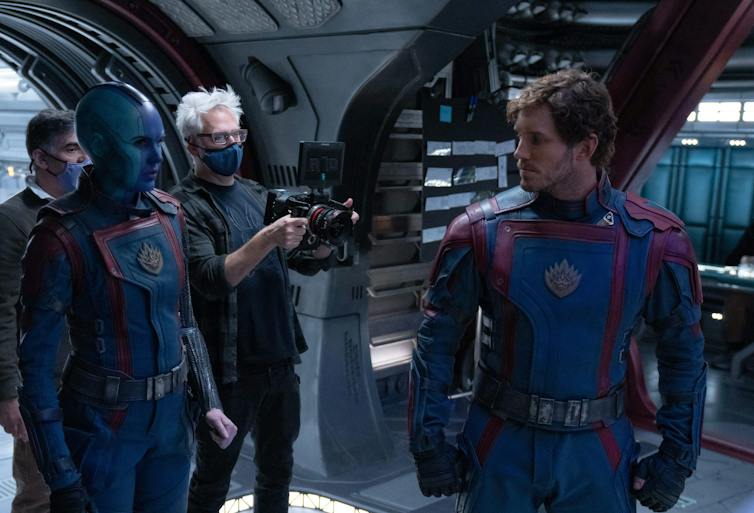
Bringing in a producer introduces an entirely different skill set:
- Operational Excellence: Streamlining production pipelines, managing budgets, and keeping sprawling creative visions on schedule.
- Macro-Narrative Cohesion: Ensuring that disparate films and television shows speak to one another, building toward satisfying multi-year payoffs.
- Risk Mitigation: Balancing artistic ambition with commercial viability to avoid isolated box-office catastrophes.
However, industry experts caution that operational excellence alone is not a silver bullet. Latcham inherits a universe that currently lacks a driving narrative engine. Without a clearly defined overarching villain, a steady pipeline of core hero films (such as Batman, Wonder Woman, and Aquaman), or a unified tone, logistical efficiency risks simply organizing a rudderless ship more effectively.
Official Statements and Industry Insights
In the wake of the leadership shuffle, insiders and trade publications have rushed to decode what Latcham’s appointment means for the future of DC Studios.
While formal corporate press releases have emphasized a smooth transition—noting that Gunn will finish his active directorial commitments for the 2027 slate—anonymous industry insiders have painted a more urgent picture. Latcham has reportedly described his immediate mandate to colleagues as acting as a "creative shepherd," focusing heavily on healing fractured internal pipelines and ensuring incoming projects possess narrative synergy.
Concurrently, reports surfaced less than 24 hours after Gunn’s departure indicating that the new management team is already quietly debating the possibility of yet another hard reset. The prospect of discarding the current continuity so soon after its inception has sparked intense debate among stakeholders, balancing the desire for absolute narrative purity against the risk of inducing severe consumer fatigue and PR backlash.
Future Outlook: Three Scenarios for DC Studios
Based on ongoing academic and industry research into superhero franchises, three distinct paths lie ahead for DC Studios under Jeremy Latcham’s leadership.
Scenario 1: Different Management, Same Direction
Under this scenario, Latcham respects the existing roadmap laid out by Gunn. Projects already deep in production—such as the Superman sequel and select 2027 series—will proceed largely as planned. Latcham’s role will be to optimize their delivery, smooth out rough edges, and ensure marketing campaigns connect with audiences more effectively than Supergirl or Clayface did.
- Likelihood: High. It is the safest, most cost-effective path that honors existing financial commitments while introducing structural adult supervision to the creative process.
Scenario 2: Tying Up Loose Threads and Consolidation
Here, Latcham acts as a cleaner. Recognizing that cancelled projects will remain dead and past missteps cannot be undone, he focuses entirely on unifying the remaining active slate. This involves introducing connective tissue—such as mandatory narrative crossovers and post-credits setups—to transform a disparate collection of movies into a holistic, binge-worthy universe worthy of long-term fan investment.
- Likelihood: Moderate-High. This approach leans directly into Latcham’s strengths as an experienced Marvel producer skilled at threading disparate narratives into a cohesive whole.
Scenario 3: The Hard Reset (The Nuclear Option)
The most radical path involves wiping the slate clean once more, brushing aside the remnants of Gunn’s brief tenure and building an entirely new continuity from scratch. While comic books do this routinely through reboots and alternate timelines, doing so cinematically after just a few years risks triggering a severe public relations crisis and alienating whatever core fanbase remains.
Furthermore, a hard reset requires profound, long-term strategic foresight—something Latcham and his team have had very little time to formulate in the immediate wake of Gunn’s sudden departure.
- Likelihood: Low to Moderate. While whispers of a reboot are already circulating within trade circles, the sheer reputational cost makes it a desperate measure unlikely to be triggered unless upcoming 2027 projects suffer catastrophic failures.
Conclusion
The replacement of James Gunn with Jeremy Latcham is far more than a routine executive reshuffle. It represents a fundamental philosophical reassessment of how DC Studios intends to manage its intellectual property. Whether Latcham can successfully shepherd DC out of its persistent identity crisis or if the studio will be forced into yet another existential reinvention remains one of Hollywood’s most compelling unfolding dramas. One thing, however, is certain: the era of the carefree, director-driven cinematic experiment at DC has officially come to a close.