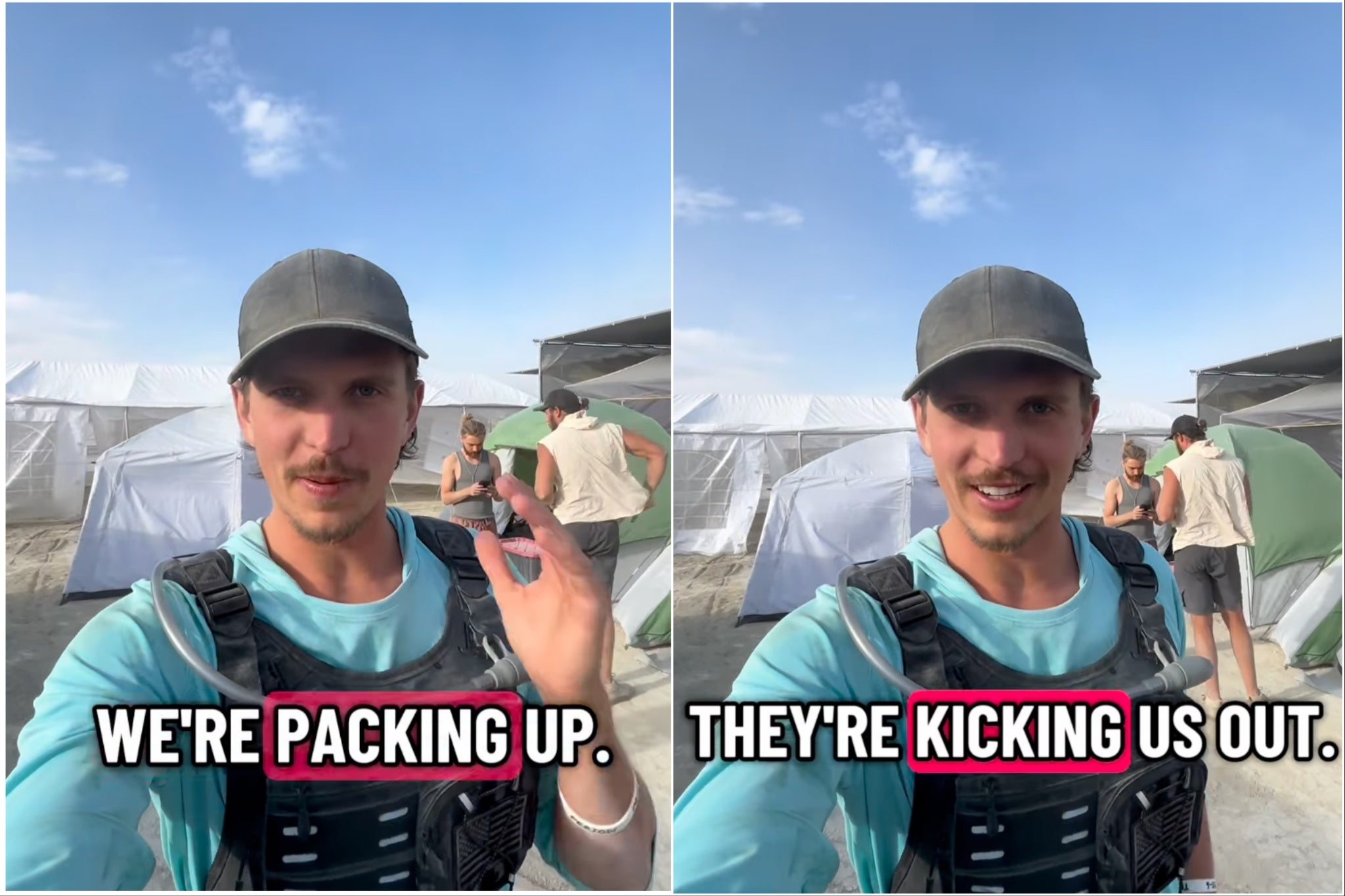
The sprawling expanse of the Nevada desert played host to a high-profile cultural clash during this year’s Burning Man festival, culminating in the abrupt, middle-of-the-night eviction of a Christian missionary group. John Hinerman and his associates, who operated a dedicated encampment under the banner "Shift the Atmosphere," claim they were forcibly removed from Black Rock City due to anti-Christian discrimination. According to Hinerman, the group’s mission to "spread the word of Jesus"—which involved playing Christian electronic dance music (EDM), serving complimentary coffee, and conducting hundreds of baptisms—infringed upon no rules, making their abrupt expulsion a direct contradiction of the festival’s foundational ethos of "radical inclusion."
Conversely, festival organizers maintain a starkly different narrative. According to official statements released by Burning Man representatives, the eviction was executed not because of the group’s religious convictions, but due to persistent, uncorrected violations of participant privacy policies, specifically concerning the unconsented filming and photography of other attendees.
This dramatic confrontation illuminates deep-seated tensions within the modern iteration of the iconic counterculture gathering. As Burning Man navigates mounting internal and external critiques—ranging from accusations of commercialization and elitism leveled by co-founder John Law to ongoing debates regarding the boundaries of personal expression and privacy—the incident serves as a cultural flashpoint. It forces a critical examination of how a community built on radical ideals manages the friction between orthodox faith and progressive, permissive desert culture.
Detailed Chronology: From Conversion to Confrontation
The events leading up to the midnight expulsion of "Shift the Atmosphere" unfolded over several days of intense activity within the temporary desert metropolis of Black Rock City.
Setting Up the Mission
Upon arriving at the annual event, which ran from August 30 to September 7, Hinerman and his fellow missionaries established their dedicated camp with the explicit purpose of religious outreach. Utilizing social media platforms, particularly Instagram, Hinerman documented their journey, showcasing the setup of their physical camp, the deployment of sound systems broadcasting upbeat Christian EDM, and a hospitality station offering free coffee to passing "Burners."
As the days progressed, the group reported significant engagement from the festival population. In various video updates shared online, Hinerman claimed that hundreds of attendees interacted positively with their camp. By the peak of the festival, the group asserted they had facilitated over 600—and later, by some accounts, upwards of 800—baptisms and spiritual conversions. For the missionaries, these numbers represented a profound spiritual victory in an environment traditionally associated with secularism and hedonism.
The Midnight Eviction
The atmosphere of celebration shifted dramatically as festival security and organizers intervened. According to Hinerman, the group was given a sudden three-hour ultimatum in the middle of the night to dismantle their camp and evacuate the premises.
Videos captured during the eviction show Hinerman and his team packing their equipment under duress, assisted by sympathetic festival-goers who helped them clear the site. Visibly shaken yet defiant, Hinerman took to social media to broadcast his version of events. In emotional video posts, he framed the eviction as spiritual warfare, declaring that "Satan’s mad" and arguing that the festival’s leadership had capitulated to intolerance.
"We have been asked to leave Burning Man. We’re packing up. They’re kicking us out," Hinerman stated in one widely viewed clip. He repeatedly contrasted the forced removal of his group with Burning Man’s core principle of "radical inclusion," arguing that the policy seemingly applied to everyone except practicing Christians. Furthermore, Hinerman launched countersuspicions regarding the festival’s social norms, vocally criticizing instances of public nudity and noting that many attendees walked around unclothed in the presence of children without securing explicit consent from families.
Supporting Context & Metrics: Principles, Privacy, and Public Perception
To fully understand the gravity of the dispute between the "Shift the Atmosphere" camp and Burning Man management, one must examine the operational framework of the festival and the specific allegations raised by both parties.
The Ten Principles of Burning Man
Established in 1990 after moving from San Francisco’s Baker Beach to the Black Rock Desert, Burning Man operates under a strict, non-commercial philosophical code known as the Ten Principles. Authored by co-founder Larry Harvey, these principles include:
Radical Inclusion: Anyone may be a part of Burning Man. We welcome and respect the stranger. No prerequisites are required for participation in our community.
Radical Self-Expression: Radical self-expression arises from the unique gifts of the individual. No other individual or group can substitute its content for this.
Decommodification: In order to preserve the spirit of cooperation, our community seeks to create social environments that are unmediated by commercial sponsorships, transactions, or advertising.
While "radical inclusion" is often cited by outside groups and participants as a blanket tolerance policy, festival veterans and organizers emphasize that inclusion does not equate to an absence of behavioral boundaries or accountability for community rules.
The Controversy Over Consent and Filming
At the heart of the official justification for the eviction lies the issue of participant privacy. Black Rock City maintains a famously protective stance regarding photography and videography. The culture of the playa relies heavily on the assurance that individuals can express themselves freely—whether through costume, performance, or nudity—without fear of unauthorized digital capture and public broadcasting.
Burning Man’s official guidelines explicitly dictate that all individuals must secure explicit permission before filming or photographing other attendees. According to organizers, Hinerman’s group repeatedly crossed this ethical and operational boundary. By filming participants to document their evangelism and posting these interactions on public social media channels without widespread consent, the camp allegedly ran afoul of a foundational community tenet.
Hinerman, however, strongly disputed this characterization, arguing that the enforcement of the photography rule was applied selectively and served merely as a pretext to silence their religious message.
Official Statements and Institutional Responses
The fallout from the midnight eviction prompted immediate public relations maneuvers from both the camp leaders and festival administration.
The Festival’s Position
In a formal statement provided to SF Gate, Burning Man spokesperson Dominique Debucquoy-Dodley articulated the organization’s rationale, prioritizing participant safety and privacy above all else.
"Burning Man takes participants’ right to privacy seriously. Seeking permission and consent before filming or engaging other participants in Black Rock City is a requirement and responsibility for anyone at the event," Debucquoy-Dodley stated.
Addressing the procedural steps taken prior to the eviction, the spokesperson added: "This camp received multiple warnings and opportunities to correct their behavior, yet continued to violate our policies and were therefore evicted."
This statement underscores that the intervention was not reactionary or targeted at the camp’s religious identity, but rather the cumulative result of unheeded operational warnings regarding privacy infractions.
The Missionaries’ Defense
In his digital rebukes, Hinerman dismissed the organization’s claims regarding privacy violations, maintaining that their outreach was conducted transparently and with the enthusiastic participation of those involved. He maintained that the true motivation behind the eviction was ideological intolerance, pointing to the stark ideological contrast between traditional Christian proselytization and the permissive, countercultural ethos of the playa.
The Independent and other major journalistic outlets reached out to Burning Man management for further clarification on whether religious expression itself faces systematic hurdles within the desert, but organizational representatives pointed back to the codified behavior policies as the sole determinant for removal.
Future Outlook: The Evolving Soul of Burning Man
The controversy surrounding "Shift the Atmosphere" arrives at a particularly sensitive moment in Burning Man’s history. Beyond the friction caused by religious missionaries, the festival is undergoing a profound existential reckoning regarding its cultural identity and societal trajectory.
The "Anarchist Soul" Debate
Just days before the missionary incident made headlines, Burning Man co-founder John Law—one of the key figures who transitioned the event to the Nevada desert in 1990—published a scathing critique of the festival’s modern evolution. In an essay for the San Francisco Standard, Law lamented that Burning Man had lost its original "anarchist soul."
Law described the contemporary festival as having devolved from an "anarchistic collaboration of equals" into a "fabulous Disneyland for the well-heeled." His essay added fuel to long-simmering criticisms that the event has become increasingly gentrified, accommodating tech billionaires and luxury camps ("plug-and-plays") while pricing out the authentic countercultural artists who built its foundation.
Broader Implications for Radical Communities
The intersection of John Law’s critique and the eviction of Christian missionaries highlights a central paradox for modern Burning Man: How does an event dedicated to "radical inclusion" and "radical self-expression" govern a massive, highly diverse, and occasionally discordant population?
As the festival continues to grapple with its scaling pains, the incident involving John Hinerman’s group will likely be cited in future discussions concerning the limits of tolerance within intentional communities. Whether viewed as a necessary defense of participant privacy against unauthorized digital exposure or as an instance of institutional bias against traditional faith, the midnight eviction at Black Rock City underscores the enduring difficulty of maintaining utopian ideals in an increasingly complex and watched world.