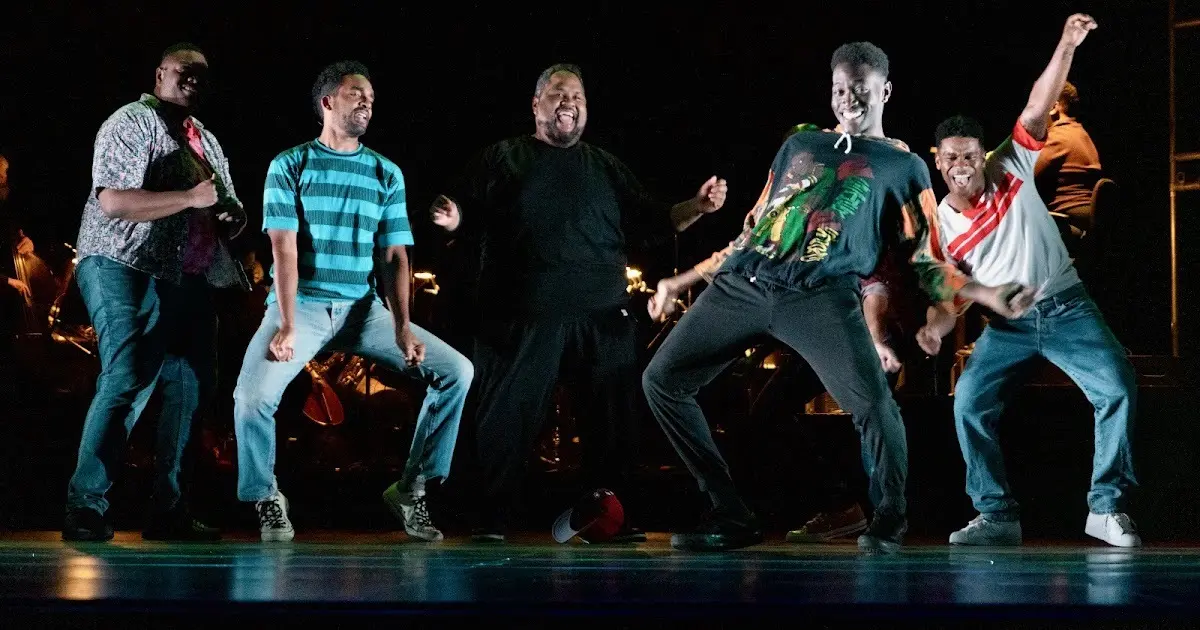
The intersection of American jurisprudence, racial politics, and contemporary opera has rarely yielded a work as culturally resonant and critically acclaimed as Anthony Davis and Richard Wesley’s The Central Park Five. Following its world premiere by the Long Beach Opera (LBO) in 2019 and its subsequent receipt of the 2020 Pulitzer Prize for Music, the powerful operatic production has officially been released on the Platoon streaming platform, drawing renewed attention to one of the darkest miscarriages of justice in late-20th-century New York City.
Derived from Joan Didion’s searing 1991 New York Review of Books essay, Sentimental Journeys, the opera dissects the 1989 assault of a female jogger in Central Park. It examines not merely the physical crime, but the psychological, media-driven frenzy that steamrolled the presumption of innocence for five Black and Latino teenagers. Long Beach Opera’s newly released studio recording—featuring a stellar cast led by conductor Anthony Parnther—captures a defining piece of modern musical theater that fuses jazz, contemporary classical, R&B, and hip-hop.
Composer Anthony Davis, renowned for his politically charged operas such as X: The Life and Times of Malcolm X and Amistad, has consistently used the operatic medium to interrogate systemic racism and historic civil rights struggles. In The Central Park Five, Davis and librettist Wesley trace the tragic arc of Kevin Richardson, Raymond Santana, Korey Wise, Yusef Salaam, and Antron McCray. Through an uncompromising lens, the work serves as both a historical reckoning and a cautionary tale about the weaponization of public sentiment, the exploitation of racial divisions, and the fragility of justice in America.
Detailed Chronology: From Tragedy to Operatic Triumph
To understand the weight of Davis’s composition, one must revisit the turbulent timeline that transformed a localized tragedy into a national sociopolitical watershed.
1989: The Incident and the Media Storm
In April 1989, a young white female investment banker jogging in New York City’s Central Park was brutally attacked, raped, and left for dead. In the ensuing panic, the New York City Police Department detained a group of predominantly Black and Hispanic teenagers who had been roaming the park that night, engaging in minor acts of vandalism and rowdiness.
Without physical, biological, or forensic evidence linking them to the crime, five of the youths—Kevin Richardson (then 14), Raymond Santana (14), Korey Wise (16), Yusef Salaam (15), and Antron McCray (15)—were subjected to grueling, multi-hour interrogations without legal counsel or adequate parental presence. The resulting coerced confessions became the cornerstone of the prosecution’s case.
Amidst an atmosphere of intense racial panic, the mainstream media fueled public outrage. Notably, real estate developer Donald Trump purchased full-page advertisements in four major New York newspapers bearing the inflammatory headline: "BRING BACK THE DEATH PENALTY. BRING BACK OUR POLICE!" This high-profile intervention crystallized a broader cultural backlash, effectively trying the teenagers in the court of public opinion long before they ever stepped foot in a courtroom. Despite glaring inconsistencies in their confessions and a complete lack of matching DNA evidence, all five were convicted and sentenced to prison terms ranging from 5 to 15 years.
2002: Exoneration and Confession
The truth remained buried until 2002, when Matias Reyes—a convicted murderer and serial rapist serving a life sentence—came forward and confessed to committing the Central Park assault alone. DNA testing confirmed Reyes’s DNA matched the biological evidence recovered from the crime scene.
In light of this undeniable proof, the convictions of the Central Park Five were formally vacated by a New York state court, and their names were cleared. They had already served between 6 and 13 years behind bars. Subsequent civil litigation against New York City resulted in a 2014 settlement of $41 million, though the systemic trauma inflicted upon the young men and their families could never be fully undone.
2016–2025: The Path to the Operatic Stage
The artistic journey from judicial injustice to operatic masterwork evolved over nearly a decade:

- 2016: Davis and librettist Richard Wesley first explored the material in a chamber opera titled Five, which premiered via Trilogy: An Opera Company in New Jersey.
- 2019: Commissioned by the Long Beach Opera, The Central Park Five expanded significantly in scope and orchestration, holding its world premiere under the direction of the company’s visionary leadership.
- 2020: The opera was awarded the Pulitzer Prize for Music, cementing Davis’s status as a preeminent voice in contemporary American music.
- 2022–2024: Regional productions followed, including runs at Portland Opera (March 2022), a heavily anticipated restaging by Long Beach Opera (June 2022), and Detroit Opera (March 2025), which showcased an expanded orchestration.
- 2024–Present: LBO brought the principal cast and conductor Anthony Parnther into the studio to record the definitive audio version, which was subsequently published globally by Platoon.
Supporting Context & Metrics: The Musical and Cultural Tapestry
The Artistic Vision of Anthony Davis
Anthony Davis’s career has been defined by his refusal to separate art from socio-political reality. Born in New Jersey and educated at Yale University, Davis established himself as a virtuoso free-jazz pianist and composer whose musical palette defies categorization. His works effortlessly bridge disparate traditions—incorporating European classical structures, African and non-Western rhythmic idioms, gospel, rhythm and blues, and Indonesian gamelan.
This stylistic fluidity is on full display in The Central Park Five. Rather than relying exclusively on traditional Western operatic idioms, Davis utilizes jazz-inflected harmonies, driving R&B rhythms, and spoken-word hip-hop elements to mirror the youthful identities of the protagonists and the gritty, urban reality of 1980s New York City. The score acts as a psychological landscape, mapping out the terror of the interrogation room, the anguish of families torn apart, and the resilience of the human spirit.
Davis’s historical focus on civil rights is well-documented:
- X: The Life and Times of Malcolm X (1986): Premiered by the New York City Opera, this seminal work enjoyed a major cultural revival with a celebrated production starring Davóne Tines, opening at Detroit Opera in 2022, before transferring to the Metropolitan Opera in 2023 and Seattle Opera in 2024.
- Amistad (1997): Commissioned by the Lyric Opera of Chicago, this opera recounts the 1839 slave mutiny aboard the La Amistad and the subsequent landmark U.S. Supreme Court ruling. Davis later revised the score for a 2008 premiere at the Spoleto Festival USA.
- Wakonda’s Dream (2007): Premiered by Opera Omaha, this contemporary work addresses the historical legacy of the 1879 trial of Standing Bear, which legally established Native Americans as "human beings under the law."
Institutional Context: Long Beach Opera
Founded in 1979, the Long Beach Opera (LBO) is Southern California’s oldest professional opera company. Operating under the leadership of Artistic Director James Darrah Black and Music Director Christopher Rountree, LBO has earned an international reputation for staging immersive, boundary-pushing productions that integrate film, modern dance, and groundbreaking contemporary music. By commissioning and championing works like The Central Park Five, LBO continues to position opera not as a static museum piece of European history, but as a vital, responsive medium for engaging with modern civic life.
Official Statements and Cast Directory
The gravity of The Central Park Five is deeply magnified by the artists who bring its harrowing narrative to life. The newly released Platoon recording features a tour-de-force cast and creative team dedicated to honoring the lived experiences of the exonerated men.
Composer’s Perspective
Reflecting on the societal backdrop that birthed the tragedy, Anthony Davis noted:
"1989. A group of predominantly Black and Hispanic teenagers enter Central Park in New York City. They turnover garbage cans, throw rocks, harass people on bicycles. A young woman is sexually assaulted in the Park and six teenagers are detained and questioned about the assault. Five of the teenagers, Kevin Richardson, Raymond Santana, Korey Wise, Yusef Salaam and Antron McCray become the center of a criminal case that would polarize New York City. The Exonerated Five were falsely accused and convicted of the crime with no physical evidence. Condemned publicly by the press, the Exonerated Five were victims in a culture war waged against Black and Hispanic communities. A politically ambitious real estate mogul condemns the teenagers with a full page ad, proclaiming ‘Bring Back the Death Penalty. Bring Back Our Police!’ The persecution of the Central Park Five marks the beginning of Donald Trump’s political career, built on racial animus and the exploitation of the deep-rooted racial divide in America."
Recording Principal Cast & Artistic Roster
- Cedric Berry as Yusef Salaam
- William Powell III as Antron McCray
- Bernard Holcomb as Kevin Richardson
- Orson Van Gay II as Raymond Santana
- Ashley Faatoalia as Korey Wise
- Justin Ryan as The Masque
- Lacey Jo Benter as District Attorney
- Todd Strange as Donald Trump
- Joelle Lamarre as Ensemble / "Antron’s Mother" / "Kevin’s Mother" / Others
- Lindsay Patterson Abdou as Sharonne Salaam / Others
- Corey Estelle as Ensemble
- José Luis Maldonado as Ensemble / Raymond’s Father / Matias Reyes
- Conducted by: Anthony Parnther
Future Outlook
The commercial and digital release of The Central Park Five on Platoon marks a watershed moment for contemporary American opera. By making this Pulitzer Prize-winning score universally accessible via major streaming platforms, Long Beach Opera and Anthony Davis have ensured that the lessons of 1989 remain accessible to global audiences, free from the physical constraints of the concert hall.
As regional houses continue to adopt Davis’s expanded orchestrations—evidenced by Detroit Opera’s ambitious staging in early 2025—the opera is cementing its place in the permanent international repertoire. In an era where conversations surrounding systemic racism, prosecutorial overreach, media manipulation, and the weaponization of criminal justice remain urgent and unresolved, The Central Park Five stands as a monumental artistic testament. It challenges audiences not simply to bear witness to past atrocities, but to interrogate the societal biases that continue to shape the contemporary American landscape.