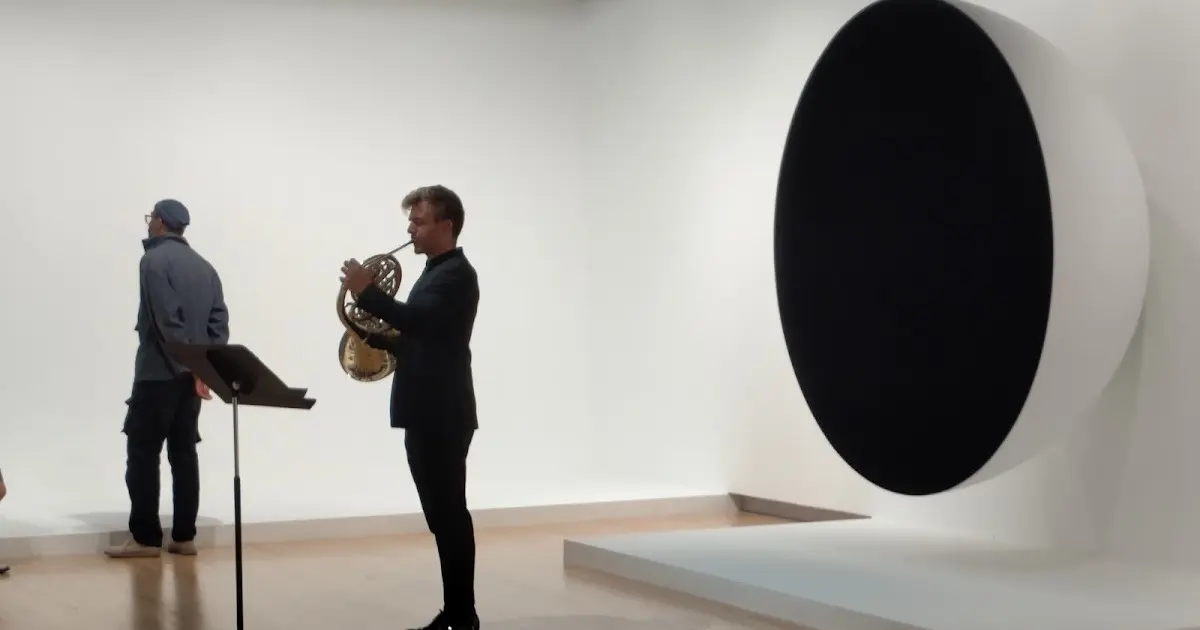
On September 12, 2026, the Southbank Centre’s Hayward Gallery in London played host to a rare and mesmerizing convergence of contemporary high art and avant-garde classical composition. Titled Touching the Quick, the event featured acclaimed horn player Ben Goldscheider performing a newly written cycle of solo horn pieces by composer Brian Elias. Crucially, this was no ordinary recital confined to a traditional auditorium. Instead, the performance unfolded nomadically, threading directly through the rooms of Anish Kapoor’s widely lauded, "gobsmacking" retrospective exhibition.
As art lovers and classical music aficionados gathered for the 6:00 PM performance (followed by a subsequent 7:00 PM set, with further dates scheduled for October 3), they were treated to an immersive sensory experience. Elias’s compositions were explicitly crafted in direct dialogue with Kapoor’s visceral, monumental, and visually arresting sculptural works. By moving from room to room alongside Goldscheider, the audience was invited to break down the traditional curatorial barriers that isolate visual art from sonic interpretation.
The resulting synthesis was a masterclass in cross-disciplinary storytelling. Elias’s Touching the Quick does not merely serve as background accompaniment; it interrogates, elevates, and converses with Kapoor’s manipulation of space, light, and material. From the light-swallowing abysses of Vantablack to bleeding, upside-down mountainous installations, this review delves deep into an evening where sound and sculpture became an indivisible entity.
Detailed Chronology: A Journey Through Sound and Sculpture
The performance was structured as a perambulatory journey, perfectly mirroring the physical architecture of the Hayward Gallery and the psychological progression of Kapoor’s exhibition themes.
[Start: Gallery 1 - Vantablack & Black Works]
       │
       ▼ (Goldscheider plays low, sustained tones)
[Room 2: Mount Moriah at the Gate of the Ghetto]
       │
       ▼ (Fast, jagged, mobile melodic lines)
[Room 3: Ha Makom]
       │
       ▼ (Chattering, high tessitura, anxious phrases)
[Room 4: Final Room - Blood & Entrails Theme]
       │
       ▼ (Muted hand-stopping, Britten-esque melancholy)
[Return: Gallery 1 - Reprise of Opening Piece]
Stop 1: The Void – Entering the Realm of Vantablack
The journey commenced at 6:00 PM in the opening galleries, dominated by Anish Kapoor’s staggering exploration of the void. This section prominently features the artist’s ongoing experiments with Vantablack—a revolutionary nanomaterial capable of absorbing virtually all incident light, creating unsettling, flat pools of absolute nothingness.
As the crowd gathered in close proximity to these visual paradoxes, Ben Goldscheider raised his horn. His opening notes were quiet, low, and heavily sustained, instantly evoking structural comparisons to the subterranean depths of Wagner’s Das Rheingold. Rather than filling the room with aggressive volume, the sound seemed to be swallowed by the black sculptures, mirroring their light-devouring properties.
As Elias’s motif gradually developed, accelerating in tempo and rising in pitch, it sparked fanciful, almost cinematic imagery—akin to a sleeping dragon slowly stirring in a cavernous lair. Despite the emergence of a more defined melodic line, every single note felt intensely calculated and weighted. The piece ultimately wound down, decaying back into the primordial silence from which it emerged.
Stop 2: Visceral Red – Mount Moriah at the Gate of the Ghetto
Moving seamlessly into the second gallery, the audience encountered Kapoor’s Mount Moriah at the Gate of the Ghetto. This monumental, deeply visceral red sculpture hangs suspended upside down from the ceiling, challenging traditional perspectives of gravity and weight.
Underneath this looming crimson mass, Goldscheider launched into the second movement of the cycle. This piece was sharply contrasting to the first: fast, vivid, and defined by a restless, highly mobile line characterized by jagged edges. The music did not cower beneath the aggressive visual dominance of the sculpture; instead, it fiercely held its ground.

Midway through, the low, sustained grounding figure from the first movement briefly returned, providing a dark anchor against the frantic, jagged upper lines before the piece dissolved into a thoughtful, contemplative cadence.
Stop 3: The Mountainous Expanse of Ha Makom
The third stage of the perambulation brought the audience face-to-face with Ha Makom, a colossal, mountainous landscape rendered in brilliant, aggressive shades of red. (Gallery attendants issued strict warnings to visitors: do not touch the installation, as the pigment stains permanently).
Here, Elias’s composition reached new heights of technical demand. The music was high, fast, and intensely percussive, almost chattering in its delivery. Short, anxious phrases succeeded one another rapidly, generating an undeniable momentum that echoed the sprawling geography of the physical artwork.
Yet, true to Elias’s structural mastery, this frenetic energy eventually gave way to a slower, deeply reflective interlude. Just as the listener settled into this respite, however, the opening chattering material reasserted itself, winding down in a gradual, controlled descent. By this juncture, it was abundantly clear that Touching the Quick was putting Goldscheider through an extraordinary gauntlet of technical hurdles—traversing a vast tessitura, deploying rapid articulation, and executing complex double notes entirely unaccompanied.
Stop 4: The Final Chamber – Blood, Entrails, and Veiled Melancholy
The final stop occurred in the gallery’s innermost sanctum—a space where museum officials explicitly warn visitors regarding "artworks suggestive of blood and entrails."
In this haunting environment, Goldscheider altered his acoustic approach, utilizing advanced hand-stopping techniques to impart a veiled, muted quality to the horn’s timbre. The resulting sound possessed a profound, thoughtful melancholy. The melodic phrasing bore an emotional kinship to the vocal and instrumental intimacy of Benjamin Britten.
At times, the music brushed against the gentle cadence of a berceuse (lullaby), yet it retained an undercurrent of raw intensity. True to the overarching architectural arc of the cycle, the performance traced its steps backward in spirit, ultimately sinking back into the long, low, resonant notes that had first greeted the audience in the Vantablack room.
The Epilogue: A Full-Circle Return
In a brilliant curatorial and musical stroke, the performance did not simply terminate in the final blood-red room. Instead, the audience retraced their steps back to the very first gallery housing Kapoor’s black works. Here, Goldscheider delivered a final reprise of the opening piece.
Having absorbed the full trajectory of the exhibition—from absolute darkness to visceral reds and bodily interiority—the audience heard the opening notes with entirely transformed ears. The music reframed the art, and the art reframed the music, proving that true multidisciplinary art can radically alter perception.

Supporting Context & Metrics
| Metric / Parameter | Detail |
|---|---|
| Event Date | Saturday, 12 September 2026 (Performances at 6:00 PM and 7:00 PM) |
| Upcoming Dates | Saturday, 3 October 2026 |
| Venues & Institutions | Hayward Gallery, Southbank Centre, London |
| Key Collaborators | Brian Elias (Composer), Ben Goldscheider (Horn), Anish Kapoor (Visual Artist) |
| Featured Composition | Touching the Quick (Cycle of pieces for unaccompanied horn) |
| Critical Reception | Kapoor exhibition hailed as "gobsmacking" by The Guardian |
The pairing of Brian Elias and Ben Goldscheider represents a high-water mark for contemporary British classical performance. Elias, celebrated for his refined ear for orchestration and chamber dynamics, has long enjoyed a reputation as a composer who values structural integrity alongside expressive depth. In Touching the Quick, he strips away the safety net of an ensemble, leaving the horn player completely exposed within a cavernous, acoustically challenging art gallery.
Ben Goldscheider, rapidly establishing himself as one of the preeminent brass soloists of his generation, navigates these demands with astounding technical control. The acoustic reality of the Hayward Gallery—hard concrete surfaces, vast open rooms, and shifting sound dispersal patterns—demands immense breath control and dynamic nuance. Goldscheider’s ability to project both whisper-quiet sustained tones (reminiscent of Vantablack’s absorption) and razor-sharp, aggressive fanfares proves his absolute mastery over the instrument.
Official Statements & Critical Reception
While Anish Kapoor’s retrospective at the Hayward Gallery has already dominated cultural discourse—earning a glowing, "gobsmacking" review from The Guardian—the integration of live, site-specific contemporary composition has elevated the exhibition from a standard retrospective to a landmark multi-sensory happening.
Cultural critics and attendees alike have noted the rarity of such seamless collaborations. Too often, music in museums is treated as ambient wallpaper or relegated to a sterile auditorium far removed from the physical art. By embedding the musician directly within the gallery space, the Southbank Centre has fostered a dynamic where the visual arts and classical music illuminate one another.
Brian Elias noted in pre-concert program notes that the inspiration for Touching the Quick stemmed directly from the physical and metaphysical weight of Kapoor’s materials. The phrase "touching the quick"—referring to the sensitive flesh beneath a nail or the core of one’s emotional sensibility—serves as an apt metaphor for an exhibition that probes the boundaries of human perception, trauma, space, and mortality.
Future Outlook
As the cultural sector increasingly looks for innovative ways to draw audiences into physical gallery spaces and concert halls alike, the success of Touching the Quick offers a compelling blueprint for the future. The synergy between Goldscheider’s virtuosic horn playing and Kapoor’s monumental sculptures proves that interdisciplinary programming, when executed with genuine artistic intent, transcends gimmickry.
For those who missed the initial September 12 performances, a final opportunity awaits on Saturday, October 3, 2026, at the Southbank Centre’s Hayward Gallery. Given the critical acclaim and strong public turnout for the opening dates, prospective attendees are strongly encouraged to secure tickets well in advance.
Ultimately, events like this remind us of the porous boundaries between artistic mediums. When a master composer like Brian Elias, a visionary virtuoso like Ben Goldscheider, and a titan of visual art like Anish Kapoor converge, the result is nothing short of transformative—a fleeting moment where sound truly becomes space, and space becomes sound.