In an era dominated by the breathless promotion of generative artificial intelligence, society is frequently assured that large language models (LLMs) represent an unprecedented technological singularity. Corporations, governments, and technocrats market AI as a cognitive revolution—an all-knowing oracle capable of replacing human labor, generating peerless creative writing, and synthesizing vast corpuses of human knowledge at the flick of a digital switch.
Yet, long before the advent of silicon chips, neural networks, or transformer architecture, the foundational premise of automated text generation was skewered by one of history’s greatest satirists. In his 1726 masterpiece, Gulliver’s Travels, Jonathan Swift envisioned a mechanical text-generating apparatus housed within the fictional Academy of Lagado. Operated by cranks and wires, Swift’s machine was designed to allow even the most ignorant individual to author comprehensive treatises on philosophy, poetry, law, and mathematics without possessing a shred of genius or engaging in formal study.
Examining Swift’s "Engine" alongside contemporary generative AI reveals a striking philosophical continuity. While today’s algorithms operate on staggering computational power rather than wooden dice and iron handles, the underlying paradigm remains identical: a mechanical system processing statistical probabilities of language to produce output, bypassing the rigors of genuine human thought. Furthermore, Swift’s satire brilliantly exposes the inherent vulnerabilities of automated text generation—namely, the mass production of probabilistic nonsense, the need for human filtering, and the illusion of manufactured omniscience. As modern society grapples with algorithmic hallucinations and the erosion of original intellectual labor, Swift’s three-century-old warning resonates with startling, prophetic clarity.
Detailed Chronology: From the Royal Society to the Age of Algorithms
To fully appreciate how Jonathan Swift anticipated the mechanisms of modern artificial intelligence, one must trace the historical and literary trajectory that led to the creation of the Academy of Lagado in Gulliver’s Travels.
1. The Scientific Revolution and Early "Projectors" (Late 17th Century)
In the decades leading up to the publication of Gulliver’s Travels, the Scientific Revolution was fundamentally reshaping European thought. The establishment of the Royal Society of London in 1660 brought together pioneering minds dedicated to empirical observation and natural philosophy. However, this fervent push toward modernization also birthed a subculture of eccentric inventors, speculators, and natural philosophers whom Swift and his contemporaries derisively termed "projectors."
These projectors proposed elaborate, often absurd schemes to master nature and accelerate human knowledge. While figures like Isaac Newton and Robert Boyle laid the groundwork for modern science, many lesser-known contemporaries pursued utopian, impractical inventions that prioritized theoretical grandiosity over tangible utility. Swift observed this climate with deep skepticism, viewing many scientific ambitions as hubristic exercises in absurdity.
2. The Publication of Gulliver’s Travels (1726)
In 1726, Anglo-Irish satirist Jonathan Swift published Travels into Several Remote Nations of the World. In Four Parts. By Lemuel Gulliver, First a Surgeon, and then a Captain of Several Ships. While the first two voyages to Lilliput and Brobdingnag remain cultural touchstones for their examinations of physical scale and human pettiness, the neglected third voyage contains Swift’s most direct critique of intellectual pretension and speculative science.
During his visit to Lagado, the metropolis of Balnibarbi, Lemuel Gulliver is taken to the grand Academy. Here, Swift unleashes his satirical fury against abstract academia. The Academy is divided into two primary wings: practical science (attempting tasks like extracting sunbeams from cucumbers) and speculative learning, where the mechanical generation of knowledge takes center stage.
3. The Invention of the Lagado Writing Engine (1726)
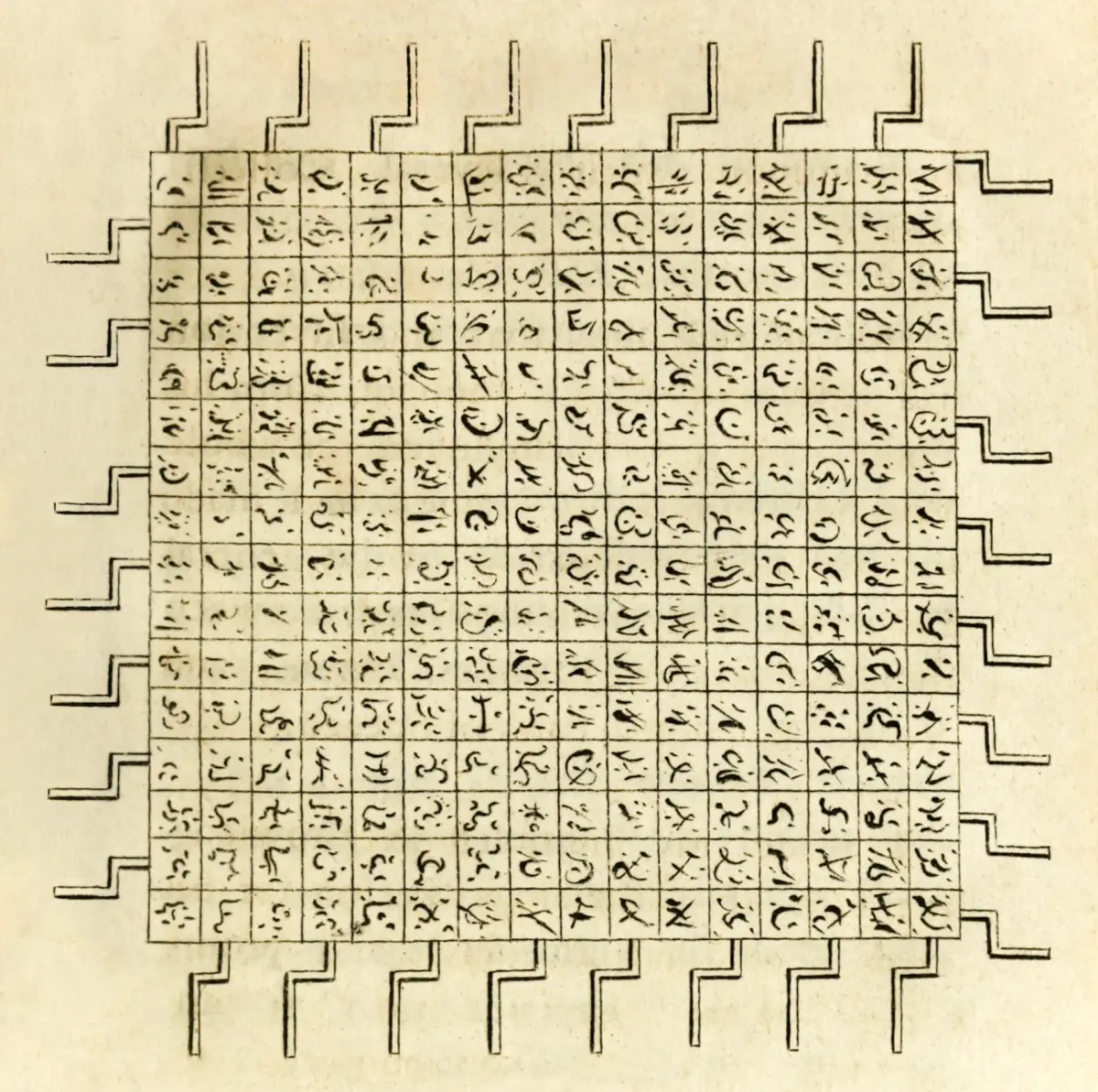
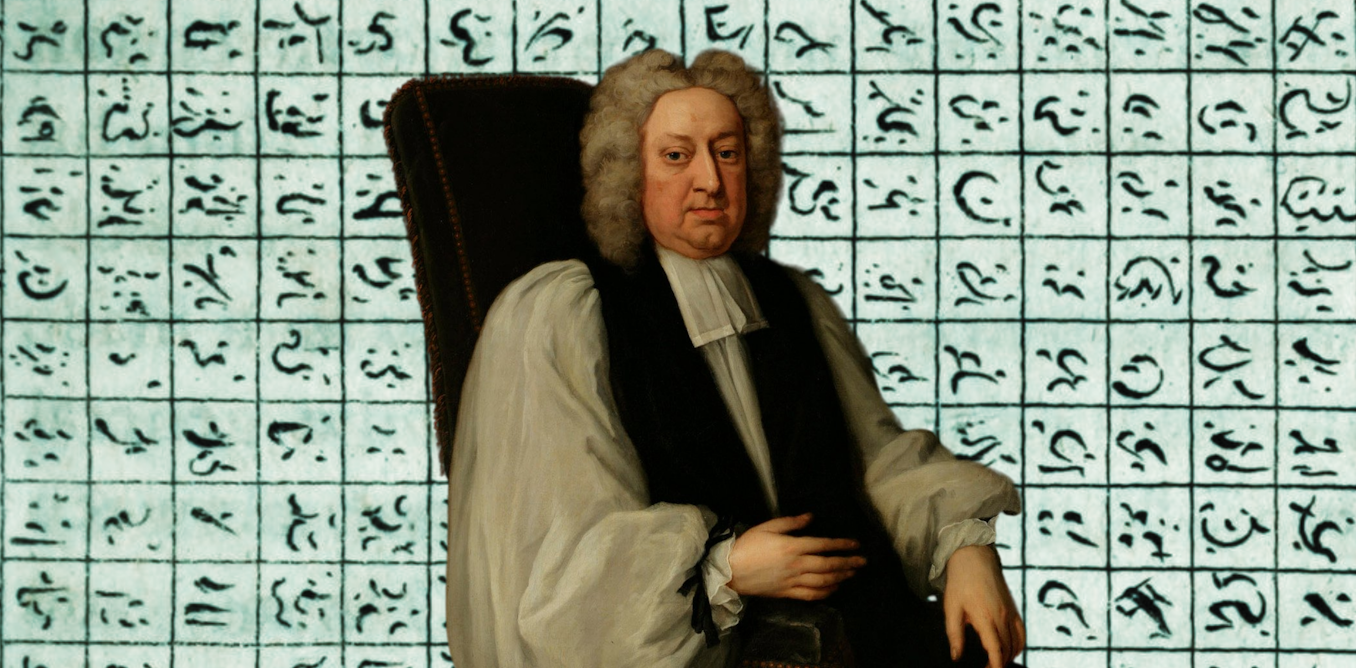
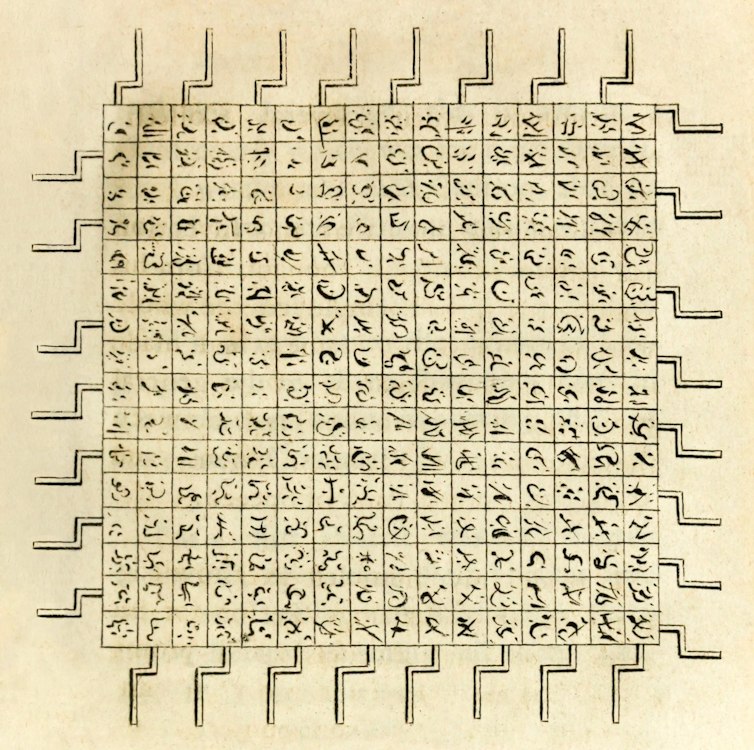
Within the speculative wing of the Academy, Gulliver encounters a professor operating a massive 20-foot-square wooden frame. This contraption—often referred to as the Engine—is managed by 40 assistants turning iron handles and cranks. The device consists of small wooden blocks (resembling dice) linked by wires, with words of the local language pasted onto each block.
By mechanically shifting the handles, the words are randomly rearranged. Scribes diligently record any intelligible phrases generated by these combinations. The professor proudly displays massive volumes of broken sentences, explaining that he plans to piece them together to form "a compleat Body of all Arts and Sciences." The promise of the machine is absolute: it democratizes creation, allowing the ignorant to compose high literature and technical treatises without study or intellect.
4. The Digital Renaissance and the Birth of LLMs (20th–21st Century)
Fast-forward nearly three centuries, and the theoretical apparatus of Lagado finds its physical realization in the digital age. The evolution from early Alan Turing computing concepts to modern transformer-based neural networks has brought mechanical text generation from the realm of satire into daily reality.
Platforms like OpenAI’s ChatGPT, Google’s Gemini, and Anthropic’s Claude function on a scale unimaginable to Swift, ingesting petabytes of human text to predict the most statistically likely next word in a sequence. Yet, at its core, the computational engine of an LLM mirrors the frantic turning of Swift’s wooden dice: it processes, rearranges, and regurgitates structural patterns of language to create the illusion of deep comprehension.
Supporting Context & Metrics: The Mechanics of Automated Text Generation
To understand the uncanny parallels between Swift’s satire and modern artificial intelligence, a structural comparison of their operational mechanics reveals profound insights into the philosophy of language processing.
| Feature | Swift’s Lagado Engine (1726) | Modern Large Language Models (21st Century) |
|---|---|---|
| Primary Medium | Wooden dice, iron cranks, and wires. | Neural networks, billions of parameters, transformer architecture. |
| Input Material | Pre-written vocabulary words pasted onto blocks. | Massive corpuses of digitized human literature, articles, and code. |
| Operational Logic | Mechanical rotation by 40 human assistants to alter word sequences. | Mathematical probability distribution determining the next token in a sequence. |
| Target Demographic | "The most ignorant person" seeking to write poetry, law, and philosophy. | Any user prompting an AI interface for essays, reports, and creative writing. |
| Quality Control | Scribes manually recording intelligible phrases and discarding gibberish. | Reinforcement Learning from Human Feedback (RLHF) and fine-tuning. |
| Underlying Fallacy | The belief that mechanical word arrangement equals genuine wisdom and insight. | The illusion of machine sapience masking probabilistic pattern matching. |
The Illusion of Omniscience
Swift’s primary satirical target is the illusion that quantitative processing can replace qualitative human intellect. In the Academy of Lagado, the professor believes that sheer volume—supported by 500 additional frames—will eventually yield an encyclopedia of all human knowledge.
This mirrors the modern race for computational scale. Tech conglomerates continuously boast about increasing parameter counts, training data sizes, and compute clusters, promising that a sufficiently massive model will achieve near-omniscience. However, as Swift noted, shuffling linguistic building blocks does not generate original thought; it merely reorganizes existing expressions into varying degrees of coherence.
Expert Perspectives & Industry Insights
Scholars of literature, historians of science, and contemporary technology ethicists have increasingly drawn connections between early modern satire and the challenges of the current AI boom.
"Swift understood that human beings are perpetually vulnerable to techno-utopian delusions. The engine of Lagado is not merely a joke about bad science; it is a profound philosophical inquiry into the nature of language, authorship, and the dangerous assumption that tools can substitute for genuine human understanding."
— Dr. Elena Vance, Professor of 18th-Century Literature and Digital Humanities
Tech ethicists have also noted the eerie accuracy of Swift’s depiction of quality control. In Gulliver’s Travels, human scribes are required to manually sift through mountains of linguistic garbage to salvage intelligible sentences. In the modern ecosystem, this burden has shifted to "data labelers" and content moderators—often underpaid human workers in the Global South—who scrub toxic outputs and filter algorithmic hallucinations before models are deployed to the public.
Furthermore, industry commentators frequently warn against the passive model of intelligence that Swift critiqued. When students, professionals, and creatives offload the cognitive burden of writing and synthesis to LLMs, they risk adopting the very passivity satirized in Balnibarbi: letting a machine do the thinking while the human operator passively consumes the output.
Future Outlook: Navigating the Legacy of Lagado
As artificial intelligence continues to integrate into every facet of modern life, society stands at a critical crossroads. The lessons embedded within Jonathan Swift’s 18th-century satire offer both a sobering caution and a valuable framework for evaluating technological advancement.
1. Managing the Crisis of Authenticity
Just as the Academy of Lagado threatened to flood the literary market with mechanically assembled volumes, the current digital landscape faces an unprecedented deluge of AI-generated content. As search engines, academic journals, and creative platforms grapple with automated spam and synthetic text, the imperative to verify human authorship and intellectual integrity has never been higher.
2. Guarding Against Algorithmic Hallucinations
Swift’s machine produced a vast amount of structural gibberish that required diligent human monitoring. Today, LLMs similarly suffer from "hallucinations"—confidently asserted falsehoods generated by statistical probability rather than factual awareness. As AI systems are deployed in high-stakes fields such as healthcare, legal services, and public policy, the absence of infallible verification mechanisms remains a perilous vulnerability.
3. Preserving Human Agency
Ultimately, Swift’s enduring message is that technology must serve human creativity, not replace it. While tools like ChatGPT and its successors offer undeniable productivity gains, treating them as oracles of absolute truth invites intellectual stagnation. By recognizing that large language models are sophisticated descendants of the Lagado engine—marvelous mechanical contrivances, yet fundamentally devoid of true consciousness—we can better harness their utility while fiercely protecting the irreplaceable depth of human ingenuity.