Annilese Miskimmon’s provocative new staging of Giacomo Puccini’s Tosca for the English National Opera (ENO), which opened at the London Coliseum on October 30, 2026, has thoroughly divided opinion among opera traditionalists and modernists alike. Reviewing the production on November 10, 2026, this reimagining firmly upends decades of conventional operatic staging. Relocating the narrative from 1800 Rome to an unspecified 1980s Eastern European concert hall—as a thematic prelude to Kaija Saariaho’s Adriana Mater—Miskimmon has stripped away centuries of religious iconography and traditional stage business. In their place, she has erected a chillingly modern narrative exploring the systematic destruction of art and the physical degradation of artists under authoritarian duress.
Musically spearheaded by conductor Ben Glassberg and anchored by a stellar principal cast featuring Axelle Fanyo as Floria Tosca, Chaz’men Williams-Ali as Mario Cavaradossi, and Christopher Purves as a chillingly insidious Baron Scarpia, the production delivers remarkable dramatic momentum. While certain directorial choices—such as collapsing the action entirely into a single, unyielding set and adjusting Amanda Holden’s English translation—reveal moments of friction, the production ultimately succeeds. It forces audiences to engage with Puccini’s blood-soaked melodrama not as a historical museum piece, but as an urgent, contemporary warning regarding political tyranny and artistic suppression.
Detailed Chronology & Production Analysis
Act I: The Co-option of the Sacred Space
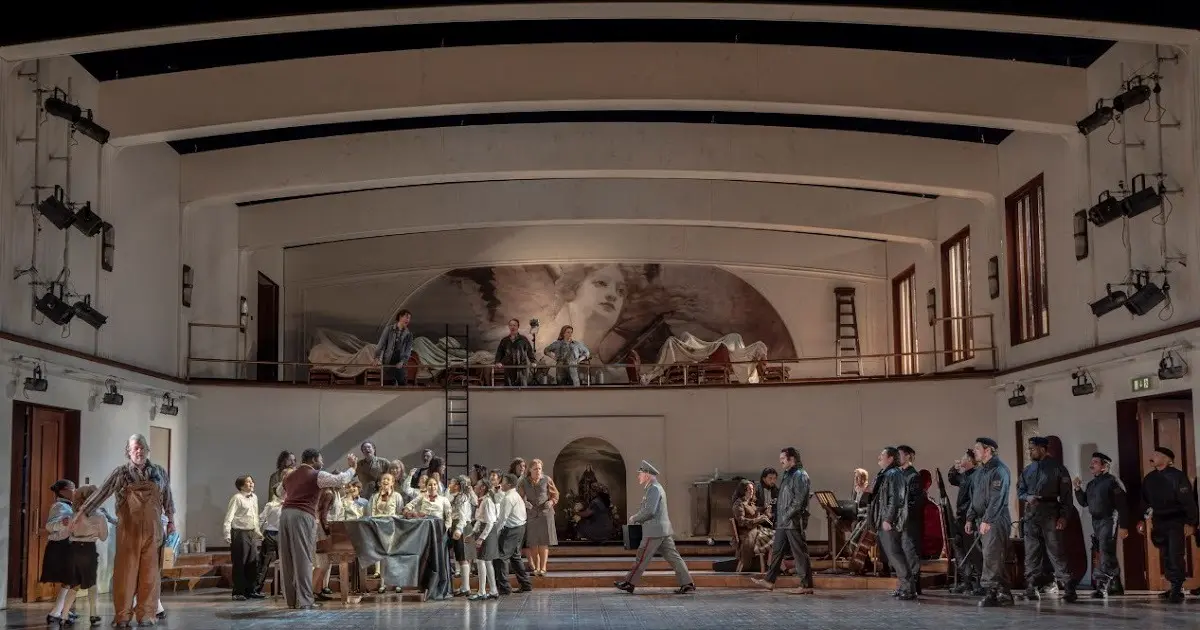
The production’s conceptual gamble becomes immediately apparent upon entering the London Coliseum. Rosanna Vize’s stark, utilitarian set completely bypasses the expected grand architecture of Rome’s Sant’Andrea della Valle. Instead, the audience is greeted by a cavernous, institutional concert hall in Eastern Europe during the turbulent 1980s.
Rather than finding a traditional sacristan pottering about, the opening scene presents a venue vibrating with musical activity—soon violently interrupted by the encroaching machinery of a military coup. In a striking directorial stroke that avoids cliché, Scarpia’s soldiers immediately order the over-painting of Cavaradossi’s Magdalene mural. This act of artistic erasure establishes the production’s core theme: the weaponization of ideology against cultural expression.
Robert Hayward brings a quiet dignity to the Sacristan, refreshingly avoiding the standard comic buffo tropes. Alaric Green commands the stage as Angelotti, portrayed not as a frantic, terrified fugitive, but as a robust political dissident capable of matching Scarpia’s gravity. However, staging choices occasionally stumble; Angelotti’s hiding mechanics carry an unintended touch of farce, slightly undercutting the early tension.
Musically, Act I builds to a fever pitch. When the offstage chorus is brought onto the upper gallery for the Te Deum, the acoustic balance is momentarily disrupted, nearly overwhelming the precise, tense dialogue unfolding between Scarpia and Cavaradossi. Yet, under Ben Glassberg’s baton, the orchestra maintains a lithe, fluid momentum that prevents the scene from collapsing under its own heavy symbolism.
Act II: Psychological Warfare and Intimacy
Act II remains anchored in the same multi-use venue, emphasizing Scarpia’s obsessive, panoptic control over his environment. Christopher Purves delivers a masterclass in psychological menace. Eschewing the bombastic, scenery-chewing villainy often associated with the Baron, Purves constructs an insidious, slimy bureaucrat who relies on vocal inflection, razor-sharp textual delivery, and an unsettling intimacy.
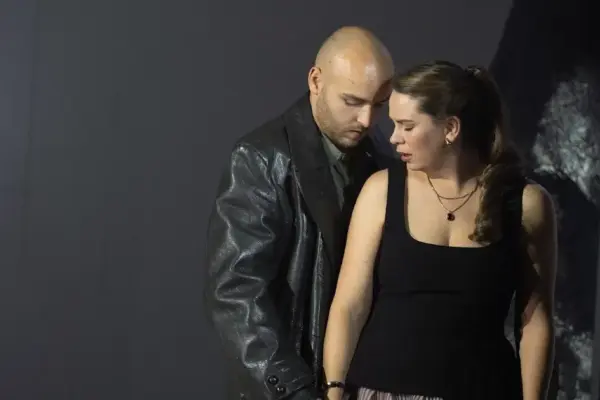
When Purves’s Scarpia prepares for his assault on Tosca by methodically removing and carefully folding his trousers, the domestic banality of the action heightens the impending horror. The staging—guided by movement director Imogen Knight, fight director Brad Wendes, and intimacy director Haruka Kurada—handles the inherent violence and sexual coercion of the act with searing credibility. The physical confrontation between Purves and Axelle Fanyo’s Tosca crackles with palpable, authentic danger.
Fanyo’s vocal profile as Tosca is both rich and commanding. In Act I, she portrays the character driven more by personal jealousy than grand diva posturing. In Act II, facing down Purves’s Scarpia, she summons a vocal intensity that keeps the dramatic momentum white-hot. Her delivery of the iconic "Vissi d’arte" is stripped of standard diva theatrics; performed entirely alone on a gradually emptied stage, it becomes a deeply dignified, moving testament to an artist living solely for love and art.
Chaz’men Williams-Ali’s Cavaradossi offers a formidable counter-weight. Possessing a spinto-adjacent tenor with a distinct, cutting edge reminiscent of roles like Manrico in Il trovatore, Williams-Ali uses his physical stature to project a dignified resilience. His scenes in Act II avoid outdated melodrama, and his injuries are rendered with a stark realism that carries seamlessly into the final act.
Act III: The Pyre of Art and Final Resolution
Puccini’s publisher, Giulio Ricordi, notoriously worried that Act III of Tosca was structurally disparate—a hurdle that directors have struggled to rectify for over a century. Miskimmon’s single-set constraint triumphantly solves this issue. The final act unfolds within the same battered concert hall, which has now been transformed into a holding ground for cultural devastation. The central visual motif is a towering pyre of damaged musical instruments destined for destruction.
Williams-Ali navigates Cavaradossi’s final aria, "E lucevan le stelle," with a breathtaking, introspective quietude, proving that dramatic impact requires no vocal roaring. The ensuing duet with Fanyo finally achieves the soaring, burning necessity that occasionally eluded their earlier interactions.
When the tragedy reaches its inevitable, visceral climax, the production successfully bypasses standard theatrical conventions. While Tosca does not execute the traditional, spectacular leap from a parapet, Fanyo’s commitment to the final death scene ensures the emotional arc remains thoroughly coherent and devastatingly final.
Supporting Context & Metrics
Production Element
Detail / Personnel
Opera & Composer
Tosca by Giacomo Puccini (Libretto by Luigi Illica and Giuseppe Giacosa)
Axelle Fanyo (Tosca), Chaz’men Williams-Ali (Cavaradossi), Christopher Purves (Scarpia)
Supporting Cast
Alaric Green (Angelotti), Robert Hayward (Sacristan), Osian Wyn Bowen (Spoleta), Christopher Nairne/Steffan Lloyd Owen (Sciarrone)
Performance Venue
London Coliseum, English National Opera
Review Date
November 10, 2026 (Production opened October 30, 2026)
Official Statements & Creative Vision
Annilese Miskimmon’s directorial notes in the ENO programme book articulate a clear, if controversial, socio-political framework for the production:
"By anchoring the opera within the stark reality of an Eastern European concert hall during the 1980s, we aim to examine the fragile ecosystem of art under military conflict. Scarpia is not merely a corrupt police chief in this context; he is the architect of institutional censorship, seeking to crush individual expression and replace it with state-sanctioned compliance. The physical destruction of instruments mirrors the psychological and physical breaking of the opera’s protagonists."
Conductor Ben Glassberg further emphasized the musical philosophy driving the pit:
"Puccini’s score is a complex mechanism, but it requires a sense of forward momentum rather than bloated, over-romanticized self-indulgence. Working alongside the staging means the orchestra must remain flexible, breathing with the actors while maintaining a lithe, driving pace that mirrors the political tension on stage."
Future Outlook
As this production settles into its run at the London Coliseum—with subsequent performances seeing baritone Craig Colclough stepping into the demanding role of Baron Scarpia for the final seven nights—the legacy of Miskimmon’s vision will undoubtedly reverberate through the British operatic landscape.
The pairing of Tosca with the upcoming staging of Kaija Saariaho’s Adriana Mater establishes a thematic bridge across centuries, challenging opera companies to program with greater sociological and political coherence. While minor textual frictions—such as adjustments to Amanda Holden’s translation and occasional acoustic balance hurdles—will be monitored by vocal purists, the overarching achievement cannot be dismissed. Miskimmon, Glassberg, and their stellar cast have proven that standard operatic masterworks can be radically refocused without losing their emotional core. By substituting historical spectacle for immediate, uncomfortably relevant political terror, the ENO has delivered a Tosca that demands not just passive viewing, but active, urgent reckoning.