Executive Overview
In the high-stakes, acoustically demanding environments of modern mixing, mastering, and post-production facilities, studio designers and engineers have long faced a persistent compromise. On one end of the spectrum, nearfield monitors offer pinpoint imaging and rapid transient response, yet frequently fall short when required to deliver the physical impact, deep low-end extension, and extended listening distances necessary for full-scale commercial mixing. On the other end, traditional large-format main monitoring systems provide the massive headroom and room-filling low frequency response engineers crave, but demand vast physical real estate, expensive custom soffit mounting, and heavily treated architecture that many contemporary, budget-conscious or spatial-audio-configured rooms simply cannot accommodate.
Enter HEDD Audio, a German manufacturer celebrated for its uncompromising approach to electroacoustic engineering and high-frequency transducer design. With the introduction of the TYPE 40 Main and its accompanying TYPE 40 System modular platform, HEDD has engineered an ambitious, paradigm-shifting solution. Designed specifically for professional mixing and mastering suites, post-production houses, and larger control rooms, the TYPE 40 seeks to bridge the chasm between nearfield intimacy and main-monitor authority.
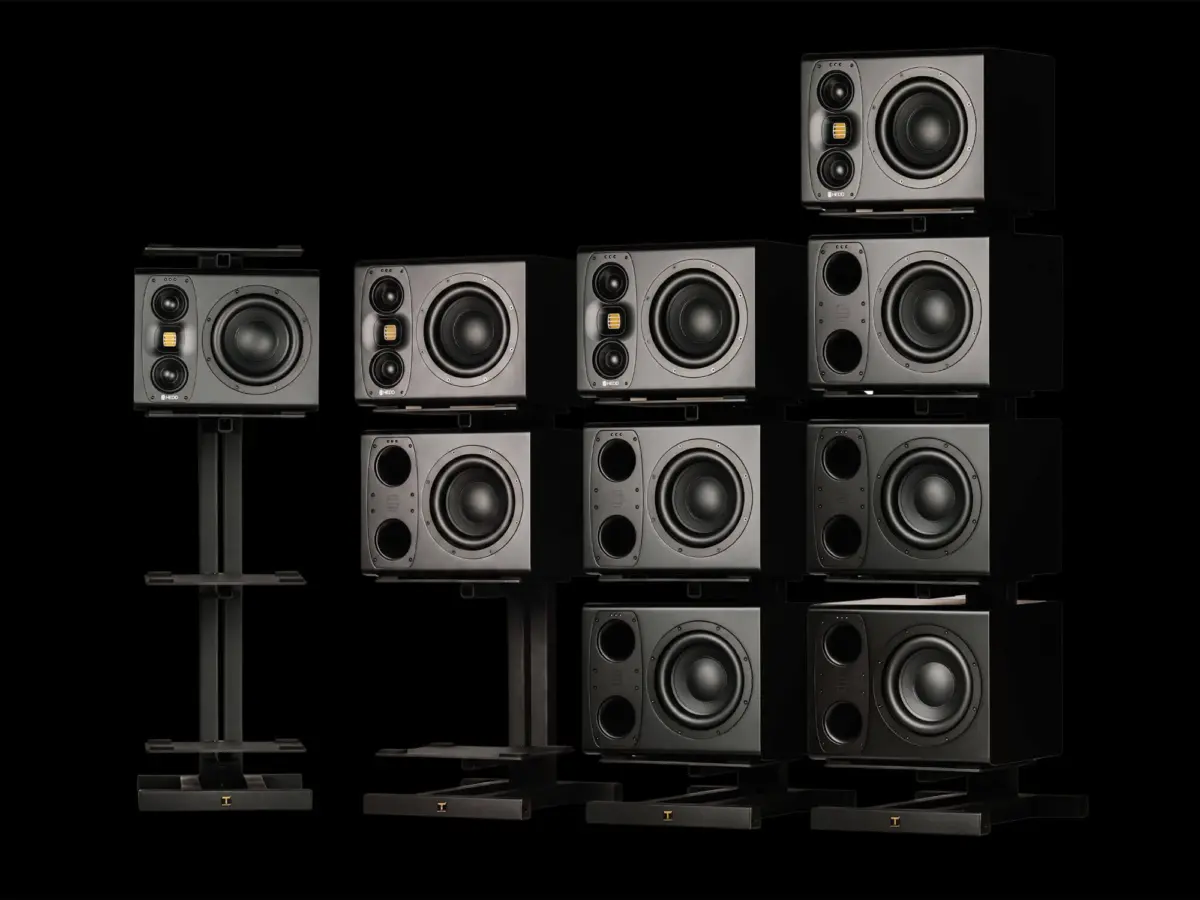
At its core, the TYPE 40 Main is a compact, sealed three-way active monitor capable of operating as a standalone, full-range reference system reaching down to a subterranean 20 Hz without the mandatory addition of a separate subwoofer. However, the true innovation lies in the TYPE 40 System ecosystem: a modular platform that allows studios to organically scale their low-end output, headroom, and directional control by physically stacking XTD modules directly beneath the main cabinet.
Boasting hand-built Air Motion Transformer (AMT) high-frequency drivers, symmetrical D’Appolito midrange layouts, massive Class D amplification, advanced cardioid acoustic dispersion control, and sophisticated Ethernet-based DSP management via HEDD CTRL, the TYPE 40 represents a comprehensive rethinking of how professional monitoring systems can be integrated into evolving studio architectures. With support for setups ranging from traditional stereo pairs to expansive, multi-channel immersive audio configurations of up to 250 speakers, HEDD Audio is positioning this hardware as the definitive monitoring backbone for the next generation of professional audio production.
Detailed Chronology and Architectural Conception
The genesis of the TYPE 40 system stems from a deep listening to the modern audio engineering community. Over the past decade, the proliferation of immersive audio formats—such as Dolby Atmos—alongside the shrinking footprint of urban commercial studios, has created a critical demand for speakers that punch far above their physical weight class.
The Evolution of the Three-Way Sealed Enclosure
HEDD Audio’s development team set out to construct a monitor that could eliminate the traditional subwoofer crossover headache. In many professional control rooms, integrating a standalone subwoofer introduces phase anomalies, crossover cancellations, and sweet-spot degradation if not calibrated with microscopic precision. By designing the TYPE 40 Main as a sealed enclosure equipped with a high-excursion woofer, HEDD ensured a naturally smooth, predictable low-frequency roll-off (down to 20 Hz) characterized by superior impulse response and tighter transient definition than equivalent ported designs.
To handle the critical midrange and high-frequency spectrum, the Main utilizes a sophisticated symmetrical D’Appolito MTM (Midrange-Tweeter-Midrange) configuration. Two bespoke four-inch midrange drivers flank HEDD’s signature, hand-built Air Motion Transformer (AMT). This layout creates a focused acoustic centre, establishing an exceptionally even horizontal listening window while strictly controlling vertical dispersion. By narrowing vertical reflections off mixing consoles and tabletops, the TYPE 40 minimizes comb filtering and preserves spatial integrity at the mix position.
The Modular Breakthrough: Integrating XTD Modules
Recognizing that different rooms and clients require vastly different SPL (Sound Pressure Level) capabilities and low-frequency reach, HEDD abandoned the rigid "one-size-fits-all" approach of traditional main monitors. Instead, they engineered the XTD (Extended Transient Dimension) module.
The XTD functions as a modular building block. Each independent module houses a formidable 10 3/4-inch high-excursion woofer driven by a dedicated 700W Class D amplifier. Up to three XTD modules can be physically stacked directly beneath a single TYPE 40 Main cabinet. This vertical integration allows studios to scale their systems over time. An engineer can start with a pair of TYPE 40 Mains for a precision mastering room, and later scale up into a high-SPL powerhouse by bolting on XTD modules as commercial demands or room sizes expand.
Supporting Context, Engineering Metrics, and Technical Specifications
To fully appreciate the engineering achievement of the TYPE 40 System, one must examine the raw technical specifications and the advanced acoustic technologies working beneath the surface.
Power and Output Capabilities
The TYPE 40 Main on its own is a formidable tool, but when coupled with its modular counterparts, the system enters elite territory.
- Standalone Performance: Powered by robust onboard Class D amplification, the TYPE 40 Main achieves a staggering peak output of up to 123 dB SPL, ensuring effortless handling of hyper-compressed modern transient peaks without audible distortion or thermal compression.
- XTD Scaling: According to internal HEDD engineering data, stacking three XTD modules in Frontfire Ported mode raises the maximum SPL at 50 Hz by up to a remarkable 15 dB compared to the Main operating independently. This transforms the compact footprint into a high-output main monitor capable of energizing large control rooms with authoritative physical weight.
Dual-Operation Modes: Ported vs. Closed
Flexibility is a defining characteristic of the XTD modules. Users can easily toggle between Ported and Closed operational states by inserting or removing a specialized port cover supplied with the unit:
- Ported Mode: Prioritizes raw acoustic efficiency and maximum low-frequency output. This mode is ideally suited for tracking sessions, electronic music production, and scenarios where maximum SPL and physical chest-impact are paramount.
- Closed Mode: Transforms the module into a sealed acoustic suspension design. This setting prioritizes ultimate low-frequency control, transient definition, and pitch resolution—traits that are indispensable during delicate classical mastering, acoustic mixing, and surgical post-production work.
Advanced Cardioid Control
Low-frequency buildup is the eternal enemy of accurate control room monitoring. Uncontrolled bass frequencies wrap around traditional speaker cabinets, striking rear and side walls and bouncing back to create severe phase cancellations, muddying the low end and tricking the mixing engineer into making poor EQ decisions.
HEDD has tackled this phenomenon head-on with selectable Cardioid configurations. By strategically combining phase-manipulated signals across the system, the TYPE 40 architecture actively cancels out energy radiating behind the speakers.

- Depending on the specific configuration, rearward low-frequency radiation can be reduced by up to approximately 10 dB.
- A single Cardioid closed XTD provides targeted directional control from roughly 20 Hz to 200 Hz. In larger, multi-module setups, engineers can seamlessly combine Frontfire modules with a Cardioid module, thereby maximizing forward-facing output while tightly controlling where the directional bass energy travels within the acoustic space.
Time-Alignment and the HEDD Lineariser
Multi-driver loudspeaker systems inherently suffer from phase discrepancies; high frequencies travel through the air faster or are processed differently than low frequencies, leading to smearing in the time domain.
The TYPE 40 Main and all connected XTD modules operate as a unified, time-aligned system governed by the proprietary HEDD Lineariser. The software suite offers three distinct operational modes tailored to different studio workflows:
- ZERO PHASE: The ultimate setting for critical listening and mixing. It corrects both amplitude and phase response, perfectly aligning the entire frequency spectrum in time to ensure pristine transient fidelity and spatial imaging.
- FLAT: Retains the core frequency-response correction without engaging phase linearisation, offering a balanced compromise for general production tasks.
- OFF: Bypasses linearisation entirely to deliver the lowest possible system latency, making it the preferred mode for live tracking, virtual instrument performance, and real-time monitoring where delay is intolerable.
HEDD CTRL Software Ecosystem
Hardware power is meaningless without intuitive software control. The TYPE 40 System is managed entirely through HEDD CTRL, a robust desktop application communicating with every Main and XTD module over standard Ethernet connections.
Once the physical configuration and XTD acoustic modes (Ported vs. Closed) are established, HEDD CTRL automatically calculates and applies the correct LF Range and Extension Qty settings. Furthermore, engineers can sculpt the sound to match their specific room acoustics using a comprehensive 12-band parametric EQ, adjustable at both the individual speaker level and across entire speaker groups.
Presets can be saved instantly, allowing facilities to switch between workflows, monitoring formats (stereo, 5.1, Dolby Atmos), clients, or listening positions with a single click. Demonstrating enterprise-grade scalability, HEDD notes that the software platform is capable of managing complex installations scaling from a simple stereo pair all the way to massive immersive audio setups comprising up to 250 individual speakers.
Official Statements and Industry Perspective
While HEDD Audio has built its reputation on uncompromising acoustic transparency—largely pioneered by co-founder Klaus Heinz and his legendary work with ADAM Audio before establishing HEDD—the release of the TYPE 40 represents a strategic pivot toward solving the systemic physical limitations of modern professional studios.
Industry insiders have noted that as high-end residential studios, project spaces, and commercial facilities alike convert to immersive audio formats, the traditional paradigm of massive, immovable main monitors is rapidly becoming obsolete. Studios can no longer afford to dedicate entire front walls to passive, space-hogging cabinets that cannot be easily recalibrated or expanded.
By launching a system that combines the transient speed of a sealed three-way monitor with the modular scalability of stackable XTD bass engines, HEDD Audio is signaling a shift toward adaptive studio architecture. Rather than forcing the acoustic engineer to build the room around the speakers, HEDD has engineered speakers that can dynamically adapt—physically, acoustically, and digitally—to the constraints and requirements of the room.
Future Outlook and Market Impact
The introduction of the HEDD Audio TYPE 40 Main and TYPE 40 System arrives at a critical juncture in professional audio history. As the demand for spatial audio mixing accelerates across film, television, and music streaming platforms, control rooms are under immense pressure to upgrade their monitoring capabilities without undergoing catastrophic structural renovations.
The modular nature of the XTD platform provides a future-proof investment for studio owners. A facility can invest in the TYPE 40 Mains today to immediately elevate their mixing and mastering precision, safe in the knowledge that they can scale their low-end extension and SPL headroom tomorrow simply by bolting on XTD modules as client demands shift.
Furthermore, the integration of advanced cardioid directional control hints at a future where poor room acoustics can be actively mitigated at the transducer level, reducing the financial barrier to achieving world-class translation in less-than-ideal physical spaces.
Pricing and Availability
Both the TYPE 40 Main and the XTD expansion modules are available immediately through selected HEDD Audio authorized partners worldwide. Reflecting their position as elite, professional-grade studio tools, the pricing is structured as follows:
- TYPE 40 Main: £5,999 / $7,499 / €6,999 per unit
- XTD Module: £5,699 / $6,999 / €6,499 per unit
As producers, mixers, and acousticians continue to push the boundaries of immersive and high-resolution audio, systems like the HEDD TYPE 40 establish a new benchmark for versatility, power, and acoustic intelligence in professional studio design.
For more information, technical specifications, and dealer listings, visit the official HEDD Audio website.