In the rapidly evolving landscape of electronic music production, software emulation has long reigned supreme. Virtual analog, wavetable synthesis, and granular plugins have dominated studios for decades, offering unprecedented convenience and flexibility at the cost of tactile, physical connection. However, a quiet revolution has been brewing at the intersection of acoustic physics and electronic engineering.
At the center of this paradigm shift is the Korg Phase8, an ambitious, wildly experimental acoustic synthesizer that first captured the imagination of the global music technology community when it was teased at Superbooth 2024 and officially debuted at NAMM. Eschewing purely digital or traditional analog architectures, the Phase8 relies on real, physical steel resonators to generate and shape sound.
As the industry converges on the Dutch capital for the Amsterdam Dance Event (ADE) 2026, Korg is positioning the Phase8 at the forefront of its exhibition. Beyond demonstrating the instrument’s staggering acoustic capabilities, Korg has announced the premier public preview of the Phase8 Companion App—a groundbreaking browser-based control interface that promises to bridge the gap between physical acoustic manipulation and modern digital sequencing workflows.
This comprehensive report examines the technological blueprint of the Phase8, chronicles its journey from concept to market, details Korg’s immersive showcase at ADE 2026, and analyzes the broader implications of physical modeling and hybrid acoustic hardware for the future of electronic music.
Detailed Chronology: From Superbooth Concept to ADE 2026 Showcase
To fully appreciate the significance of Korg’s ADE 2026 presentation, it is essential to trace the development timeline of one of the most unconventional instruments released in recent memory.
The Genesis: Superbooth 2024
When Korg first dropped hints of the Phase8 at Superbooth 2024, industry insiders and sound designers were immediately intrigued. The concept defied standard categorization. Rather than building another subtractive synthesizer or a purely digital workstation, Korg’s engineering team—led by visionaries like Product Lead Lukas Hartmann and Lead Embedded Software Engineer Iarla Scaife—set out to harness the chaotic, organic beauty of actual vibrating metal.
The NAMM Reveal and Early Shipping
Following months of refinement and prototype testing, the Phase8 made its formal public debut at the NAMM show, where attendees were given their first hands-on experience with the instrument. The response was electric. Critics praised its ability to deliver rich, evolving metallic textures that simply could not be replicated by traditional digital means.
Following a successful launch phase, the Phase8 officially commenced shipping to early adopters and professional studios in March and April. As units landed in the hands of forward-thinking producers, the demand for deeper integration tools—specifically regarding sequencing, modulation routing, and global parameter management—became immediately apparent.
ADE 2026: The Next Chapter
Now, arriving at the Amsterdam Dance Event (October 21–25, 2026), the Phase8 is entering its next phase of maturity. Korg’s activation at ADE is not merely a static hardware display; it is a live, breathing testament to how physical acoustic synthesis can be integrated into high-energy electronic performance environments. The centerpiece of Korg’s ADE presence is scheduled for Friday, October 23 at 4:00 PM, where Hartmann and Scaife will host an exclusive live sequencing and performance masterclass at the intersection of cutting-edge hardware and acoustic innovation.
Technical Anatomy: Inside the Korg Phase8
To understand why the music technology world is so captivated by the Phase8, one must examine the ingenious physics and engineering underlying its architecture.
The 13-Resonator System
At the physical core of the Phase8 are 13 precisely engineered steel resonators, each individually tuned to specific frequencies corresponding to the chromatic scale.
Polyphonic Limitation & Customization: Out of the 13 available resonators, up to eight can be installed on the synth chassis at any given time, yielding a maximum polyphony of eight voices. This modular approach allows users to swap out resonators, altering the scale, harmonic profile, or tuning temperament of the instrument before even turning it on.
The Transduction Process: To produce sound, specialized electromagnetic coils send an electrical signal directly to the steel resonators. This causes the metal to vibrate physically.
Bridging the Acoustic and Electronic Worlds
What truly sets the Phase8 apart is how these vibrations are processed and manipulated. Once the steel elements are set into motion, the resulting acoustic resonance is fed through traditional synthesizer parameters:
Envelopes: Shaping the attack, decay, sustain, and release of the acoustic energy.
Velocity Sensitivity: Allowing dynamic keyboard or sequencer performance to physically excite the metal with varying degrees of force.
Physical Interaction: Because the design is partially acoustic, players are actively encouraged to physically interact with the resonators in real time—damping them with their hands, striking them, or introducing external objects to modulate the timbre organically.
The Phase8 Companion App: Expanding the Horizon
While the tactile nature of the Phase8 is its primary selling point, modern electronic music production demands tight integration with sequencers, software environments, and advanced modulation matrices. Recognizing this, Korg has developed the Phase8 Companion App, which will receive its world-premiere public preview during the ADE 2026 masterclass.
Browser-Based Architecture
Rather than forcing users to install cumbersome desktop software or proprietary drivers, Korg has engineered the Companion App as a browser-based interface. This ensures cross-platform compatibility and instantaneous connection, allowing producers to plug in and immediately access deep-level controls without friction.
Key Features of the Companion App:
Global Parameter Control: A unified visual dashboard that allows sound designers to adjust deep synthesis parameters, envelope timings, and routing configurations that might otherwise require navigating dense hardware menus.
Advanced Step Sequencing: Expanding far beyond basic trigger patterns, the app introduces intuitive step-sequencing environments tailored specifically to the unique dynamic response of steel resonators.
Modulation Matrix Management: Complex routing options that let users map LFOs, envelopes, and external MIDI CC data to various acoustic parameters.
Random Sequence Generation: Built-in algorithmic and stochastic tools designed to inject organic variation into performances, capitalizing on the unpredictable physical interactions of the metal resonators.
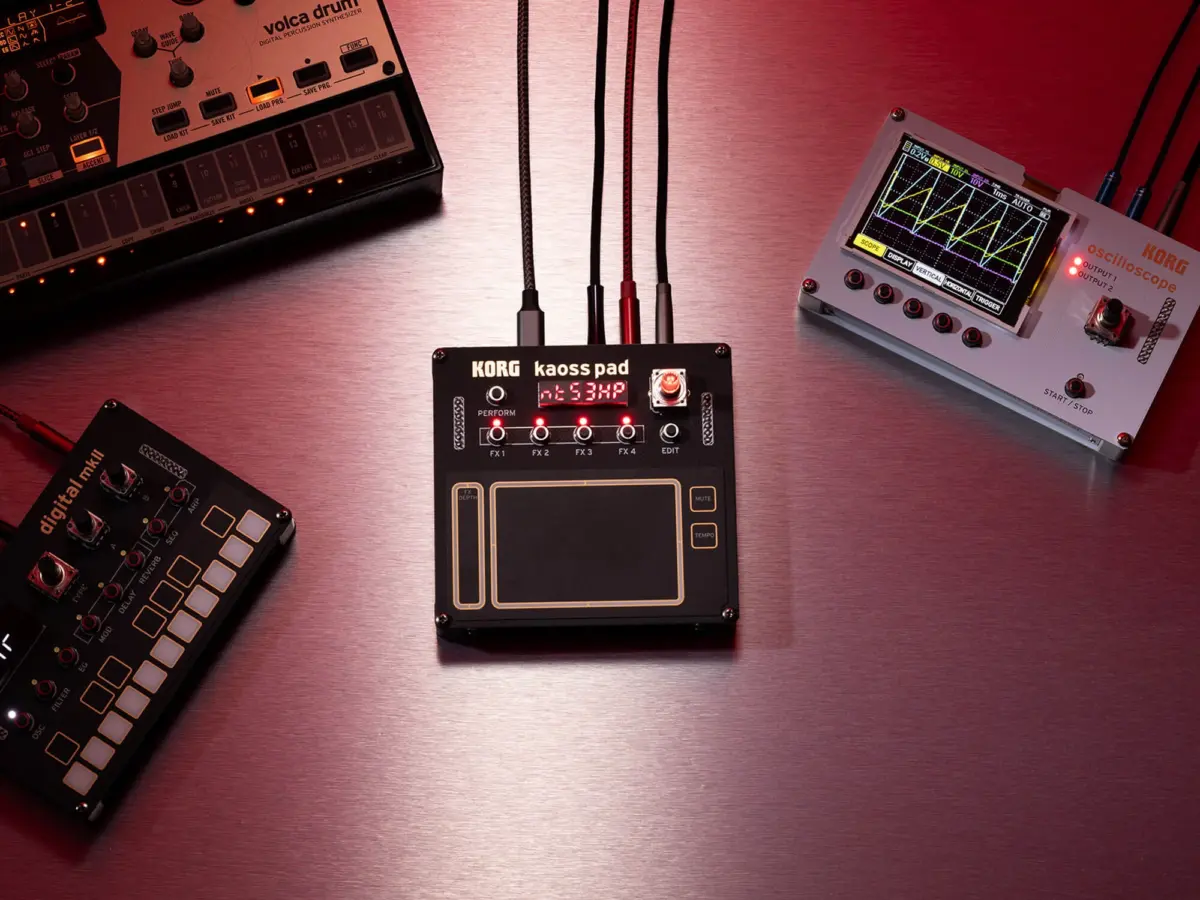
Korg’s presence in Amsterdam extends far beyond a single flagship instrument. At the Gear Test Lab located at Het Ketelhuis, Westergas (running from October 21 to October 23), Korg has curated a comprehensive playground for electronic musicians, showcasing a diverse hardware lineup that bridges legacy analog warmth with modern digital workflows.
The Korg ADE 2026 Hardware Showcase:
KAOSS PAD V: The latest iteration of Korg’s legendary X-Y touchpad performance processor, offering enhanced effects algorithms and deeper connectivity.
NTS-3 Kaoss Pad Kit & NTS-4 Mixer Kit: Part of Korg’s popular DIY Nutekt series, offering powerful, compact signal-shaping and mixing capabilities for mobile setups.
microKORG 2: The modern reimagining of the best-selling virtual analog/vocoder synthesizer of all time, featuring an updated interface, expanded polyphony, and pristine sound engines.
minilogue xd: The hybrid polyphonic synthesizer combining rich analog circuits with digital multi-engines and user-loadable oscillators.
Handytraxx Play: A nod to portable vinyl and performance culture, capturing the imagination of crate-diggers and mobile DJs.
Volca Beats & Volca Drum: Staples of the pocket-sized groovebox revolution, proving that immense rhythmic power can be packed into ultra-portable form factors.
Official Statements & Expert Insights
The collaboration between hardware engineers and product strategists is vital when bringing experimental instruments like the Phase8 to market.
During the upcoming ADE session on October 23, Product Lead Lukas Hartmann and Lead Embedded Software Engineer Iarla Scaife will pull back the curtain on the design philosophy that drove the project.
"The challenge with the Phase8 was never just about making metal vibrate; it was about giving producers precise, musical control over a medium that behaves with inherent physical chaos," notes industry commentary surrounding the development team’s ethos. "By combining real steel resonators with digital envelope shaping and now, the browser-based Companion App, we are offering an entirely new sonic palette that respects traditional acoustic principles while embracing modern electronic workflows."
The live session will not only demonstrate the Phase8 in isolation but will showcase how the instrument integrates seamlessly alongside complementary hardware in a live performance setting, culminating in an interactive Q&A session where attendees can direct their technical queries straight to the creators.
Future Outlook: What Phase8 Means for the Industry
The introduction of the Phase8 and its accompanying browser-based control software signals a broader trend within the music technology sector. As the market becomes increasingly saturated with software plugin bundles and standard analog emulations, musicians and producers are craving tactile authenticity.
By successfully commercializing a physical modeling acoustic synthesizer that permits direct human intervention with vibrating steel, Korg has carved out a unique territory. The Phase8 is not merely a novelty; it represents a blueprint for how future instruments may merge acoustic physics with digital precision.
As electronic music continues to fracture into increasingly sophisticated subgenres—where unique sound design and organic texture are the ultimate currencies—instruments like the Phase8 ensure that the physical world remains a vital, breathing component of the modern electronic studio.
Producers and attendees at Amsterdam Dance Event 2026 are strongly encouraged to witness history in the making at the Korg Gear Test Lab at Het Ketelhuis, Westergas, and secure their seats for the exclusive Phase8 live sequencing masterclass on Friday, October 23 at 4:00 PM.