Executive Overview
“You don’t care. You only pretend to care!”
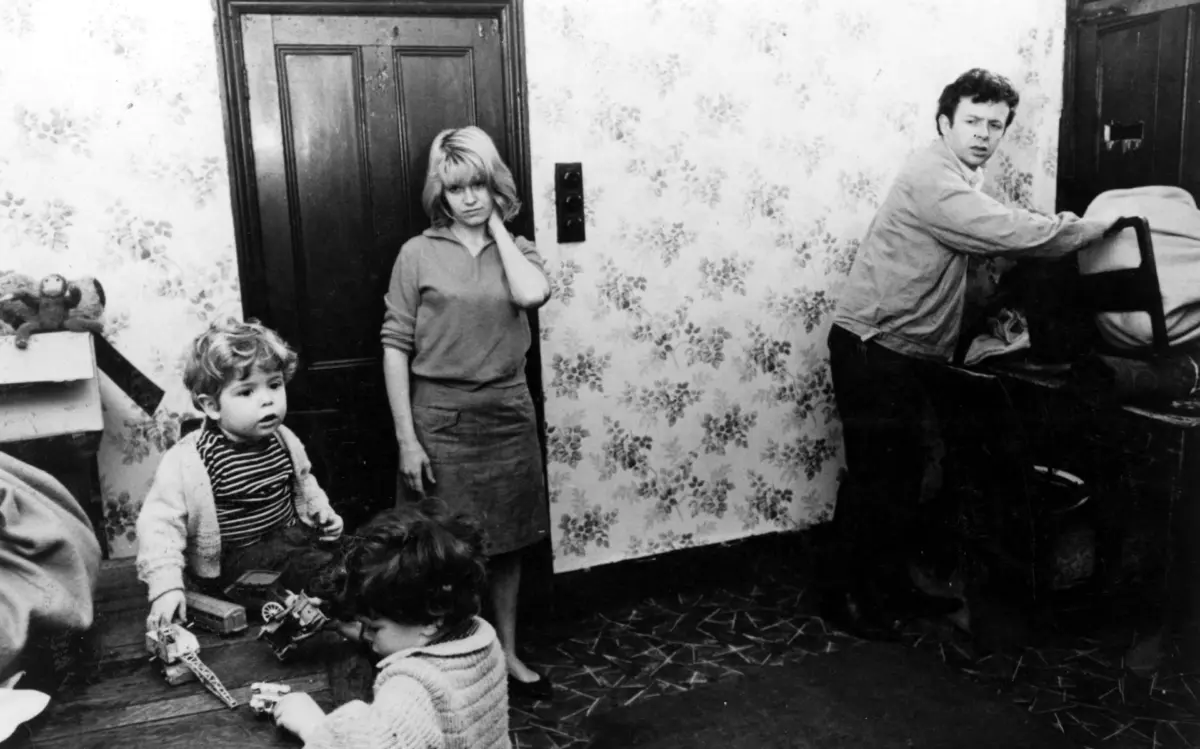
With these gut-wrenching words, shouted across a sterile, bureaucratic room by an exhausted, destitute mother to an impassioned board of welfare officials, British television changed forever. These lines, delivered by actress Carol White in the titular role of the 1966 BBC television play Cathy Come Home, remain as raw and resonant today as they were six decades ago. Directed by Ken Loach, written by Jeremy Sandford, and produced by Tony Garnett, the drama stands as a towering cultural touchstone—a visceral interrogation of poverty, systemic institutional failure, and the devastating human cost of housing shortages.
Broadcast at a time when Britain was basking in the cultural optimism of the swinging sixties, Cathy Come Home shattered the illusion of the postwar welfare state. It exposed a brutal, hidden underbelly where ordinary families could slide into destitution overnight through a combination of injury, unemployment, and a hostile property market. When it aired to an astonishing 12 million viewers—roughly a quarter of the UK’s population at the time—it overwhelmed BBC telephone switchboards, sparked fierce parliamentary debates, and directly catalyzed the formation of modern housing advocacy groups such as Shelter and Crisis.
Yet, nearly sixty years later, the article’s central thesis remains an indictment of modern governance: the systemic nightmares captured by Loach and Sandford have not been eradicated; they have merely evolved. Today, England is grappling with unprecedented housing pressures. Government statistics reveal that over 135,500 households, including nearly 180,000 children, are trapped in temporary accommodation—often in conditions officially deemed “unfit for human habitation.” Between 2019 and 2025, substandard temporary housing was cited as a contributing factor in the tragic deaths of over 100 children.
This retrospective explores the profound legacy of Cathy Come Home, its groundbreaking narrative techniques, the complex institutional reactions it provoked, and its structural blind spots—particularly regarding race and family structures. By holding up a mirror to the past, we are forced to confront uncomfortable truths about contemporary Britain’s ongoing failure to secure safe, affordable, and permanent housing for all its citizens.
Detailed Chronology: From Script to Screen and the Long Shadow of Reform
To understand the cultural tectonic shift caused by Cathy Come Home, one must examine the meticulous craftsmanship and the historical trajectory that brought the drama from conception to legislative reality.
1966: The Genesis and Broadcast
Jeremy Sandford spent months researching the lived experiences of itinerant workers, squatters, and families swept up in Britain’s mid-century housing crisis. When he collaborated with director Ken Loach, they deliberately rejected traditional, melodramatic television tropes in favor of a hybrid form of docudrama. They cast relative unknowns, shot on location in real slums and hostels, utilized heavy improvisation, and embedded hard statistical data directly into the visual narrative.
When the BBC broadcast the play in November 1966, the response was immediate. Viewers were not merely entertained; they were deeply disturbed. The final sequence—showing Cathy broken, desperate, and sitting on a railway platform after her three children were forcibly taken into care by the state—triggered nationwide outrage.
1967–1976: The Rise of Advocacy and Legislative Lull
The immediate aftermath of the broadcast saw unprecedented civic mobilization. Just two weeks after the film aired, the housing campaign charity Shelter was officially launched, utilizing the public fury and mobilizing star power, including lead actress Carol White, to raise tens of thousands of pounds. Shortly after, in 1967, the homelessness charity Crisis was founded.
Politicians were forced to take notice. The Minister of Housing invited Loach, Sandford, and Garnett to Whitehall to account for the systemic failures depicted. Local authorities, notably in Birmingham where portions of the film were shot, pledged to end the practice of separating homeless families within two years.
Yet, genuine legal reform lagged far behind the cultural noise. Despite parliamentary debates and continuous media scrutiny, it took more than a decade for substantive legislative change to materialize.
1977: The Housing (Homeless Persons) Act
The watershed moment arrived with the passage of the Housing (Homeless Persons) Act 1977. For the first time in British legal history, local authorities were placed under a statutory duty to secure accommodation for certain categories of homeless people. Crucially, the act established the concept of "priority need" and protected those who were not deemed to have made themselves "intentionally" homeless.
However, historians note that this legislative breakthrough was driven as much by internal civil service anxieties over administrative chaos in local councils as it was by the grassroots pressure catalyzed by Loach’s masterwork. Furthermore, the promise of the 1977 Act has steadily eroded over subsequent decades under the weight of successive housing crises, underscoring the limits of legislative fixes divorced from long-term capital investment in social infrastructure.
Supporting Context & Metrics: The Scale of Modern Housing Poverty
While Cathy Come Home utilized groundbreaking cinematic techniques to blur the lines between fact and fiction, the metrics driving today’s housing emergency prove that the fiction has tragically become everyday reality.
Temporary Accommodation Under Strain
The contemporary landscape of British homelessness is defined by the explosive growth of temporary housing. Recent data from the Department for Levelling Up, Housing and Communities outlines a staggering humanitarian toll:
- 135,580 households in England are currently living in temporary accommodation.
- 177,530 children grow up without a permanent front door, moving frequently between B&Bs, converted shipping containers, and cramped emergency hostels.
- Decaying Infrastructure: Parliamentary inquiries by housing committees have repeatedly categorized much of this provision as “unfit for human habitation,” plagued by chronic damp, toxic mould, structural disrepair, and severe safety hazards.
+-------------------------------------------------------------------+
|      CONTEMPORARY HOMELESSNESS METRICS IN ENGLAND (2025/2026)     |
+-------------------------------------------------------------------+
| Total Households in Temporary Accommodation:        135,580       |
| Total Children Impacted:                            177,530       |
| Child Deaths Linked to Substandard Housing (2019-25):   104       |
| Disproportionate Risk for Single-Parent Families:    Nearly 4x     |
+-------------------------------------------------------------------+
The Human Toll: Preventable Tragedies
The physical and psychological toll of substandard housing is lethal. Research published by the Shared Health Foundation revealed a grim statistic: between 2019 and 2025, temporary accommodation environments directly contributed to the deaths of 104 children. These losses are symptoms of a systemic failure where profit margins and administrative backlogs are prioritized over the fundamental right to shelter.
Official Statements and Institutional Perspectives
The debate surrounding Cathy Come Home and its modern echoes has consistently forced a confrontation between grassroots humanitarian advocates and institutional gatekeepers.
The Institutional Defense (1960s vs. Present)
When the film was first released, government officials and conservative commentators fiercely contested its veracity. They questioned whether characters like Cathy and Reg were representative of the broader population, or whether their downfall was the result of personal moral failings rather than macroeconomic and structural deficits. This defense mechanism—shifting blame from the state onto the individual—has remained a recurring motif in British political discourse for decades.
In recent years, however, parliamentary bodies have been forced to adopt a more self-critical tone. Recent reports from the Housing, Communities and Local Government Committee have described the reliance on emergency bed-and-breakfast accommodation for families as a "national scandal" that breaches basic human rights.
Housing Charities Speak Out
Modern advocacy organizations continue to trace their lineage directly back to the momentum generated by Loach’s film. Speaking on the enduring relevance of the crisis, representatives from organizations like Shelter and Justlife emphasize that temporary accommodation was never designed to be a permanent destination:
"Temporary accommodation was conceived as a short-term safety net, not a multi-year black hole where childhoods are stolen and families disintegrate. When we see children growing up in mould-infested rooms, we are witnessing the institutional echoes of Cathy’s nightmare. The state has a legal obligation, but more importantly, a moral imperative, to build social housing at scale."
Critical Blind Spots: Race, Gender, and Representation
Despite its monumental cultural impact, historical analyses of Cathy Come Home have increasingly pointed out significant blind spots in its narrative framework—limitations that continue to plague modern housing policy.
The Erasure of Minority Communities
The film focused overwhelmingly on the struggles of a white, working-class nuclear family. Yet, historical data from the period demonstrates that Black and minority ethnic (BME) households faced disproportionate levels of discrimination within the private rental market and were significantly more vulnerable to housing poverty and substandard conditions.
This oversight persists today. Contemporary quantitative research shows that:
- Black-led households are statistically more likely to apply for statutory homelessness support.
- They spend significantly longer periods trapped in temporary accommodation.
- They face systemic barriers that make them demonstrably less likely to be successfully rehoused in secure social housing compared to their white counterparts.
Gender and Family Structures
Cathy and Reg represented a traditional nuclear family ideal. In 1966, unmarried mothers, women escaping domestic violence, or those fleeing relationship breakdowns faced immense societal stigma and virtually insurmountable legal and financial barriers to securing housing.
Today, while societal attitudes have shifted, the structural vulnerability of specific demographics remains acute. Recent research by Shelter highlights that single-parent households are nearly four times more likely to be homeless or at imminent risk of homelessness in England compared to two-parent families. The failure to adapt safety nets to support non-traditional households leaves millions exposed to the exact brand of institutional cruelty documented in 1966.
Future Outlook: What Must Change?
As we mark sixty years since Cathy Come Home first seared itself into the British consciousness, the anniversary must be approached not merely as a moment of nostalgic television history, but as an urgent call to action.
The enduring legacy of Loach, Sandford, and Garnett’s work proves that art and investigative media possess the extraordinary power to capture the public imagination and force political elites to the negotiating table. However, television plays and viral journalism cannot replace sustained political will and capital investment.
To prevent the next generation of children from experiencing the nightmare of the railway platform, policymakers must address the root causes of the crisis:
- Massive Social Housebuilding: A government-backed commitment to constructing hundreds of thousands of genuinely affordable, high-quality social homes annually.
- Reforming Temporary Accommodation: Enforcing strict, legally binding quality standards with zero tolerance for damp, mould, and overcrowding, alongside strict time limits on how long any family can remain in temporary housing.
- Targeted Equity in Housing Allocation: Dismantling systemic biases within local authority housing departments to ensure that Black households and single-parent families receive equitable, expedited support.
- Preventing Family Separation: Ensuring that poverty and housing destitution are never again used as legal justifications for tearing vulnerable children away from their parents and placing them into the care system.
Cathy Come Home held up an unsparing mirror to British society in 1966. Sixty years later, that mirror reflects an image that is uncomfortably, unacceptably familiar. True progress will only be achieved when future generations look back at Cathy’s story as a historical artifact of a bygone era, rather than a mirror of their current reality.