Executive Overview
In the contemporary cultural landscape, the rhythm of fashion has ceased to be a steady march. Instead, it has transformed into a dizzying, hyper-accelerated trend loop. Where previous generations measured stylistic eras in decades, today’s digital natives contend with a daily conveyor belt of micro-trends, hyper-specific "cores," and aggressively marketed aesthetics. From the fleeting viral hysteria of "balletcore" and "whimsymaxxing" to the polarizing waves of "mob wife," "brat," and "indie sleaze," fashion trends zoom in and out of the cultural consciousness with an alarming, exhausting velocity.
This relentless cycle creates an unprecedented paradox: consumers are simultaneously inundated with an infinite buffet of choices while being starved of the time required to develop an authentic, personal sense of style. Far from being a golden age of sartorial freedom, the modern fashion ecosystem—supercharged by algorithms, social media feeds, and ultra-fast-fashion manufacturing lines—has trapped consumers in a system of hyper-consumption.
Drawing upon historical sociological frameworks, modern psychological theories, and actionable strategies for sartorial reclamation, this investigation explores how the algorithmic feedback loop operates, why traditional theories of fashion evolution have collapsed, and how individuals can reclaim their wardrobes from the digital noise.
Detailed Chronology: From Laver’s Law to the Algorithmic Flattening of Time
To understand just how radically the mechanics of fashion have shifted, one must look back at how clothing styles were historically understood to evolve.
1937: James Laver and the Predictable Life Cycle of Style
In 1937, the British author, critic, and art historian James Laver formulated what would become known as Laver’s Law. Laver charted a deterministic, 160-year cycle through which clothing styles supposedly evolve in public perception as they recede into the past:
- Indecent: 10 years before its time
- Shameless: 5 years before its time
- Dutiful: Exactly contemporary
- Smart: 10 to 20 years after its time
- Frumpish: 30 years after its time
- Hideous: 50 years after its time
- Ridiculous: 70 years after its time
- Amusing: 100 years after its time
- Quaint: 150 years after its time
- Charming: 160 years after its time
According to Laver, a silhouette passed through these predictable emotional milestones, eventually becoming obsolete and "ridiculous" after two decades, only to be rediscovered as "charming" centuries later.
2004: Lars Svendsen and the Logic of Supplementation
Decades later, Norwegian philosopher Lars Svendsen challenged the foundational assumptions of traditional fashion theory in his seminal work, Fashion: A Philosophy (2004). Svendsen observed that the "traditional replacement logic of fashion […] has itself been replaced by a logic of supplementation."
In the past, a new trend systematically displaced an older one; hemlines rose and fell, silhouettes widened and slimmed, and distinct eras neatly replaced their predecessors. Today, however, we no longer swap styles in and out of vogue. Instead, we continuously accumulate them. New aesthetics are bolted onto existing ones without any prior trend being formally retired, creating a mountainous backlog of cultural references that consumers are expected to maintain simultaneously.
The Present Day: The Death of Sequential History
Today, this logic of supplementation has been taken to its absolute extreme by social media platforms like TikTok, Instagram, and Pinterest. We witness a bizarre chronological collapse: 1990s minimalism and Y2K cyber-futurism dominate consumer desires, operating alongside a 48-hour-old micro-trend born on a smartphone screen.
Rather than cycling through distinct historical eras sequentially as Laver predicted, social media feeds flatten time entirely. Decades of vintage subcultures and instantaneous viral aesthetics are crammed into the same endless scroll. Crucially, these historical revivals defy Laver’s timeline; styles from the 1990s and Y2K era do not look "ridiculous" to contemporary youth—they are embraced as vital, living expressions of identity, completely untethered from their original historical context.
Supporting Context & Metrics: The Paradox of Choice and the Rise of "Anti-Style"
Why does modern fashion feel so exhausting? The answer lies at the intersection of mass accessibility, aggressive algorithmic marketing, and psychological overburdening.
The Paradox of Choice
In his 2016 book The Paradox of Choice, psychologist Barry Schwartz argues that an overabundance of options—whether encountered on high-street ecommerce sites or within endless digital feeds—ultimately leads to psychological paralysis and demoralization rather than liberation. When consumers are presented with an infinite array of micro-trends ("normcore," "dadcore," "gorpcore," "indie sleaze"), decision fatigue sets in.
"An overabundance of choice—whether on high street shelves or digital feeds—ultimately causes demoralisation rather than liberation."
At no other time in human history have we been surrounded by so much material abundance, with so many distinct lifestyle possibilities aggressively marketed at us around the clock. The psychological toll of keeping up with this moving target manifests as a pervasive sense of inadequacy: if you aren’t currently participating in the latest aesthetic "core," you risk feeling culturally invisible.
The Co-Opting of "Anti-Style"
The hyper-accelerated trend loop has proven remarkably adept at absorbing even its own critiques. Consider the rise of aesthetic movements like normcore, dadcore, and gorpcore. These movements originated as reactions against the relentless pressure to perform sartorial uniqueness; they prioritized utilitarianism, comfort, irony, and nonchalance over high-fashion statements.
Yet, the algorithmic machinery of modern retail quickly commodified these anti-styles. Technical gear originally engineered for extreme alpine survival by heritage performance brands—such as Arc’teryx and Gore-Tex—was stripped of its functional context, repackaged as high-fashion streetwear, slapped with exorbitant price tags, and pushed through the exact same viral promotion channels as any other fast-fashion fad. Even when consumers try to opt out of the trend cycle by dressing "ordinarily," they find themselves buying into a pre-packaged version of ordinariness.
Official Industry Insights and Environmental Toll
The environmental and ethical costs of this rapid turnover are staggering. The modern fast-fashion complex relies on the systematic manufacture of artificial obsolescence, manipulating consumer psychology to provoke a knee-jerk reaction: buy new goods immediately to avoid the social stigma of looking outdated.
Environmental analysts point out the sheer absurdity of the "whimsymaxx" and ultra-fast-fashion pipelines. Millions of garments are manufactured, shipped, worn for a single TikTok video, and subsequently discarded into landfills—all to satisfy a fleeting digital moment.
As sustainability researchers note, this cycle exploits deep-seated human desires for community, belonging, and self-expression. By tying these emotional needs to commercial consumption, digital platforms ensure that users remain trapped inside an endless loop of buying, posting, and discarding.
Future Outlook: Reclaiming Sartorial Agency in an Algorithmic Age
Developing an authentic personal style amidst the constant roar of marketing can feel daunting. However, breaking away from the feeds, reels, ads, and algorithms is entirely possible. Moving forward, conscious consumers are increasingly adopting a series of radical countermeasures to reclaim their sartorial agency.
1. Find Timeless Style Icons
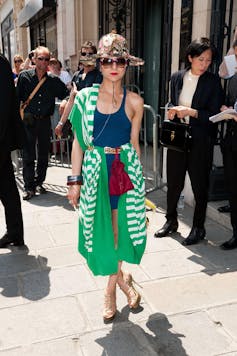
Instead of looking to the top trending creators on your FYP (For You Page), look to figures whose attitude and self-expression transcend temporal fads. Consider the uncompromising, sharp tailoring of Lauren Bacall, the classic, unpretentious elegance of Paul Newman, or the fearless eclecticism of contemporary stylist Catherine Baba. Looking back to eras before commercial algorithms dictated daily wear reveals how individuals curated distinct personal styles anchored in craftsmanship, silhouette, and personal eccentricity.
2. Reevaluate Where, When, and What You Buy
It sounds simple, but a revolutionary act in the modern era is to buy only what you genuinely love. Stripping away the pressure to dress for an audience makes getting dressed a joyful ritual rather than an anxious performance. Exploring local charity shops and vintage boutiques offers a space where trend interference is significantly muted, allowing you to connect with garments based on tactile and visual appeal rather than algorithmic push notifications.
3. Consider Your True Messaging
Evaluate whether transient high-street silhouettes actually align with your lifestyle, professional needs, and self-image, or if they merely reflect passing promotional campaigns. A wardrobe should serve as a physical extension of your personality, not a rotating advertisement for whatever aesthetic happened to go viral last Tuesday.
4. Ditch the Influencers for Personal Archives
Look to personal and family archives—photographs of parents, grandparents, or historical eras—to identify classic silhouettes and durable materials. These offer a grounded, authentic alternative to influencer-driven fast fashion. If a parent looked effortless in a well-cut trench coat or a ribbed polo neck, there is a strong probability those same lines will work for you, entirely independent of current digital trends.
5. Embrace the Power of Less
More is rarely more. Clever styling, proper garment maintenance, repairing, dyeing, and thoughtful wardrobe management can help you realize that what you already own is more than enough.
By stepping off the algorithmic treadmill, consumers can break free from the manufactured anxiety of the micro-trend cycle. The future of fashion does not belong to the fastest-moving feed or the newest viral "core"—it belongs to those who possess the confidence to wear what speaks to who they truly are.