In the modern landscape of electronic music production, efficiency is often heralded as the ultimate virtue. Producers are frequently encouraged to enter the studio armed with concrete concepts, precise project goals, and meticulous production plans. While this structured approach reliably yields finished tracks and ensures deadlines are met, it can inadvertently strip away the raw, exploratory joy that sparks true artistic innovation. In an algorithmic world saturated with hyper-polished, market-tested sounds designed to mimic commercially successful tracks, adherence to a strict blueprint can result in sterile, predictable music.
Enter the counter-movement: a methodology predicated on absolute spontaneity. By deliberately abandoning preconceived notions and stripping away any overarching plan, producers open the door to happy accidents, unconventional melodies, unique architectural structures, and fresh sonic palettes. This philosophy of purposeful experimentation is the core premise behind this month’s deep dive into sound design.
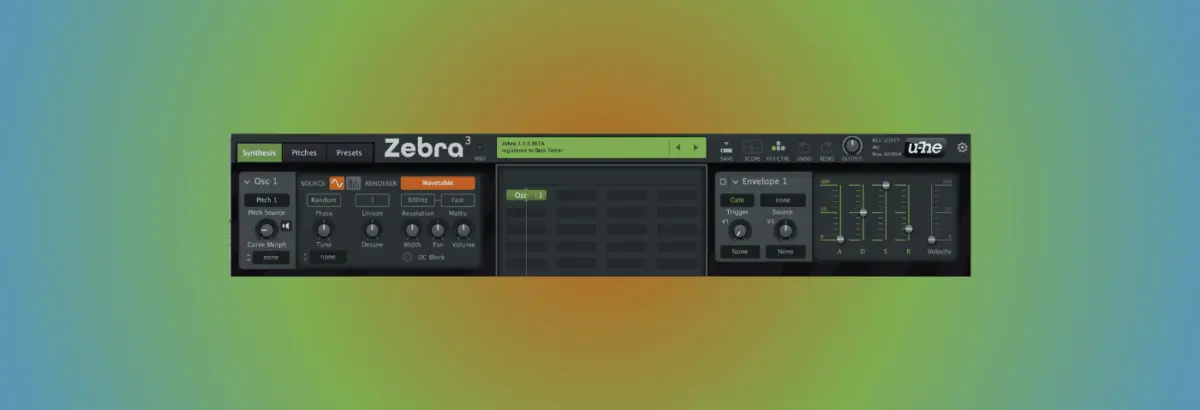
To put this philosophy into practice, we turn our attention to one of the most anticipated software instruments in modern production: u-he Zebra 3. As a comprehensive, from-the-ground-up sequel to u-he’s legendary wireless modular soft synth, Zebra 3 provides an expansive, highly malleable playground for unguided exploration. Rather than aiming to meticulously recreate a classic, pre-existing patch, our goal today is pure empirical discovery—turning knobs, routing modulation sources blindly, and listening closely to the raw acoustic reactions of the software.
This guide documents a 10-step improvisational patch-building session. Designed to challenge rigid production habits, this tutorial invites producers to load specific modular blocks alongside us while deliberately choosing their own parameter values, ultimately comparing their divergent sonic creations at the end of the journey.
Detailed Chronology: A 10-Step Guide to Unguided Patch Building
To follow this experiment accurately, producers should configure their Digital Audio Workstation (DAW) to a project tempo of 127 BPM, import the standard MIDI progression (WhoKnows.mid), and loop the rhythm foundation track (Kick.mp3).
Step 1: Setting the Initial Canvas (Set Init)
Every journey begins with a clean slate. Open an instance of u-he Zebra 3 within your DAW, load the default initialization ("Init") patch, and press play alongside the imported rhythm tracks. Initially, the synth relies entirely on its default oscillator settings, producing a standard, unmodulated tone that serves as a neutral starting point. It is deliberately plain, stable, and unassuming—the perfect blank canvas for complex processing.
Step 2: Introducing the FM Oscillator Module
To steer the patch away from generic territory, we dive straight into Zebra 3’s advanced Frequency Modulation (FM) oscillator capabilities. Setting the External Modulation Type (Ext. Mod Type) to "Dry," we transition the FM architecture away from classic linear DX styles and into Zebra 3’s innovative Through-Zero FM (TZFM) mode, setting the modulation depth parameter (Mod) to a value of 8.
Experimenting with the oscillator’s frequency ratio yields an array of unpredictable, metallic bleeps and chirps. After sweeping through various configurations, we settle on a ratio of 1.0 : 2.5. The resulting sound is instantly resonant, harmonically rich, and striking. While this standalone tone is strong enough to anchor a track on its own, our commitment to unguided exploration demands that we push further into uncharted territory.
Step 3: Modulating FM with an LFO
Next, we introduce a Low-Frequency Oscillator (LFO) to actively modulate the FM oscillator’s behavior, configuring a robust Modulation Depth of 48. The LFO time base is locked to a two-bar cycle (2 / 1), and the trigger parameter is set to "Single" to ensure rhythmic consistency across phrase starts.
Even at this early stage, the interaction between the LFO and the FM module generates a dense wash of evolving harmonics—a testament to the inherent power of frequency modulation. To explore the behavioral nuances of Zebra 3, we cycle through the LFO’s core wave shapes:
Triangle: Yields a smooth, rolling harmonic undulation.
Sine: Provides a fluid, organic swell.
Square: Produces harsh, abrupt jumps that initially appear difficult to tame within a traditional mix context.
Recognizing the untapped potential of the unruly square wave shape, we choose to retain it as our driving modulation source.
Step 4: Injecting Harmonic Grit via Feedback
While the patch is undeniably rich in harmonics, it currently lacks raw attitude; it is too polite for contemporary underground electronic music. To introduce grit, we experiment with Zebra 3’s feedback architecture. Pushing the Feedback knob upward yields an immediate transformation. At lower levels, it introduces subtle, warm digital distortion; as we approach a value of 73, it blossoms into a fierce, screaming resonance reminiscent of classic hardware synthesizers like the EDP Wasp.
Step 5 & 6: Taming the Beast with Multimode Filtering
While the aggressive resonances unlocked by the square-wave LFO and high feedback setting are deeply inspirational, they require structural control. Zebra 3’s newly engineered multimode filter provides the ideal mechanism for tonal containment.
Switching the filter mode to "Old Time" paired with a steep 24 dB Low-Pass configuration immediately warms up the core timbre, rounding off the jagged high frequencies. To introduce motion, we pull the raw filter cutoff frequency down to a foundational 8.18 Hz, effectively shutting the filter completely. This prepares the circuit to be dynamically opened by a dedicated envelope generator, shifting the patch’s character from a sustained drone into a sharp, percussive plucked instrument.
Step 7: Sculpting the Percussive Envelope
With our filter baseline established, we assign Envelope 1 to control the filter cutoff. The envelope is shaped with a snappy, percussive profile: an instantaneous Attack (0ms), a Decay of 1.25 seconds, a Sustain level of 31, and a long Release of 96.1ms.
Dialing the modulation depth up to 105 injects immediate kinetic energy into the patch. To judge the sound within a real-world musical context, we drop in the accompanying rhythm track (Skippy_beat.mp3). To cement the spatial environment, we route Zebra 3’s internal stereo reverb onto a dedicated auxiliary send bus, adding a cinematic sense of scale that allows subsequent micro-adjustments to shine.
Step 8: Dynamic Overdrive via Envelope 3
While our control over the filter cutoff brings architectural stability, the patch loses some of its initial bite. We need to reintroduce grit, but without sacrificing transient clarity. Applying a static Drive setting makes the sound too harsh on the attack phase of each note.
The solution lies in modular routing: we assign a third envelope (Envelope 3) exclusively to the filter’s Drive parameter. By zeroing out the base drive level and pushing the modulation depth to maximum, we tie the overdrive intensity to time. Setting Envelope 3’s Decay to maximum initially restores the harshness, but by carefully dialing in a tiny Attack time of 40ms, we achieve the best of both worlds: the overdrive swells in after the initial transient passes, resulting in rich harmonic saturation without muddying the rhythm.
Step 9: Keyboard Velocity Integration
To inject human-like variance and performance dynamics into the patch, we map keyboard Velocity to Envelope 3 at maximum depth. Now, the intensity of the overdrive directly mirrors the playing force of the MIDI data. Softer notes remain clean and breathy, while hard-hitting accent notes trigger aggressive filter saturation, creating an organic, bouncy rhythmic groove.
Step 10: Advanced Automation and Layering
To conclude our unguided design session, we explore macroscopic arrangement possibilities:
Cutoff Automation: Drawing an 8-bar filter sweep across the timeline introduces massive dynamic progression.
Release Manipulation: Extending Envelope 1’s release time to 3.61 seconds transforms the plucked sequence into a sprawling, ambient wash.
Unison Layering: Finally, we blend the previously discarded, buzzy "Init" patch back into the mix as a secondary layer, enriching it with an 8-voice detuned Unison mode to create an imposing wall of sound.
Supporting Context & Metrics: The Philosophy of Algorithmic vs. Experimental Production
Production Approach
Primary Driver
Typical Result
Risk Profile
Plan-Driven
Deadlines, Market Trends
Efficient, commercially viable tracks
Creative stagnation, sonic fatigue
Unguided (No Plan)
Curiosity, Tactile Exploration
Unconventional structures, unique patches
Directional drift, time sink
The tension between structured composition and exploratory sound design is well-documented in modern music production discourse. Industry analysts note that contemporary digital audio workstations (DAWs) encourage visual, template-based workflows. While templates streamline the path from concept to master, cognitive science research in creative workflows indicates that strict goal orientation suppresses divergent thinking—the mental process required to generate unique ideas.
Software suites like u-he Zebra 3 are explicitly engineered to bridge this gap. By offering modular flexibility combined with modern DSP innovations like Through-Zero FM and flexible multi-mode filters, instruments of this caliber reward tactile exploration. Producers who step away from preset libraries and embrace unguided patch design consistently report higher satisfaction, deeper technical understanding of synthesis, and a distinct sonic signature that sets their productions apart in an increasingly homogeneous market.
Official Statements & Developer Insights
Reflecting on the design philosophy behind Zebra 3, representatives from u-he have consistently emphasized the importance of tactile engagement in software synthesis:
"Modern virtual instruments are frequently judged by how quickly they allow a producer to find a recognizable, ready-to-use sound. However, synthesis was never meant to be merely an exercise in preset browsing. With Zebra 3, our primary objective was to build an environment where turning a single unassigned knob could radically alter the acoustic trajectory of a patch, encouraging producers to abandon their safety nets and rediscover the thrill of acoustic discovery."
This sentiment underscores why unguided tutorials remain vital educational tools. By removing the pressure to replicate commercial hits, sound designers can interface directly with the mathematical and physical realities of sound generation.
Future Outlook: The Evolution of Modular Software Design
As we look toward the future of electronic music production, the boundary between hardware modular workflows and software polyphony continues to blur. Instruments like Zebra 3 represent a generational leap, merging the infinite routing capabilities of modular systems with the recallability and precision of modern DAW integration.
Future developments in synthesis are expected to lean heavily into generative modulation, machine-learning-assisted randomizers, and deeper modulation matrixes. Yet, regardless of how advanced software tools become, the human element—curiosity, experimentation, and the willingness to work without a plan—will remain the ultimate catalyst for groundbreaking art. Producers who master the art of unguided exploration will undoubtedly lead the next wave of electronic music innovation.