In what historians and cultural authorities are already calling a once-in-a-millennium event, the Bayeux Tapestry has returned to British soil for the first time since its creation nearly 960 years ago. The monumental 70-metre-long linen embroidery, universally recognized as one of the most significant visual chronicles of the medieval European world, crossed the English Channel from France this past July to take up a landmark residency at the British Museum in London.
The artifact’s unprecedented relocation from its longstanding home at the Bayeux Tapestry Museum in Normandy has captured the public imagination on a historic scale, drawing unprecedented crowds and generating intense academic scrutiny. To document this monumental cultural bridge-building exercise, the BBC has produced a premier-tier, 60-minute documentary titled Secrets Of The Bayeux Tapestry. Narrated by beloved actor, comedian, and presenter Sir Michael Palin, the film brings together an elite consortium of historians, archaeologists, and cultural commentators—including David Olusoga, Professor Janina Ramirez, Dan Snow, and former politician-turned-academic Rory Stewart—to unpack the complex layers of history, artistry, and political intrigue embedded within the embroidered threads.
As the landmark exhibition continues to shatter visitor projections in Room 30’s Sainsbury Exhibitions Gallery, this comprehensive report explores the tapestry’s return, the unprecedented logistical and diplomatic efforts required to move it, the historical mysteries the documentary aims to solve, and the broader cultural implications of this monumental Anglo-French collaboration.
Detailed Chronology: The Journey of the Tapestry
To fully grasp the magnitude of the Bayeux Tapestry’s return to the United Kingdom, one must trace both its ancient origins and the intricate modern diplomacy required to orchestrate its temporary repatriation.
The 11th-Century Genesis and the Norman Conquest
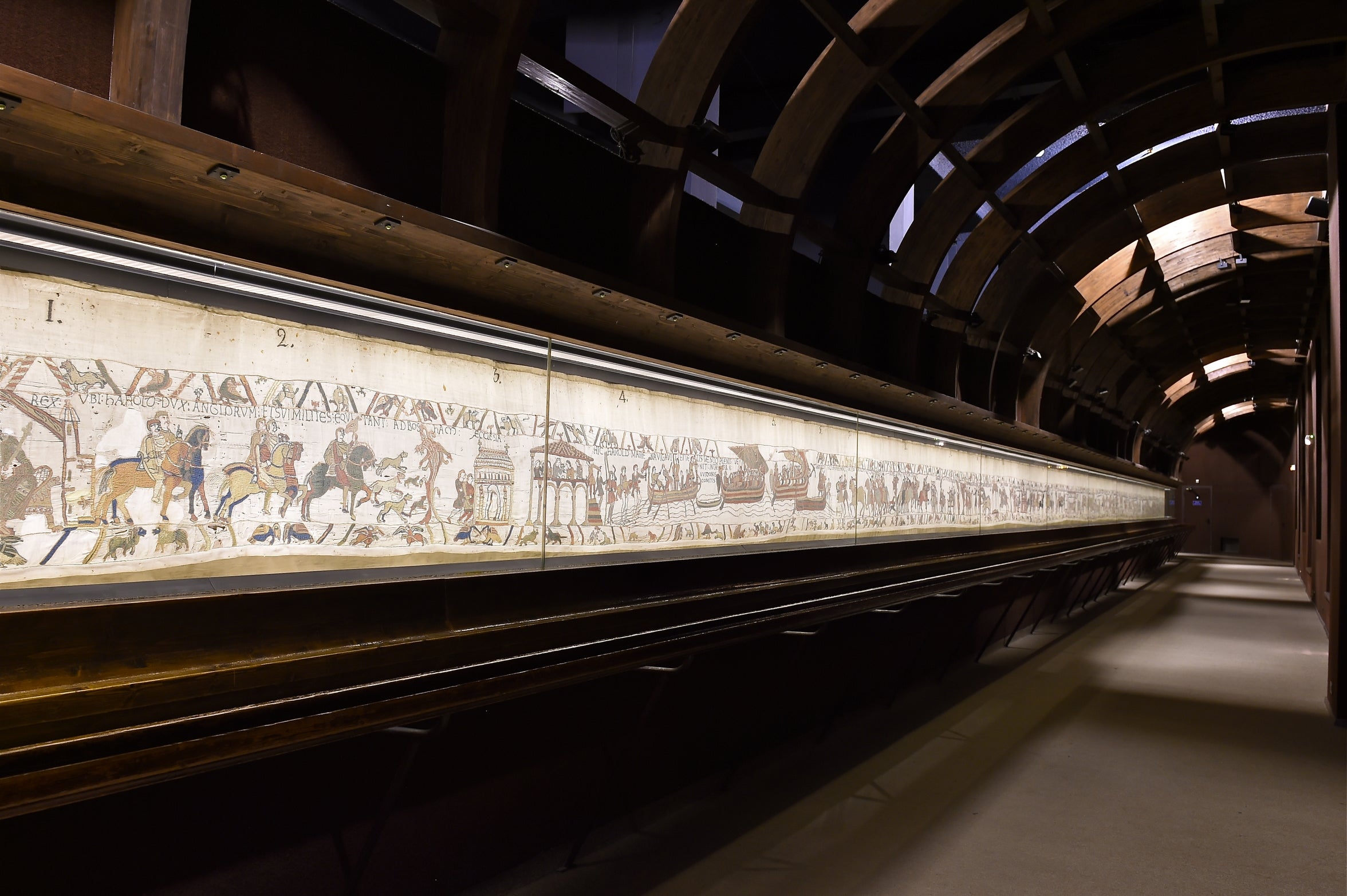
Created in the late 11th century—most likely within a decade or two of the pivotal events it portrays—the tapestry is not technically a woven textile, but rather an exquisite work of embroidery. Stitched with colored wool yarns onto linen cloth, the masterpiece spans an astonishing 70 meters (approximately 230 feet) in length and roughly 50 centimeters in height.
The narrative sweep of the embroidery meticulously details the cataclysmic events leading up to and culminating in the 1066 Norman Conquest of England. It visually records the decline of Anglo-Saxon dominance under King Harold Godwinson, the diplomatic missions and alleged oath-breaking that preceded the invasion, the ambitious shipbuilding efforts of William, Duke of Normandy, and the bloody crescendo of the Battle of Hastings on October 14, 1066. The conflict resulted in the death of Harold and the coronation of William as the first Norman king of England, forever altering the linguistic, architectural, cultural, and political trajectory of the British Isles.
For centuries, the physical artifact remained in France, housed for modern generations at the Bayeux Tapestry Museum in Normandy since 1983. Prior to this summer, proposals to transport the fragile linen across the English Channel were consistently scuttled due to conservation anxieties, insurance complexities, and the profound political sensitivities surrounding the loan of France’s premier national treasure.

The Modern Repatriation: Crossing the Channel
The breakthrough came following years of high-level diplomatic negotiations between the British and French governments, spearheaded by heritage officials, conservators, and museum directors from both nations. The goal was to establish whether modern conservation science could safely facilitate the transport and exhibition of an irreplaceable 960-year-old organic artifact without risking its structural integrity.
In July, a specialized Franco-British team of curators, conservators, and transport logistics experts executed the high-stakes operation. Moving the priceless object from Normandy involved state-of-the-art climate-controlled transport units designed to mitigate fluctuations in humidity, temperature, and light exposure.
Upon its arrival at the British Museum, the tapestry was carefully unfurled and installed within Room 30, the Sainsbury Exhibitions Gallery. The meticulous mounting process required bespoke engineering to display the entire 70-meter length safely while offering visitors an intimate, unobstructed view of the intricate needlework. The resulting exhibition represents the centerpiece of the British Museum’s cultural calendar, projected to run continuously until next July.
Supporting Context & Metrics: Unlocking the Medieval Masterpiece
The BBC Two documentary Secrets Of The Bayeux Tapestry steps into this charged cultural moment to answer longstanding questions about the artifact, moving far beyond the standard historical narrative taught in classrooms.
Deconstructing the Visual Record
While millions recognize the tapestry as a chronicle of war, experts emphasize that its true brilliance lies in the margins. As former politician and academic Rory Stewart observes in the documentary, the textile is "the best way of really understanding the depth and detail of what can otherwise be quite a perplexing line of images."
Stewart highlights the significance of the decorative borders—the upper and lower registers that run parallel to the main historical narrative. "Something we often miss are the hidden details, particularly around the frames: leaves, mysterious figures, and strange implications," he notes. These marginalia feature recurring motifs, Aesop’s fables, agricultural scenes, mythological beasts, and cryptic human figures whose symbolic purposes continue to confound scholars.
Historical Enigmas Explored by the Experts
The 60-minute documentary marshals an impressive roster of intellectual heavyweights to dissect these lingering mysteries:
- The Commissioners and Creators: Who actually ordered the creation of the tapestry? Was it commissioned by William’s half-brother, Odo, Bishop of Bayeux, or by Queen Matilda? Furthermore, were the embroiderers Anglo-Saxon craftspeople working under Norman rule, or Norman artisans? Recent scholarship suggests the exceptional skill required points strongly to English needleworkers, who were renowned throughout medieval Europe for opus anglicum (English work).
- Intended Purpose: Was the tapestry designed as a propaganda piece to legitimize the Norman conquest to a largely illiterate populace, a narrative scroll meant to adorn a cathedral nave, or a political tool to cement Odo’s status within the emerging Anglo-Norman aristocracy?
- Reflecting Modern Identity: Beyond its 11th-century context, the documentary explores what the tapestry reveals about the construction of British and French national identities, immigration, conquest, and cultural synthesis over the past millennium.
Exhibition Economics and Attendance Metrics
The public appetite for this historical encounter has broken all anticipated records. According to British Museum projections, the exhibition is expected to draw approximately 7.5 million visitors over the course of its year-long residency—a transformative figure for London’s post-pandemic cultural tourism sector.
Demand has so drastically outstripped capacity that tickets for the exhibition are currently completely sold out through December. Recognizing the unprecedented public interest, museum administrators have announced that the next wave of public tickets will go on sale on October 21, covering time slots between January and March of next year, with subsequent ticket releases scheduled for later in the exhibition cycle.
Official Statements and Expert Perspectives
The convergence of cutting-edge documentary filmmaking, high-stakes museum curation, and deep academic research has generated profound commentary from those intimately involved in the project.
Dr. Millie Horton-Insch, the project curator of The Bayeux Tapestry exhibition at the British Museum, described the sheer emotional weight of the artifact’s arrival:
"It was the thrill of a lifetime to watch the Tapestry arrive at The British Museum, quite literally a once in a millennium event. It is the most incredible investment of time and labour. I think that audiences will be amazed to see the work that went into it, and it’s wonderful that this documentary will allow them to."
Reflecting on the collaborative spirit of the historic loan, French and British cultural ministers have repeatedly emphasized the exhibition as a testament to the enduring, if often complex, cross-Channel relationship. The documentary captures this spirit by profiling the Franco-British team of conservators who collaborated to ensure the tapestry’s safe passage—a poignant symbol of modern European cooperation preserving a monument to medieval conflict.
Rory Stewart expanded on the intellectual challenge of interpreting the artwork for contemporary audiences:

"When you look at the main register, you see armies, horses, armor, and death. But when you slow down and examine the borders, a completely different medieval mind opens up to you—one filled with humor, folklore, and profound psychological nuance that helps us understand the true texture of eleventh-century life."
Future Outlook: Legacy and Cultural Impact
As Secrets Of The Bayeux Tapestry prepares to broadcast on BBC Two and stream on BBC iPlayer, its release marks a watershed moment in how cultural institutions communicate heritage to the mass public. The documentary serves not merely as a companion piece to a museum block-buster, but as a critical academic intervention that democratizes high-level medieval scholarship.
Looking ahead, the legacy of this exhibition will likely redefine international museum loan protocols. For decades, conservators argued that monumental organic textiles of this age were simply too fragile to travel. The successful transit, installation, and climate-managed exhibition of the Bayeux Tapestry proves that with advanced engineering, rigorous interdisciplinary planning, and cross-border political will, even the most guarded global treasures can bridge geographic divides.
For the millions of visitors queuing outside Room 30 at the British Museum, and for the television audiences tuning into BBC Two, the return of the tapestry offers a rare, visceral connection to the year 1066. It reminds modern Britain that its national story was forged in the crucible of migration, conflict, and cultural fusion—a narrative as vibrant and intricate today as the woolen threads stitched by anonymous hands nearly a thousand years ago.