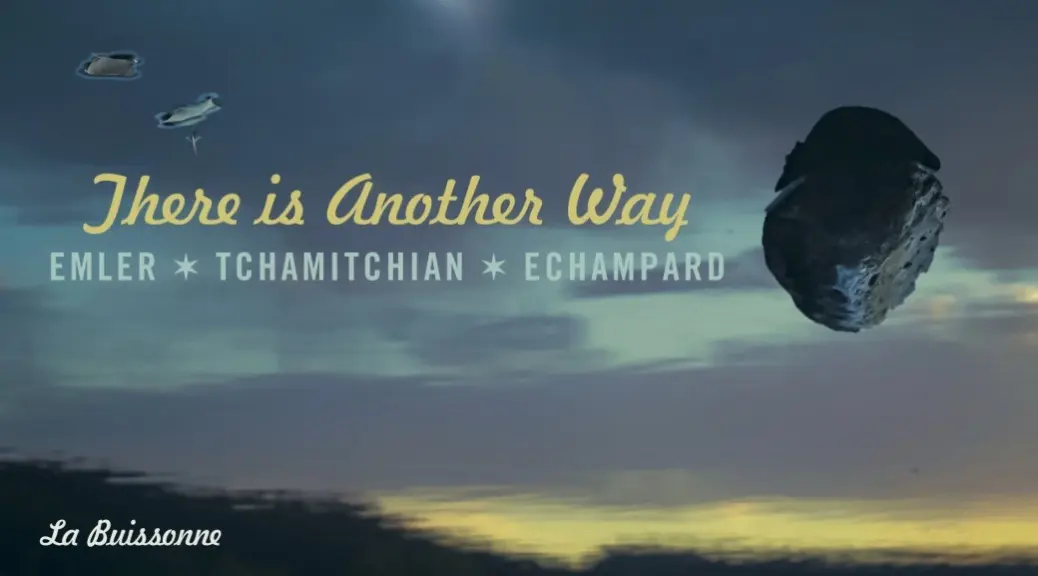
Executive Overview
In an era dominated by hyper-compressed streaming singles and hyper-segmented genre definitions, true musical iconoclasm remains a rare and precious commodity. Enter French pianist, composer, and sonic architect Andy Emler. Alongside long-standing collaborators Claude Tchamitchian on double bass and Eric Echampard on drums—collectively known as the ETE Trio—Emler has delivered a masterclass in modern, genre-defying composition titled There Is Another Way.
Released on the illustrious, independent French label La Buissonne, the seven-track recording stands as a monumental achievement in contemporary improvised music. It effortlessly bridges the structural demands of classical composition, the raw energy of rock, and the expansive freedom of avant-garde jazz.
This in-depth review and journalistic profile explores the anatomy of There Is Another Way, tracing the roots of a collaborative partnership that spans over two decades. It examines the technical virtuosity of the trio, unpacks the album’s sweeping tracklist, and evaluates the pristine sonic craftsmanship engineered at the world-renowned Studios La Buissonne. For aficionados of uncompromising, visionary artistry, Emler’s latest offering is not merely an album to be heard, but a sonic landscape to be thoroughly explored.
+-------------------------------------------------------------------------+
|                        THE ETE TRIO DYNAMICS                            |
+--------------------------+----------------------------------------------+
| Andy Emler               | Paris Conservatoire-trained pianist/composer |
| Claude Tchamitchian      | Innovative European double bassist           |
| Eric Echampard           | Rhythmic visionary & dynamic percussionist   |
+--------------------------+----------------------------------------------+
| Established Partnership  | Formed in 2002; evolved from MegaOctet       |
+-------------------------------------------------------------------------+
Detailed Chronology: From the Paris Conservatoire to the ETE Trio
To truly appreciate the multi-layered sophistication of There Is Another Way, one must trace the developmental arc of its primary creator. Andy Emler’s musical foundation was forged within the hallowed, rigorous halls of the Paris Conservatoire. There, he mastered classical structures and music theory before pivoting toward the uncharted waters of modern jazz and contemporary composition. Rather than viewing these worlds as mutually exclusive, Emler perceived them as complementary dialects of a universal musical language.
The Genesis of the MegaOctet (1989)
Emler’s ambition first crystallized on a larger scale in 1989 with the foundation of the MegaOctet. This adventurous, large-scale ensemble quickly established itself as a cornerstone of modern French jazz. It required a unique blend of tight compositional discipline and expansive improvisational freedom. It was within this demanding creative crucible that Emler forged deep, symbiotic relationships with some of Europe’s finest instrumentalists.
Among them were bassist Claude Tchamitchian and drummer Eric Echampard. Both musicians proved indispensable to the MegaOctet’s dense, shifting orchestrations. They developed an innate understanding of Emler’s idiosyncratic compositional habits—his penchant for sudden metric modulations, dense harmonic clusters, and soaring, cinematic melodic arcs.
The Birth of the ETE Trio (2002)
Thirteen years after launching his celebrated octet, Emler recognized the need for a more intimate, agile vehicle to explore the outer reaches of his writing. In 2002, he formally brought Tchamitchian and Echampard together to form the ETE Trio (an acronym derived from their respective surnames: Emler, Tchamitchian, Echampard).
This smaller configuration stripped away the orchestral safety net of the MegaOctet, placing each player under an intense, magnifying lens. Without horn sections or auxiliary percussion to bridge gaps, the trio relied entirely on telepathic communication, dynamic interplay, and mutual trust. Over the next two decades, this trio evolved from a side project into one of the most cohesive, telepathically synchronized units in European improvised music. There Is Another Way is the latest, and arguably most refined, fruit of this twenty-year evolution.
Supporting Context & Metrics: The Anatomy of a Masterclass
To understand the mechanics of There Is Another Way, one must examine the distinct stylistic contributions of each member, as well as the technical specifications that elevated the recording from a standard studio session to an audiophile landmark.
The Instrumental Triad
- Andy Emler (Piano & Composition): Emler’s playing defies easy categorization. While his technical fluency is rooted in classical tradition, his harmonic language borrows equally from late-romantic impressionism, contemporary art music, and the angular phrasing of post-bop jazz. On this recording, his acoustic piano balances percussive aggression with crystalline, lyrical delicacy.
- Claude Tchamitchian (Double Bass): Widely recognized as one of Europe’s most distinctive and fearless bassists, Tchamitchian treats his instrument as an equal voice rather than a mere timekeeping device. Whether anchoring the trio with a thunderous, woody lower register or exploring arco (bowed) textural soundscapes, his contribution provides the music with its gravitational pull.
- Eric Echampard (Drums & Percussion): Echampard possesses a rare synthesis of geometric rhythmic precision and unbridled expressionistic freedom. His approach to the kit resists predictable swing patterns or rigid rock backbeats. Instead, he constructs shifting rhythmic architectures that can pivot on a dime from whispering brushwork to thunderous, polyrhythmic explosions.
                  [Andy Emler: Piano & Composition]
                                 /
                                /
                               /
    [Claude Tchamitchian: Bass] ------- [Eric Echampard: Drums]
         (Harmonic Anchors)                (Rhythmic Architecture)
Production and Engineering: Studios La Buissonne
A critical element in the success of There Is Another Way is its sonic fidelity, captured by master engineer Gérard de Haro at Studios La Buissonne. Located in the south of France, this renowned studio has long been a sanctuary for uncompromising acoustic music, maintaining close historical distribution ties with ECM Records.
The production values on this release are nothing short of breathtaking:
- Spatial Realism: Every instrument is granted its own distinct acoustic pocket, eliminating frequency masking while maintaining a unified, room-like cohesion.
- Dynamic Range: Uncompressed and unmitigated by modern loudness wars, the album allows devastating percussive transients to sit comfortably alongside delicate, whispered piano runs.
- Instrumental Timbre: The piano exhibits an extraordinary wooden warmth and iron-string resonance; the double bass throbs with a tactile, physical grain; and the drum kit rings out with metallic clarity and skin-deep impact.
Track-by-Track Analysis: Navigating There Is Another Way
Spanning seven diverse compositions, the album functions as a narrative journey. It features sudden plot twists, moments of deep introspection, and exhilarating bursts of collective euphoria.
1. "There Is Another Way" (The Title Manifesto)
The album opens with its title track, setting the ideological and sonic tone for what is to follow. Rather than easing the listener in with a conventional melody, the piece immediately establishes a complex rhythmic framework. Emler’s piano introduces a recurring motif that is swiftly destabilized by Echampard’s shifting metric accents and Tchamitchian’s anchoring low-end notes. It serves as a manifesto: traditional jazz paths are acknowledged, but the trio is explicitly choosing a different, more challenging route.

2. "Incipit" (The Interlude)
Acting as a brief, bridge-like interlude, "Incipit" offers a moment of suspension. Clocking in at a fraction of the longer suites, it functions as a breath between movements. The piano floats impressionistically, while the bass and drums provide subtle, atmospheric shading rather than forward momentum.
3. "Drums Habits Die Hard" (The Progressive Suite)
One of the album’s crown jewels, "Drums Habits Die Hard," showcases the trio stretching their collective imagination to its absolute limits. Echampard lives up to the track’s clever title, driving the ensemble through a labyrinth of shifting rhythmic structures. The composition evokes the sprawling, conceptual ambition of progressive rock royalty like King Crimson and Pink Floyd, while retaining the improvisational elasticity of classic Duke Ellington extended suites. It is a gripping, high-octane workout that rewards repeated, active listening.
4. "Mess Around the Mood" (The Dynamic Pivot)
Continuing the energy of its predecessor, "Mess Around the Mood" thrives on emotional and stylistic whiplash. The track plays with tension and release, shifting from jagged, dissonant harmonic episodes into buoyant, swinging interludes before dissolving back into abstract sonic exploration. The interplay between Emler and Tchamitchian on this track is particularly telepathic, trading melodic fragments so seamlessly that it becomes impossible to determine where composition ends and improvisation begins.
5. "Enough" (The Substantial Statement)
Serving as the emotional anchor of the record’s second half, "Enough" is a masterclass in dynamic restraint. Rather than relying on high-velocity pyrotechnics, the trio utilizes space, silence, and micro-tonal variations to build profound emotional resonance. Emler’s touch on the keyboard is at its most tender, while Tchamitchian and Echampard wrap the piano lines in a velvet cushion of supportive textures.
6. "There Is Our Way" (The Reflective Pause)
Before the album’s final statement, "There Is Our Way" provides a poignant moment of collective self-reflection. Much like "Incipit," its brevity gives the listener space to digest the monumental weight of the preceding suites, grounding the emotional arc of the record before the final push.
7. "Final Movement / Closing Reflections"
The album concludes with a powerful summation of the trio’s ethos. It draws together the disparate threads of classical form, rock energy, and free jazz exploration into one cohesive, triumphant crescendo, leaving the listener suspended in the afterglow of an uncompromising musical journey.
Official Statements & Industry Reception
While the album speaks volumes through its notes, the critical and industry response underscores its significance within the broader European jazz landscape.
In promotional statements accompanying the release on La Buissonne, representatives for the label emphasized the album’s alignment with their core mission:
"La Buissonne has always championed artists who refuse to compromise their artistic vision for commercial expediency. Andy Emler, alongside Claude Tchamitchian and Eric Echampard, represents the absolute pinnacle of this philosophy. There Is Another Way is not merely an album; it is a monument to independent musical thought, recorded with an uncompromising dedication to sonic truth."
Jazz critics across Europe have been similarly effusive, praising the album’s refusal to posture or pander. Reviewers have highlighted the rare alchemy that occurs when three musicians reach their fifth decade of life with their creative curiosity entirely uncorrupted. As noted in contemporary jazz criticism, the album stands as proof that European improvised music remains one of the most vital, intellectually stimulating art forms of the 21st century.
Future Outlook: The Legacy of Emler’s Improvised Vision
As Andy Emler, Claude Tchamitchian, and Eric Echampard look beyond the release of Thereis Another Way, the broader implications of their work resonate throughout the contemporary jazz ecosystem. In an industry increasingly pressurized by algorithmic playlisting and homogenized production standards, the ETE Trio offers a vital blueprint for artistic longevity.
What Lies Ahead?
- Live Performance Integration: The intricate compositions of There Is Another Way were built with the stage in mind. Plans are currently underway for targeted European and international tour dates throughout the upcoming concert seasons. These performances will undoubtedly push these already daring arrangements into even wilder improvisational territories.
- Educational Impact: Emler’s pedagogical background (including his history with the Paris Conservatoire) ensures that his methodologies continue to influence a new generation of European instrumentalists. By demonstrating how to organically fuse classical composition with free jazz and rock aesthetics, the ETE Trio provides a masterclass for conservatory students looking to break free from rigid stylistic boxes.
- Continued Independence: As independent labels like La Buissonne continue to champion high-definition acoustic production, records like There Is Another Way serve as beacons for audiophiles and purists alike. They prove that there is a thriving, dedicated global audience hungry for music that respects their intelligence.
Final Verdict
There Is Another Way is a resounding success—a compelling, multi-dimensional reminder that adventurous jazz does not need to tread familiar, well-worn paths to find its audience. With three master musicians operating at the absolute peak of their powers, a shared musical language forged over twenty years, and state-of-the-art production from Studios La Buissonne, this release is an essential addition to any serious music library.
Dive in, listen closely, and discover a world where boundaries simply cease to exist.