Executive Overview
For over a century, the cultural legacy of British painters Vanessa Bell and Duncan Grant has been inextricably tangled in the amber of popular mythmaking. Too often, the conversation surrounding their radical artistic output is hijacked by sensationalized accounts of their unconventional, boundary-pushing romantic lives. As central figures of the informal Bloomsbury Group—that gilded constellation of artists, writers, and intellectuals centered around Gordon Square in central London—Bell and Grant are frequently remembered more for their tangled triangular liaisons, fluid sexualities, and domestic bohemianism than for their formidable contributions to visual modernism.
A major new survey at Tate Britain, Vanessa Bell and Duncan Grant: Inside Bloomsbury, seeks to decisively upend this narrative. Running from November 12, 2026, to April 11, 2027, the exhibition cuts through the decades of scandalous gossip to train a clear, unblinking lens squarely on the canvas. Through a meticulously curated chronological journey featuring seminal self-portraits, early experiments in British abstraction, avant-garde interior designs, and radical decorative commissions, the exhibition reveals a pair of pioneering visionaries who were not merely reacting to Victorian social mores, but actively forging the blueprint for British modernity.
Yet, the exhibition does not completely sanitize their history; rather, it contextualizes it. By tracing their evolution from Edwardian traditionalists to European avant-garde firebrands—and finally to the cozy, if occasionally insular, domesticity of their later years at Charleston—the survey offers an authoritative, balanced reappraisal. It asks viewers to look past the tabloid-esque fascination with their open relationships and recognize the genuine, groundbreaking artistry that emerged from their five-decade creative partnership.
Detailed Chronology: From Edwardian Formalism to Avant-Garde Rebellion
The Prologue: Early Encounters and Mutual Portraits
The exhibition opens with a compelling cameo of what is to follow, introducing the artists in their early association through a pair of striking portraits by Duncan Grant. A dramatic self-portrait of Grant from 1910, featuring a teal headscarf with his right arm purposefully framing his face, is paired directly with a vibrant 1911–1912 portrait of Vanessa Bell costumed in a brilliant yellow shawl.
Grant had been introduced to Bell (then Vanessa Stephen) in 1905 by his cousin during a weekly painting salon. Their relationship deepened significantly in 1909 when Bell wrote to Grant, suggesting they drop formal pleasantries and address each other by their first names. Despite the profound complexities—Grant was a gay man and Bell was married—they entered into an intensely close personal and creative partnership that would endure for fifty years, producing a daughter, the acclaimed writer and painter Angelica Garnett, alongside a constellation of numerous other lovers.

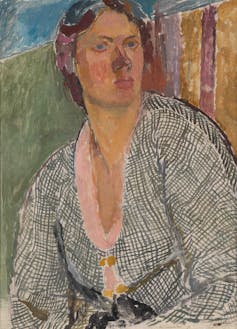
As visitors move through the opening galleries, they encounter works that highlight the pair working at the absolute cutting edge of contemporary style. Vanessa Bell’s Self-Portrait of 1915—serving as the hero image for the exhibition—establishes a palpable dialogue with Parisian art of the period, demonstrating the undeniable influence of Henri Matisse.
The narrative arc of this introductory space closes with two deeply moving self-portraits created in later life, showing the artists growing together in both style and life. Their posture and attire in these two canvases mirror one another, while the aggressive, sharp radical edge of their youth has noticeably softened and mellowed. Bell’s self-portrait, executed around 1958 two years after Grant’s, carries an unmistakable weight of resignation and impending departure. She would pass away three years later, predeceasing Grant by seventeen years.
The Awakening: The Post-Impressionist Shockwave
Stepping back chronologically, the exhibition walks the viewer through the formative years of the artists’ training. Early academic works reveal Duncan Grant precisely but superficially copying the French master Jean-Siméon Chardin, missing the metaphysical, quiet heart of Chardin’s true greatness. By contrast, Bell’s early still lifes—such as the slightly maladroit Iceland Poppies (1908–1909) and Apples: 46 Gordon Square (c. 1908–1909)—are squarely rooted in the Edwardian era, yet manage to capture far more than the mere physical appearance of their subjects.
A seismic shift occurred within the Bloomsbury sphere with the arrival of painter and critic Roger Fry. In the famous words of Bell’s sister, the novelist Virginia Woolf, “human character changed” following Fry’s landmark exhibition, Manet and the Post-Impressionists, staged at the Grafton Galleries in London in 1910. Through Fry, Bell and Grant absorbed the raw experimental velocity of the European avant-garde.
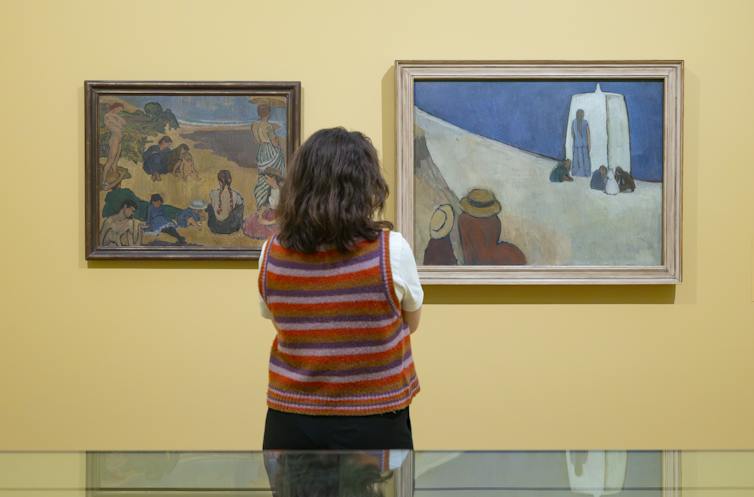
What followed was a frenetic period of intense artistic innovation. Two paintings by Vanessa Bell depicting Studland Beach (c. 1911 and c. 1912) chart her rapid stylistic evolution, transforming a visual language received from Paul Gauguin into a radical, pared-down abstraction that functions as a pure study in form and color. Several works in this gallery represent some of the earliest purely abstract paintings produced in Britain. Stylistically, Bell and Grant arrived at modernism remarkably early, though much of this experimental output relies heavily on the context of its early date to maximize its historical impact.
Commercial Design and the Omega Workshops
The pair’s restless creativity extended far beyond traditional easel painting. They became pivotal figures in the Omega Workshops, a commercial enterprise launched by Fry in 1913 designed to dismantle the artificial, elitist barrier separating the fine arts from the decorative arts. Although the venture ultimately ran out of steam within six years—doomed, in Fry’s bitter words, by the “utter indifference […] of the public”—it generated an extraordinary wealth of vibrant, charming objects.
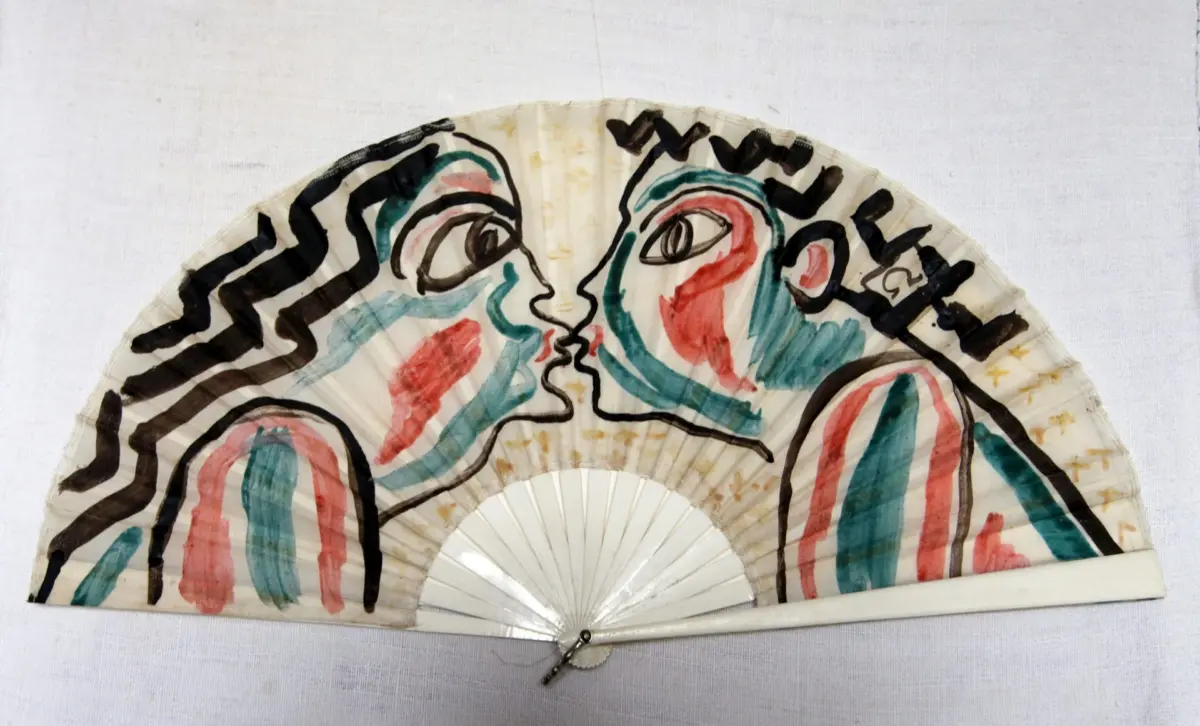
Included in the Tate Britain exhibition are several survivors of this era, such as a pair of impishly joyous ivory and silk fans painted by Grant. Even after the Omega Workshops closed, Bell and Grant’s exceptional flair for spatial arrangement, pattern, and color found lucrative outlets in theatrical stage designs and high-profile interior commissions.
Among the exhibition’s absolute standout pieces is the Famous Women Dinner Service (1932–1934), a major collaborative project commissioned by the patrician art historian Kenneth Clark. This ambitious joint work features fifty porcelain plates bearing painted portraits of historical and cultural luminaries, including Jezebel, Cleopatra, Elizabeth Tudor, the archetypal modern figure "Miss 1933"—and, in a delightfully eccentric self-referential twist, both Bell and Grant themselves. Created a full four decades before Judy Chicago’s globally celebrated feminist installation The Dinner Party (which honors 39 famous women), Bell and Grant’s slightly idiosyncratic dinner service feels decades ahead of its time.
The Controversy of Private Sketches
Tucked away in the exhibition is a small, dramatic room painted in a rich, dark purple, dedicated entirely to Duncan Grant. This space displays his "very private" erotic drawings—unpolished, highly candid sketches depicting gay sexual encounters, many of them acrobatic in nature, hurriedly scrawled on the reverse of discarded receipts and everyday scraps of paper.
While approximately forty of these drawings were exhibited three years ago at Charleston, the artists’ former Sussex home-turned-museum, their inclusion in a major national survey aiming for an unsensationalized reappraisal has sparked debate. While many works in the main galleries clearly testify to Grant’s complex sexuality, dedicating an entire room to intimate, private drawings never intended for public exhibition risks pulling the audience right back into the sensationalism the curators worked so hard to dispel.
Supporting Context & Metrics
To fully understand the weight of Vanessa Bell and Duncan Grant: Inside Bloomsbury, one must examine the broader cultural and institutional landscape surrounding the preservation of early 20th-century British modernism.
- Chronological Span: The exhibition covers more than five decades of continuous creative output, stretching from their initial 1905 meeting through the height of Post-Impressionism, the turbulent interwar period, and into the late 1950s.
- Institutional Collaboration: The survey draws upon major international and national holdings, including significant loans from the Yale Center for British Art (Paul Mellon Fund), the Tate’s permanent collection, and material preserved by Charleston Trust.
- The Gender Parity Milestone: The inclusion of the Famous Women Dinner Service (1932–1934) highlights a largely under-acknowledged contribution to feminist institutional critique in British art history, predating contemporary feminist art installations by nearly half a century.
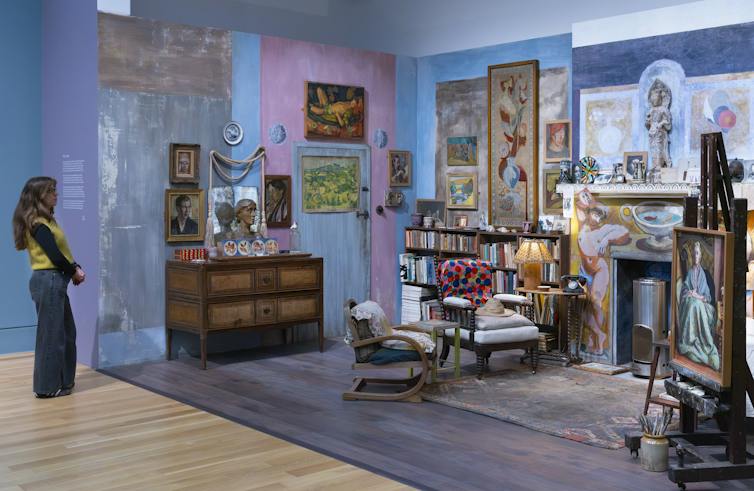
- The Charleston Legacy: The exhibition culminates in a painstaking, three-year preparation of a physical recreation of Bell and Grant’s shared studio at Charleston, offering visitors an immersive look into the physical crucible where their domestic and creative lives intertwined.
Official Statements and Curatorial Perspectives
The persistent cultural obsession with the personal lives of the Bloomsbury Group has long overshadowed their aesthetic achievements. Speaking to the curatorial intent behind the exhibition, exhibition curator Thomas Kennedy offered a vital perspective on breaking free from historical clichés:
"I think people bring it down to sex, but actually it’s about freedom. It’s freedom from the Victorian traditional norms that they felt had been imposed upon them. So, actually, they were looking at new ways of living, and freedom to love who you wanted."
While contemporary British society protects these freedoms by law—however complicated daily life may remain—Kennedy notes that the true radicalism of Bell and Grant lies not merely in the unconventionality of their actions, but in the sheer earliness of them. At the turn of the 20th century, stepping outside the rigid moral architecture of the Edwardian establishment was a perilous and revolutionary act.
Yet, as the exhibition demonstrates, this desire to break molds was never confined to their social arrangements; it was systematically applied to line, form, and color. By placing their canvases side-by-side with European avant-garde movements, Tate Britain successfully establishes that Bell and Grant were not provincial followers, but active co-creators of the modernist lexicon.
Future Outlook: Re-Evaluating British Modernism
As Vanessa Bell and Duncan Grant: Inside Bloomsbury welcomes visitors to Tate Britain through April 2027, it serves as a timely reminder of the cyclical nature of art-historical canonization. For decades, male-dominated art histories marginalized Vanessa Bell as a derivative domestic painter, while reducing Duncan Grant to a footnote of bohemian eccentricity.
This exhibition firmly dismantles those outdated hierarchies. By carefully dissecting their trajectory—from academic traditionalists absorbing the shockwave of the 1910 Post-Impressionist exhibition, to radical pioneers of British abstraction, commercial artisans of the Omega Workshops, and finally to the quiet, introspective retreat of their later years—the survey provides a definitive, nuanced portrait.
Not every piece in the vast retrospective feels equally vital; the later works occasionally lapse into a comfortable, cosseted introversion. However, the sheer volume of groundbreaking early abstraction, the fearless embrace of decorative arts, and the intellectual rigor underpinning their creative partnership ensure that Bell and Grant’s legacy will be judged on their own terms. Ultimately, Tate Britain has delivered an essential correction to the historical record, proving that beneath the layers of scandalous myth lie two of the most daring and original painters in modern British history.