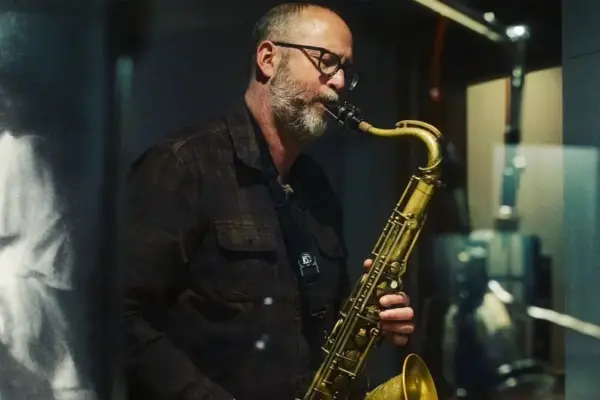
In the contemporary landscape of boundary-pushing improvised music, few instrumentalists command the quiet reverence and cross-genre fluency of saxophonist and flautist Tamar Osborn. A ubiquitous and vital presence in numerous acclaimed record collections and cutting-edge ensembles across the United Kingdom and beyond, Osborn has spent decades carving out a reputation as a master collaborator. Yet, remarkably, Varier: Berlin marks a historic milestone in her illustrious career: her very first release issued under her own name.
Released to critical intrigue, Varier: Berlin is far more than a simple debut; it serves as the foundational opening salvo of an ambitious, multi-part conceptual recording project. Osborn has articulated a fascinating long-term artistic arc for the Varier series, outlining an intentional trajectory designed to move across subsequent albums from purely improvised soundscapes through to almost fully composed contemporary suites, executed gradually over the unfolding course of the series.
For this inaugural chapter, Osborn decamped to the creative crucible of Berlin, gathering a powerhouse ensemble of international avant-garde musicians currently based in the vibrant eastern districts of the German capital. The resulting album features a masterclass in spontaneous composition, uniting Regis Molina on diverse reeds, a formidable percussion triad comprising Bex Burch, Maurizio Ravalico, and Dudú Kouate, Maurice Louca deploying prepared guitar and electronics, and Rosa Brunello anchoring the lower frequencies on electric bass.
While the album is largely improvisational in execution, each track is anchored by a skeletal thematic framework or guiding conceptual word—ranging from evocative states like "heart," "gut," "trance," "raw," and "space"—or, in the case of the stark track "Raw (Berlin)," Osborn actively exploring the percussive depths of a traditional Nigerian clay udu drum. The project immediately establishes a high-water mark for European improvised music, setting a rigorous standard for the thematic releases slated to follow in its wake.
Detailed Chronology and Sonic Architecture
To fully appreciate the sonic world of Varier: Berlin, one must trace the granular architecture of its tracklist, which captures an ensemble moving with telepathic synergy. The album opens with "Heartbeat No1 (Berlin)," introduced by the austere, rhythmic snapping of handclaps that immediately establish a terrestrial human pulse. True to the stylistic signatures found throughout the record, Rosa Brunello steps forward with a disciplined, hypnotic, and relentlessly repetitive electric bass line. This anchoring groove serves as a steady anchor, providing vital spatial architecture for a rich, conversational call-and-response passage between Osborn and fellow reed player Regis Molina.
As the record progresses, the emotional and dynamic register shifts decisively with "Gut (Berlin)." Beginning in a posture that feels ponderous and faintly menacing, the piece gradually accumulates mass and velocity, building into a stimulating, deeply visceral percussive intensity that justifies its anatomical title. This organic propulsion bleeds seamlessly into "Trance (Berlin)," where Maurice Louca’s otherworldly, heavily prepared guitar percolates beneath the surface like an electronic heartbeat, casting a hypnotic spell over the listener.
Contrasting sharply with the density of the previous tracks, "Space (Berlin)" demonstrates the ensemble’s profound collective restraint. Characterized by measured, breathtaking sparseness, this movement opens up vast sonic vistas, allowing lush saxophone harmonies to bloom organically within the acoustic environment.
The emotional zenith of the album arrives with "Raw (Berlin)." Here, stripped-down electronics intersect with primal, abrasive saxophone phrasing. According to critical analysis, the piece evokes "the vulnerability of complete emotional and physical exhaustion yet also the renewal and emerging wholeness that follows the process of catharsis." Notably, this track showcases Osborn stepping away from her primary wind instruments to experiment directly on a Nigerian clay udu drum, drawing out earthy, hollow resonances that ground the electronic coldness in organic warmth.
Directly following this cathartic peak, "Heartbeat No2 (Berlin)" references the structural essence of the album’s opening movement, yet reimagines it through a starker, harder-edged sonic lens that reflects the shifting physical and psychological landscape of the Berlin sessions.
For digital consumers, the release is further enriched by a pair of compelling bonus tracks. "Premonition/Memory (Berlin)" offers a surprisingly almost entirely electronic journey that retains faint, ghostly echoes of the album’s central "Trance" motif. This is complemented by an alternate take of "Raw," which provides academic and aesthetic insight into the improvisational malleability of the Berlin sessions.

Supporting Context & Metrics: The Anatomy of the Varier Project
To understand Varier: Berlin, one must examine the broader methodological framework governing Tamar Osborn’s career and the structural blueprint of the Varier series. For years, Osborn has been celebrated as a stylistic chameleon, lending her sophisticated phrasing on baritone, tenor, and soprano saxophones, as well as flute and bass clarinet, to projects spanning spiritual jazz, Afrobeat, Middle Eastern-infused modal music, and contemporary classical crossovers. Her decision to withhold her name from a primary leader-release until this juncture speaks to a deliberate, patient maturation process.
The conceptual mechanics of the Varier series represent a fascinating compositional experiment. By plotting an inverse trajectory—starting at the absolute zero-point of spontaneous, unwritten free improvisation and progressively introducing structural constraints, thematic notation, and formal arrangement across subsequent records—Osborn is effectively mapping the evolutionary history of music in reverse.
The personnel assembled in Berlin reflect Osborn’s acute curation skills, bringing together virtuosos from distinct geographical and stylistic lineages:
- Tamar Osborn (UK): Bandleader, composer, saxophones, flutes, udu drum.
- Regis Molina (Cuba/Germany): Reeds, contributing to the sympathetic reed-duelling dynamic that defines the album’s frontline.
- Bex Burch, Maurizio Ravalico, Dudú Kouate (International): A formidable percussion section that shifts effortlessly between metallic textures, wooden timbres, and folkloric African polyrhythms.
- Maurice Louca (Egypt/Germany): Prepared guitar and electronics, bridging acoustic traditions with avant-garde sound design.
- Rosa Brunello (Italy/Germany): Electric bass, providing the unyielding harmonic and rhythmic gravity that holds the chaotic elements in orbit.
From a structural standpoint, the album balances accessibility with high-art abstraction. While free improvisation can occasionally alienate casual listeners through its resistance to form, Osborn’s use of evocative single-word prompts ("Heart," "Gut," "Trance," "Space," "Raw") provides a cognitive anchor. These linguistic catalysts ensure that even when the ensemble ventures into radical sonic deconstruction, the musical narrative remains intensely human and emotionally legible.
Official Statements and Critical Reception
The arrival of Varier: Berlin has generated significant discourse within European jazz and avant-garde circles, particularly regarding its positioning as a transitional waypoint in a much larger artistic statement. Critics have universally lauded the telepathic interplay between Osborn and Molina, whose sympathetic reed-duelling has been described as both engaging and thoroughly joyous.
In his authoritative review for UK Vibe, critic Kevin Ward captured the dual nature of the release, noting that while it stands as "a mostly complete and satisfying record," it inherently carries "an unavoidable anticipation of the next piece of the project… or of the ‘almost fully composed’ conclusion, which leaves a slight feeling of an unfinished work." This structural tantalization is entirely intentional on Osborn’s part. By framing the album as chapter one of an unfolding multi-year narrative, she actively cultivates an audience invested in the macro-arc of her creative evolution rather than treating each release as an isolated commercial product.
Reflecting on her collaborative ethos, Osborn has frequently emphasized the importance of geographic and cultural cross-pollination. The Berlin sessions were not merely an exercise in gathering proficient instrumentalists, but an attempt to tap into the specific zeitgeist of the city’s creative underground—a space where European free improvisation intersects fluidly with migratory global musical traditions. The integration of Dudú Kouate’s ancestral percussion methodologies with Maurice Louca’s contemporary electronic processing epitomizes the cross-generational and cross-cultural dialogue that defines modern European improvised music.
Future Outlook: The Road to London and Beyond
As Varier: Berlin establishes a formidable artistic benchmark, attention naturally shifts toward the horizon of Tamar Osborn’s master plan. The overarching architecture of the Varier project demands forward momentum, and the blueprint is already firmly in motion.
The next installment in the sequence, provisionally titled Varier: London, is officially slated for release in May 2027. This upcoming chapter will trade the brutalist, electronic-leaning edges of the German capital for a brand-new, entirely different ensemble drawn from the rich, diverse ecosystem of the United Kingdom’s contemporary creative music scene. This geographic pivot promises not only a shift in personnel—potentially altering the dynamic between reeds, strings, and percussion—but also a subtle step forward along Osborn’s predetermined gradient from pure improvisation toward structured composition.
As the series continues to unfold over the coming years, culminating in the anticipated "almost fully composed" final chapters, Varier: Berlin will undoubtedly be re-evaluated not merely as a brilliant debut album, but as the daring, uncompromising ignition point of one of the most intellectually rigorous and sonically thrilling conceptual projects in modern improvised music. For now, listeners are invited to inhabit the vast, breathing spaces of this Berlin chapter—savoring its catharsis, tracking its pulses, and eagerly awaiting the next transformation in Osborn’s grand design.