Executive Overview
In the waning days of the Ancien Régime, humanity’s desperate flirtation with the occult finds a chilling, operatic echo in Fromental Halévy’s long-forgotten 1850 score, La Dame de Pique (The Queen of Spades). Staged for its annual Halloween production by the avant-garde champion of dark lyric theatre, Gothic Opera, this ambitious revival marks the first time the piece has been performed in a century and a half. Running at the historic Battersea Arts Centre, the production explores a devilish pact, a legendary magic ring, and the trio of secret cards guaranteed to yield infinite wealth at the roulette and hazard tables.
Directed by Jonny Danciger, conducted by Hannah von Wiehler, and featuring a reimagined chamber score by Leon Haxby, the production is a masterclass in atmospheric ambition. It pairs sublime, unexpectedly rich vocal performances with striking, expressionistic design by Céleste Langrée. While occasional dramatic stumbles—stemming from heavy-handed, unsubtle dialogue adaptations—prevent the narrative from achieving total theatrical synergy, the musical triumph is absolute.
By resurrecting Halévy’s neglected gem, Gothic Opera has proven that the intersection of classical lyricism and spine-chilling seasonal horror is a potent formula for audience engagement. As major houses search for ways to revitalize classical repertory and court contemporary demographics, this ambitious staging establishes a compelling blueprint for how to weaponize the Halloween season in service of high art.
Detailed Chronology: A Descent Into the Macabre
The narrative architecture of La Dame de Pique unfolds across two starkly contrasting theatrical environments, expertly mapped onto the tiered architecture of the Battersea Arts Centre’s Main Hall.

Act I: The Aristocratic Chateau and the Legend of the Cards
The production opens within the rarefied, suffocating confines of Princess Polowska’s chateau, representing the dying gasps of aristocratic excess just prior to the French Revolution. The spatial design uses three tiers, with a deep, elevated back platform that lends an immediate, supernatural aura to characters looming in the shadows.
We are introduced to André Roskaw (baritone Charlie Epps), a foreman of the local mines whose ambitions stretch far above his station. Epps’s character harbors designs on Lisanka (soprano Alice Usher), the governor’s daughter, provided he can accumulate the capital necessary to bridge their vast social chasm. Usher commands the stage with a formidable, dramatic voice, delivering the exposition of the terrifying Polowska family legend with crystalline gravity.
Shortly thereafter, Lieutenant Constantin (tenor James Hutchings) enters the narrative. Hutchings embodies the archetypal chivalric, upright hero required by gothic drama. His vocal contribution is characterized by a deep, aching romanticism, effortlessly navigating soaring phrases and delivering top notes with disarming ease.
The social ecosystem of the chateau is rounded out by the entrance of Prince Zizianow (tenor Sam Utley), a wildly entertaining comic villain whose exaggerated, émigré-style caricature channels the satirical energy of Blackadder the Third.

Act II: The Infernal Depths of the Mines
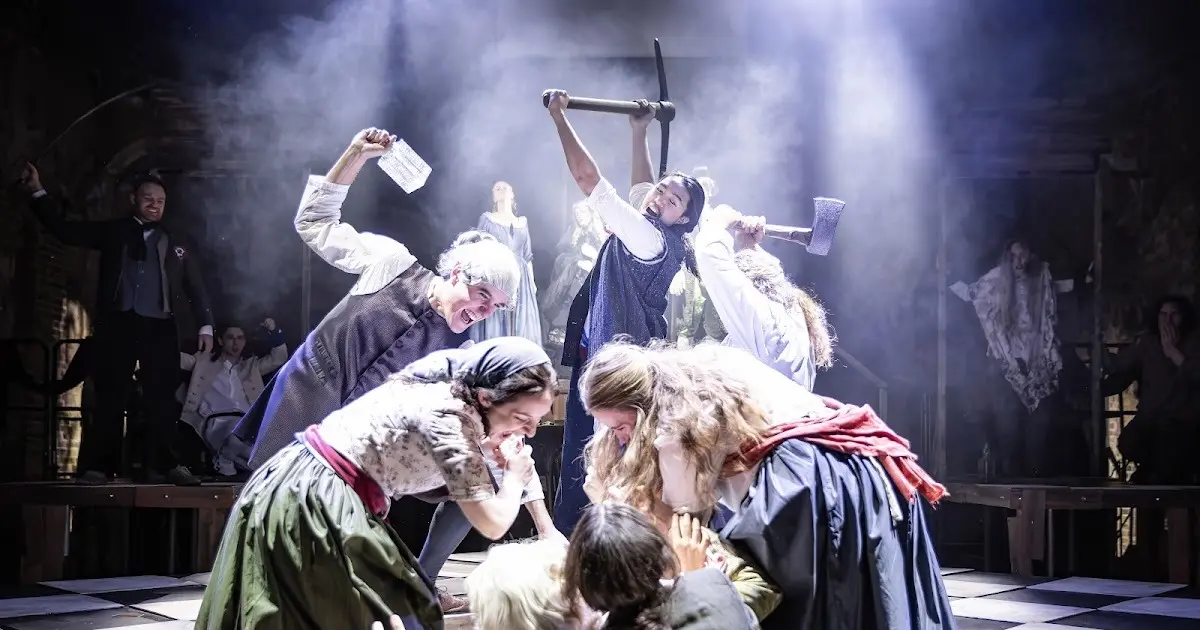
As the pact with the darkness takes hold of the characters, the narrative plunges from the pristine drawing rooms of the aristocracy down into the pitch-black, suffocating atmosphere of the local mines. Here, Céleste Langrée’s set and costume design truly shines. The visual lexicon shifts from French Revolution satins, powdered wigs, and tricolor rosettes to billowing smoke, flickering mining lanterns, and jagged, shadowy architecture.
It is within this subterranean labyrinth that the true stakes of the narrative are revealed. Grace O’Malley’s Princess Polowska—the chilling keeper of the secret cards—delivers a moment of profound theatrical vulnerability. Her performance in the mines strips away the cold, untouchable veneer of her aristocracy, exposing the psychological rot of a soul bound to occult forces.
As André Roskaw’s descent into madness accelerates, Epps abandons his initial naturalistic restraint. Driven by an ancient curse, he embraces a full-throated, expressionistic melodrama. As the characters converge in the darkness—surrounded by clandestine plots, whispered bets, and the looming threat of societal collapse—the production reaches its fever-pitch climax. The psychological tension, however, occasionally buckles under the weight of the English dialogue adaptation, setting up a complex interplay between vocal perfection and dramatic friction.
Supporting Context & Metrics: Production Breakdown & Musical Analysis
To understand the magnitude of Gothic Opera’s achievement with La Dame de Pique, one must examine the metrics of both the original composition and the contemporary staging.

The Compositional History
Fromental Halévy is best remembered today for his grand opera La Juive, yet his vast catalogue contains numerous works swallowed by the passage of time. La Dame de Pique, written long before Tchaikovsky’s more famous 1890 operatic treatment of Alexander Pushkin’s short story, utilizes a libretto by Eugène Scribe. Halévy’s musical language sits in a fascinating historical lineage: its brisk, jaunty ensembles directly foreshadow the idioms of Georges Bizet (who was, notably, a student of Halévy), while its lush, sweeping lyrical phrases gesture toward the proto-Pucciniana of the late 19th century.
The Chamber Orchestration
Leon Haxby’s chamber arrangement of the orchestral score presents an immense technical challenge. In a full opera house, a large orchestra can easily mask instrumental imperfections; in a stripped-back chamber setting, every line is terrifyingly exposed. The instrumental ensemble met this challenge with uncompromising precision, buoyed by conductor Hannah von Wiehler. Von Wiehler maintained rigorous control over tempo and texture while leaving sufficient interpretive oxygen for the musicians to explore wild, passionate abandon during the score’s most turbulent demonic passages.
Production Value Metrics
- Total Running Time: Approximately 2 hours and 30 minutes (including interval).
- Chorus Size: An astonishingly potent ensemble of just 7 vocalists, producing a sonic volume and textural richness that repeatedly deceived the ear into imagining a much larger body of singers.
- Creative Team: Directed by Jonny Danciger; Conducted by Hannah von Wiehler; Arranged by Leon Haxby; Set and Costume Design by Céleste Langrée; Lighting Design by Eli Hunt and Jonny Danciger; Produced by Maryann Wright.
- Venue: Battersea Arts Centre, Main Hall (utilizing its historic, timeworn architectural quirks to enhance the gothic atmosphere).
Official Statements & Artistic Insights
The creative vision behind La Dame de Pique relied heavily on bridging the gap between historical obscurity and contemporary theatrical relevance. While formal press releases from Gothic Opera emphasized the company’s ongoing mission to unearth "inexplicably neglected gems" of the lyric canon, the review by cultural critic Saskia Bibb highlights the unique artistic friction encountered during the rehearsal and performance process.
Director Jonny Danciger’s English dialogue adaptation drew mixed notices for its calculated departure from traditional operatic decorum. In attempting to make the socio-political unrest of the Ancien Régime legible and immediate to modern audiences, the text occasionally veered away from nuance. As noted in the critique:

"The dialogue… is devoid of subtlety. It reads like a child’s guide to the French Revolution. That said, I would be lying if I said I didn’t enjoy the line ‘Christ on a chaise longue!’"
This stylistic collision—between high-flown 19th-century bel canto vocalism and colloquial, occasionally jarring vernacular text—became the central talking point among critics and attendees alike. Yet, this very friction underscored the production’s overarching thesis: that classical opera does not need to be wrapped in untouchable, museum-piece reverence to be effective.
Furthermore, the performers themselves embraced the gothic duality of the piece. Grace O’Malley’s portrayal of Princess Polowska was universally praised for its technical brilliance and icy coloratura, with critics pointing out her rare ability to preserve the semantic integrity of the text even while navigating dizzying vocal acrobatics. Similarly, Charlie Epps’s transition from an honest, earthbound baritone to a man utterly consumed by feverish, demonic obsession provided an emotional anchor for the opera’s second half.
Future Outlook: The Commercial and Cultural Viability of "Spooky Opera"
The success of La Dame de Pique at the Battersea Arts Centre offers broader strategic implications for the future of opera programming in the United Kingdom and beyond. For decades, traditional opera houses have struggled to attract younger, more diverse demographics, often relying on tired stagings of standard-repertoire warhorses like La Bohème or The Magic Flute.

Gothic Opera’s calculated gamble—marry rare, historically significant 19th-century scores with the cultural momentum of the Halloween season—offers a replicable roadmap for artistic survival and growth.
Key Takeaways for the Sector:
- Genre Cross-Pollination: By leaning into gothic horror, the company successfully tapped into a pre-existing cultural appetite for the macabre, echoing the public-imagination pathways previously cleared by figures like Andrew Lloyd Webber.
- High-Yield Minimalism: Proving that world-class artistic standards do not require massive state-subsidized budgets, Gothic Opera leveraged smart, tiered stage design, atmospheric lighting, and hyper-talented chamber ensembles to punch significantly above its weight class.
- Repertory Expansion: The revelation that Halévy’s score contains writing nearly on par with the 19th-century greats demonstrates that there are vast swaths of music history waiting to be audited, corrected, and re-introduced to contemporary ears.
If the enthusiastic, packed opening night crowd and warm public reception are any indication, audiences are more than ready for a walk on the dark side. It is to be fervently hoped that La Dame de Pique does not have to wait another century and a half for its next revival—and that other regional and independent companies take note. A spooky night at the opera is officially a winning proposition.