Executive Overview
The Bayeux Tapestry stands globally as one of the most magnificent and fiercely debated works of material culture produced in medieval Europe. Spanning nearly 70 meters of embroidered linen, it is universally acknowledged as a primary visual source for understanding the Norman Conquest of 1066—documenting not only the geopolitical sequence of events that reshaped the British Isles, but also the cultural memory of a seismic societal upheaval. However, while traditional historical narratives have overwhelmingly concentrated on the titanic struggles of William, Duke of Normandy, and King Harold Godwinson, a profound revisionism is underway.
Recent scholarship, archaeological findings, and textile analyses have forced a radical reassessment of the tapestry’s creators and characters. Long before professional needlework became an institutionalized trade, a cadre of elite English women—famed across the European continent for their mastery of opus anglicanum—crafted the masterpiece. More strikingly, beneath the surface of marching armies, cavalry charges, and falling monarchs lie the hidden figures of women: queens, abbesses, anonymous victims of war, and enigmatic figures whose identities remain fiercely contested by modern historians.
As educational advocacy groups such as End Sexism in Schools and Teaching Medieval Women highlight a chronic underrepresentation of female history in academic curricula, re-examining the women of the Bayeux Tapestry offers a critical corrective. Far from being mere passive bystanders in a grand military theatre, these women—both those who held needle and thread and those immortalized in wool—offer an illuminating lens through which to interrogate power, gender, and survival in the eleventh century.
Detailed Chronology: The Narrative Arc of the Tapestry and Its Female Subjects
The visual narrative of the Bayeux Tapestry unfolds like an eleventh-century graphic novel, beginning in 1064 with diplomatic missions and culminating in the catastrophic English defeat at the Battle of Hastings in October 1066. Woven into this sweeping political and military chronicle are precisely three named or prominently featured women within the main frieze, supplemented by numerous allegorical and decorative figures in the upper and lower borders.
1. The Opening Diplomatic Missions (c. 1064)
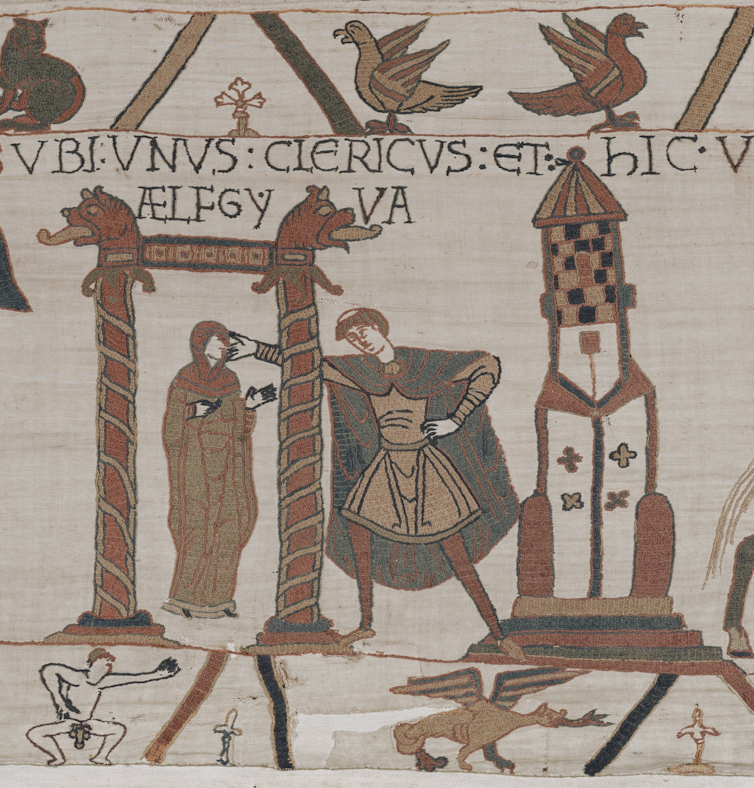
The narrative commences when King Edward the Confessor dispatches his brother-in-law, Harold Godwinson, Earl of Wessex, across the English Channel to Normandy. This initial sequence establishes the diplomatic entanglements that would ultimately legitimize William’s invasion. It is within the early scenes of political maneuvering that historians encounter the tapestry’s most confounding female cipher: a woman embroidered within an architectural doorway, accompanied by a cleric, bearing the enigmatic inscription “Ubi unus clericus et Alfgyva” (“Where a certain cleric and Ælfgifu”).
2. The Deathbed of Edward the Confessor (January 1066)
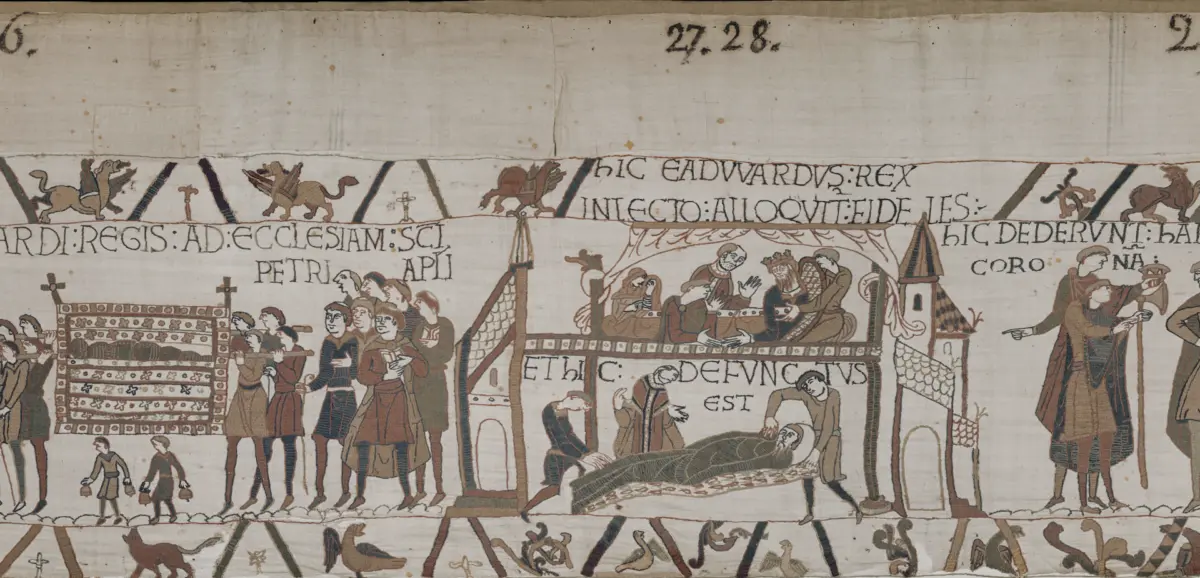
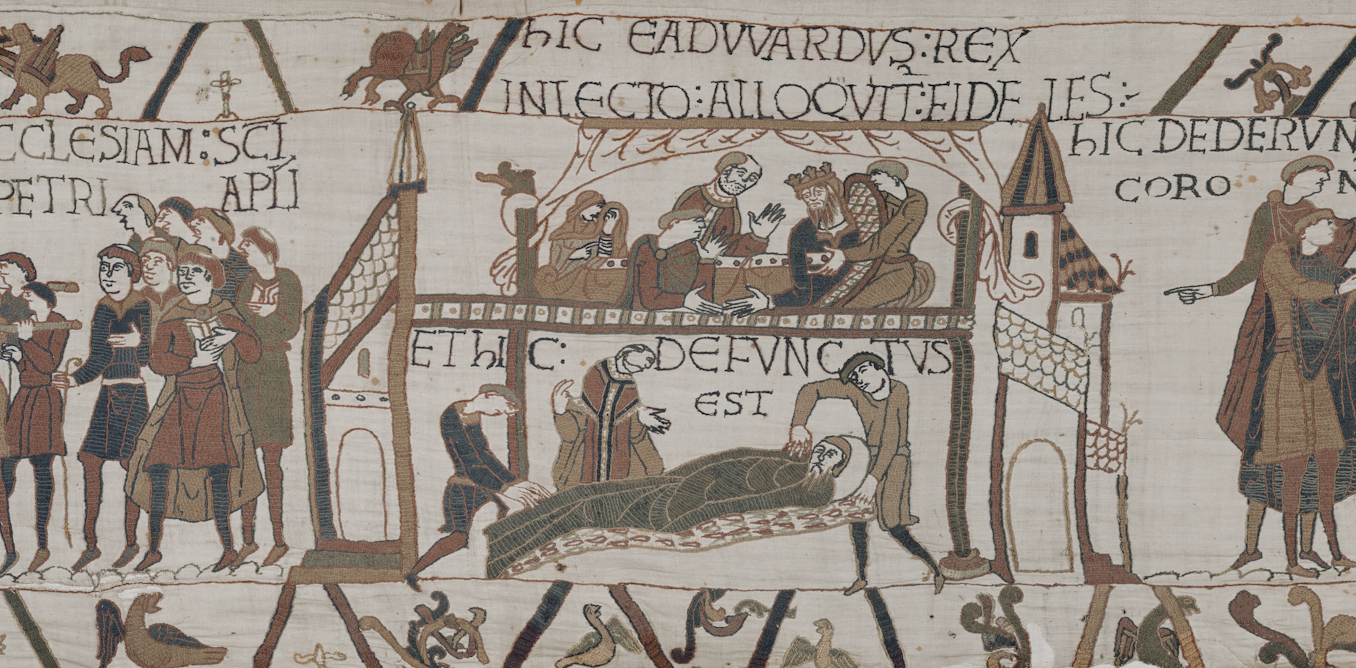
As the timeline progresses to early 1066, the political landscape fractures. King Edward the Confessor lies dying in London. Positioned directly at the foot of the royal deathbed is a weeping, veiled woman witnessing the monarch’s final moments and his fateful transfer of power to Harold. Historians universally identify this grieving figure as Queen Edith of Wessex, wife of Edward and sister to the newly proclaimed King Harold. Her presence marks a pivotal transition in the tapestry’s narrative, bridging the old Anglo-Saxon royal house with the turbulent twilight of the realm.
3. The Harrowing of the English Countryside (Late 1066)
As the narrative shifts toward the invasion itself, the focus pivots from royal courts to the devastating human cost of war. Amidst scenes of pillage, troop movements, and burning homesteads, an unnamed woman is depicted fleeing a burning building while clutching the hand of a terrified child. This poignant vignette captures the brutal reality of William the Conqueror’s scorched-earth tactics—specifically the systematic harrying of the English countryside designed to draw Harold out into a premature and decisive engagement.
Supporting Context & Metrics: The Makers and the Material Evidence
To fully appreciate the women of the Bayeux Tapestry, one must examine the physical creation of the artifact and the socio-political realities of Anglo-Saxon and Norman elite women in the eleventh century.
The English Needleworkers of Opus Anglicanum
Art historical consensus, supported by technical textile research—such as that spearheaded by archaeologist Alexandra Lester-Makin—indicates that the tapestry was not produced in a French monastery by Norman hands, but rather in England. Anglo-Saxon women were renowned throughout medieval Europe for their peerless embroidery skills, a luxury export known as opus anglicanum (English work). Whether working collaboratively in a professional monastic workshop—such as at Barking Abbey—or under the direction of an elite secular overseer, these anonymous craftswomen utilized laid-and-couching stitch techniques using wool yarn on linen cloth to immortalize a version of history that subtly preserved Anglo-Saxon perspectives.
Queen Edith of Wessex (c. 1023–1075)
Edith was far more than a passive royal consort. The daughter of the powerful Godwin, Earl of Wessex, and Gytha, Edith was educated at the prestigious Wilton Abbey, a major center of female literacy and patronage. She was celebrated by contemporaries for her intellect, piety, and skill with a needle.
Crucially, Edith’s political acumen allowed her to navigate the catastrophic transition of 1066 with remarkable agility. Unlike her brothers—King Harold and Earl Tostig, both of whom perished violently—Edith managed to retain her vast landholdings and socio-political influence under the new Norman regime. Records indicate her presence at high-profile ecclesiastical events, such as the Easter 1071 consecration of Walcher as Bishop of Durham. Upon her death on December 18, 1075, she was buried with full royal honors beside her husband, Edward the Confessor, in Westminster Abbey.
The Enigmatic Ælfgifu
Few figures in medieval art have generated as much scholarly ink as the woman labeled Ælfgifu. Because the name was exceptionally popular in eleventh-century England and Scandinavia, historians have proposed at least a dozen compelling candidates:
- Ælgyva, Sister of Harold: Some chroniclers suggested Harold had promised his sister in marriage to William. However, prominent historian Ann Williams has demonstrated that this is likely a misreading of the Domesday Book, arguing Harold had no sister by that name.
- The Abbess of Barking: Given the architectural framing of the figure—suggesting a cloister or religious enclosure—and the strong possibility that wealthy English nunnery workshops contributed to the embroidery, Ælfgifu, Abbess of Barking at the time of the Conquest, remains a strong contender.
- Ælfgifu of Leominster: Abducted in 1046 by Harold’s notorious brother, Swein Godwinson, this noblewoman bore a son, Hakon, who later served as a political hostage in Normandy—providing a direct narrative link to Harold’s journey.
- Ælfgifu of Northampton: The influential first wife of King Cnut, whose political legacy and contested succession rumors were recorded by medieval chroniclers like John of Worcester.
- Emma of Normandy: Edward the Confessor’s mother, who temporarily adopted the name Ælfgifu upon her marriage to Æthelred the Unready.
Compounding the mystery are the tapestry’s borders, which flank the Ælfgifu scene with iconography of a cross and a naked man—implying themes of illicit sexuality or public shaming that defy easy historical reconciliation.
Classical Influences and the Anonymous Refugee
The depiction of the woman fleeing a burning building with her child offers a profound insight into medieval artistic transmission. Art historians have noted striking compositional similarities between this fleeing mother and classical Roman reliefs depicting the spoils and traumas of war, most notably the scenes carved onto the Column of Marcus Aurelius in Rome.
This stylistic parallel strongly suggests that the tapestry’s designer—hypothesized by some researchers to be Abbot Scolland of St Augustine’s Abbey in Canterbury—may have personally traveled to Rome on pilgrimage around 1071–1072, integrating classical motifs of civilian suffering into an eleventh-century narrative of conquest.
Official Statements and Academic Perspectives
The academic rehabilitation of women’s history within medieval studies has gained substantial momentum, moving from marginalized niche research into mainstream pedagogical frameworks.
Dr. Eleanor Parker, a leading medieval historian and lecturer at the University of Oxford, emphasizes the importance of reading the Bayeux Tapestry against the grain:
"When we look at the Bayeux Tapestry, we are looking at a masterclass in political narrative construction. Yet, the inclusion of women—from Queen Edith’s quiet dignity at the deathbed to the nameless mother fleeing the flames—reminds us that the Norman Conquest was experienced by the entire fabric of society, not just armored knights on horseback. These figures are vital threads in understanding how contemporaries processed trauma, legitimacy, and memory."
Concurrently, educational reform organizations have flagged severe systemic gaps in how history is taught to younger generations. A recent interim report published by Teaching Medieval Women titled Finding Women in School Assessments revealed a chronic deficiency in the inclusion of female historical actors across GCSE and A-Level history curricula in England.
A spokesperson for End Sexism in Schools issued a statement regarding the broader implications of these curricular blind spots:
"History education in secondary schools too often defaults to an exclusively male narrative of kings, battles, and treaties. When foundational national treasures like the Bayeux Tapestry are taught purely as a military chronicle, generations of students are robbed of half the human story. By integrating recent research on the female makers and subjects of these artifacts, we foster a far more complete, inclusive, and accurate understanding of our past."
Future Outlook: Reimagining Medieval Studies for the 21st Century
As historians and archaeologists continue to interrogate artifacts like the Bayeux Tapestry using advanced digital imaging, material science, and feminist historiography, the horizon of medieval studies is expanding rapidly.
Future research initiatives promise to cross-reference textile analysis with comprehensive prosopographical databases, such as the Prosopography of Anglo-Saxon England (PASE) and regional administrative records like the Domesday Book. These interdisciplinary approaches aim to shed light on the decentralized networks of elite and non-elite women whose labor sustained the economic and cultural infrastructure of Anglo-Saxon England before and after 1066.
Ultimately, the enduring mystery of Ælfgifu, the quiet resilience of Queen Edith of Wessex, and the poignant desperation of the anonymous refugee fleeing a burning home serve a vital modern purpose. They challenge educators, historians, and museum curators to look beyond the dominant victors’ narratives etched into public consciousness. By bringing these hidden women back into the light, we not only enrich our comprehension of the Norman Conquest—we restore the fullness of human experience to the tapestry of history itself.