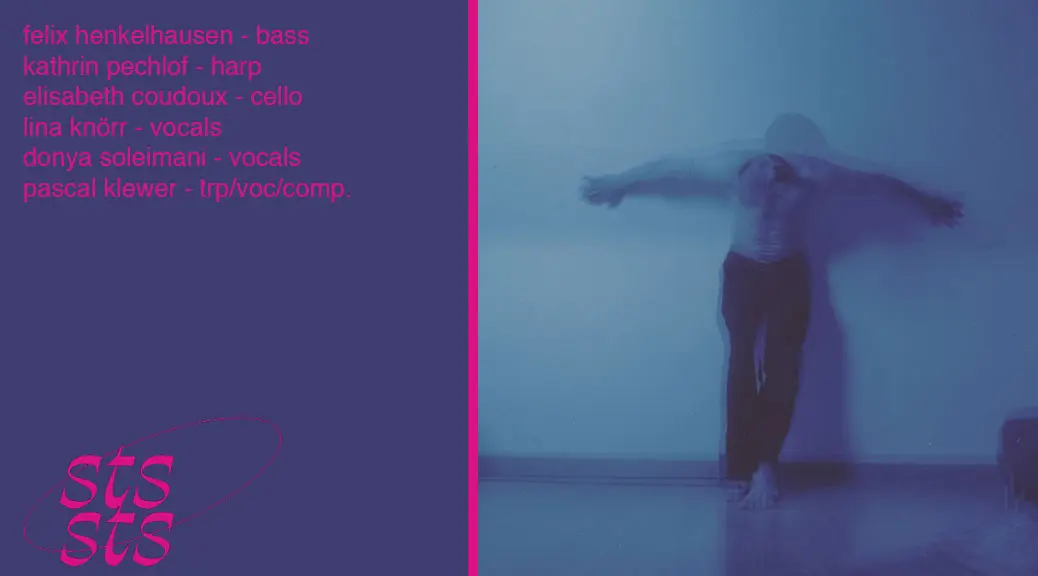
In the contemporary landscape of European improvised music, few releases arrive with the conceptual weight, structural refinement, and emotional resonance of Limerence, the latest masterwork from German trumpeter, composer, and infrastructural architect Pascal Klewer. Issued on his own bespoke imprint, sts|sts Records, and captured during pristine sessions at the legendary Deutschlandfunk broadcast studios in January 2025, Limerence challenges the traditional boundaries separating contemporary classical chamber music, vocal avant-garde, and jazz improvisation.
At its core, the album is an exploration of limerence—the psychological state of acute, all-consuming fixation on a future romantic prospect that remains unfulfilled and perhaps fundamentally unattainable. This thematic current is deeply personal, drawing its inspiration from a collection of intimate love letters penned during Klewer’s formative residency in Istanbul, where he collaborated closely with visionary Turkish filmmaker Nadir Sönmez. Yet, rather than descending into saccharine sentimentality or self-indulgent melancholy, Klewer translates this romantic agony into a remarkably controlled, texturally rich suite for an unorthodox ensemble: a six-piece constellation featuring harp, cello, double bass, trumpet, and a dynamic three-voice vocal section.
The physical release itself—pressed daringly onto a 10-inch vinyl format—demands an active, almost ritualistic engagement from the listener. As the needle tracks the grooves and forces an early, contemplative turnover, the physical medium mirrors the album’s thematic preoccupation with longing, anticipation, and abrupt thresholds.
This comprehensive review-essay examines the architecture of Limerence, tracing the trajectories of its world-class ensemble, analyzing its intricate compositional mechanics track by track, and positioning Klewer’s latest statement within the wider arc of contemporary European creative music.
Detailed Chronology: From the Bosphorus to the Broadcast Studio
To fully understand the artistic maturity displayed on Limerence, one must trace the rapid, multifaceted ascent of its creator. Born in 1997, Pascal Klewer’s musical journey began at the age of eight with the trumpet, before a pivotal relocation to Austin, Texas, at age fourteen exposed him to the vibrant pulse of American jazz. Returning to Germany, he honed his craft at the prestigious Hochschule für Musik und Tanz Köln, studying under luminaries such as Andy Haderer, Niels Klein, and Jürgen Friedrich.
However, Klewer quickly proved that he was not merely an instrumentalist waiting for chairs to open in established orchestras or big bands. Instead, he emerged as a vital cultural organizer and infrastructural builder within the German scene. His fingerprints are visible across numerous contemporary institutions: he founded the innovative 222 Festival, curated the vital Monday Meetings series, and established the ambitious "Pascal Klewer Bigband meets" concert format. These gatherings purposefully thrust his large ensemble alongside vanguard giants such as Peter Brötzmann, Evan Parker, Christopher Dell, Christian Lillinger, and harpist Kathrin Pechlof.
Despite this intense burst of creative organizing, Klewer’s physical discography has remained remarkably selective. His large-ensemble debut, Chasing Memories, was issued on UNIT Records in 2019, followed shortly thereafter by a dynamic, critically lauded Thelonious Monk repertory program recorded live at Cologne’s LOFT in March 2020 alongside Rudi Mahall, Johanna Summer, Reza Askari, and Leif Berger.
Then came a period of profound internal and geographical relocation—most notably his time spent immersed in the cultural crossroads of Istanbul. Working alongside Turkish filmmaker Nadir Sönmez, Klewer found himself caught in the crosshairs of cultural displacement, deep introspection, and intense romantic yearning. The emotional fallout of this period coalesced into a series of intimate, unmailed love letters.
These letters became the textual and emotional libretto for Limerence. When Klewer finally entered the Deutschlandfunk studios in Cologne in January 2025, he brought with him a fully realized suite of music designed to capture the exact neurological and emotional signature of unrequited, future-focused desire. By utilizing an ensemble where the traditional frontline is replaced by the delicate, shimmering timbres of harp, cello, and vocal polyphony, Klewer crafted a sonic ecosystem where emotional vulnerability is matched only by compositional rigor.
Supporting Context & Metrics: The Anatomy of an Ensemble
The brilliance of Limerence cannot be separated from the caliber of the musicians Klewer assembled for the project. Each member brings a distinct pedigree in both classical discipline and radical improvisation, forming a seamless hive-mind capable of shifting from whispering minimalism to soaring polyphonic drama in a single breath.
Kathrin Pechlof (Harp): Born in Munich in 1978, Pechlof is widely recognized as one of the very few harpists to successfully integrate the instrument into the native vocabulary of European improvised music. Following classical training in Munich and jazz composition studies in Cologne, her trio with Christian Weidner and Robert Landfermann has become a benchmark for chamber jazz, culminating in her receipt of the prestigious SWR Jazzpreis in 2023.
Elisabeth Coudoux (Cello): Born in 1985, Coudoux bridges classical precision with downtown-style free improvisation. After studying under Frank Gratkowski and Dieter Manderscheid in Cologne, she founded the forward-thinking ensemble Emißatett and helped establish IMPAKT, Cologne’s vital collective for free improvisation.
Felix Henkelhausen (Double Bass): Hailing from Oldenburg, Henkelhausen studied at the Jazz-Institut Berlin under Greg Cohen and Marc Muellbauer. He has rapidly become an omnipresent force on the capital’s creative music scene, collaborating with luminaries like Jim Black, Nate Wooley, Marc Copland, and Lucia Cadotsch, earning a well-deserved nomination for the German Jazz Award in 2023.
The Vocalists and Frontline
Lina Knörr (Vocals): A former Jugend jazzt prize winner in North Rhine-Westphalia and a 2018 alumnus of the prestigious Bundesjazzorchester (BuJazzO), Knörr studied jazz voice under Anette von Eichel and Susanne Schneider in Cologne. Her flexible, crystal-clear phrasing has made her a cornerstone of Klewer’s artistic ecosystem for years.
Donya Solaimani (Vocals/Guitar/Composition): Born in Berlin and operating out of Cologne, Solaimani brings a transcultural dimension to the ensemble. Her debut EP, Feast, brilliantly juxtaposes minimalist composition and jazz-pop aesthetics against the deep roots of Iranian traditional music and poetry.
Pascal Klewer (Trumpet/Vocals/Composition): Beyond his duties as bandleader, Klewer’s trumpet serves as the suite’s emotional epicenter. Operating as the sixth voice in the ensemble—and the only one incapable of forming a literal syllable—his horn acts as a bridge between the linguistic confessions of the vocalists and the abstract textures of the strings.
Official Statements & Aesthetic Philosophy
In contemporaneous discussions surrounding the release of Limerence, Klewer has emphasized that the project was born out of a desire to strip away the bombast traditionally associated with large-scale jazz arranging.
"When you are dealing with a concept as psychologically consuming as limerence, the music cannot afford to hide behind wall-to-wall swing beats or gratuitous brass climaxes," Klewer notes regarding the conceptual framework of the album. "Every note has to feel like a calculated risk—a desperate reach across a chasm that may or may not have a bridge on the other side."
This philosophy is echoed by label representatives and participating artists alike, who view Limerence as a deliberate rebuke to the hyper-commercialized, algorithm-driven production cycles dominating modern streaming platforms. By insisting on a physical 10-inch release sourced from pristine German radio broadcast masters, Klewer and sts|sts Records have made an emphatic statement in favor of tactile, intentional listening experiences.
The integration of text and tone was meticulously planned during the Istanbul residency. According to notes from the sessions, the vocal arrangements were structured to mirror the linguistic cadence of the original love letters—shifting abruptly between spoken-word cadence, wordless choral hums, and soaring, harmonized English lyricism. The vocalists do not merely sing over the band; they operate as a living, breathing harmonic envelope that wraps around Pechlof’s cascading harp arpeggios and Coudoux’s gut-wrenching bowed cello lines.
Track-by-Track Breakdown: A Journey Through Side A and Side B
Side A: The Architecture of Desire
Side A opens with "4B," an immediate masterclass in atmospheric tension. Choral writing unfolds above a brooding, low-end cello anchor. As the voices hold their sustained pitches, Felix Henkelhausen’s double bass enters from beneath, producing a tone that is simultaneously moody, deeply inviting, and texturally stunning. It is an arresting, cinematic entry point that establishes the emotional stakes of the record within seconds.
This leads directly into "TRPSOL," a mesmerizing dialogue between Klewer’s trumpet and Pechlof’s harp. To the uninitiated listener, the interplay is so tightly woven that the harp frequently mimics the percussive hammer and sustain of a prepared piano. Klewer’s phrasing here draws striking parallels to the introspective, lyrical phrasing of master trumpeter Avishai Cohen, floating effortlessly above the harp’s shimmering harmonic grid.
The centerpiece of the first movement is "DRONE," the longest and most compositionally expansive piece on the record. True to its title, the track anchors itself around a persistent, meditative tonal center. Bowed cello lines intertwine with subterranean harp reverberations, while the three vocalists are withheld until the very late stages of the piece, arriving like a distant apparition breaking through a morning fog. Side A leaves the listener suspended in a state of profound emotional suspension; experienced through headphones, the mix reveals an oceanic depth and spatial expanse that rewards repeated, rigorous listening.
Side B: Thresholds and Catharsis
Side B opens with "VAGABOND," a startling stylistic pivot that immediately subverts expectations. Featuring all three vocalists harmonized in English under a delicate folk umbrella, the piece utilizes zero instrumental accompaniment. As the shortest track on the album, it initially threatens to pull the record into entirely different territory—a fear that is quickly dispelled by the cohesive internal logic of the suite.
"INTRUSIVE THOUGHTS" follows, introduced by a walking, plucked cello line before Klewer’s vocal entry draws Knorr and Solaimani into a tight, shimmering web of vocal embellishments. The microphoning captures every breath, scrape of finger on string, and vocal overtone with breathtaking fidelity. Roughly two-thirds into the piece, the harp blooms into the mix. Just as the voices recede, a faint, disappearing ghost of bass notes closes the chapter. The piece possesses an intentionally truncated quality—leaving the listener with the intoxicating sense that the composition could have travelled twice as far into the avant-garde ether.
The album closes with "ENCORE," where the double bass gently dampens the restless energy of the choral opening before Pechlof’s harp re-emerges to provide a serene, definitive resolution.
Future Outlook
As Limerence makes its way into the hands of discerning critics, collectors, and contemporary music enthusiasts worldwide, it marks a critical turning point in Pascal Klewer’s career. By successfully wedding the academic rigor of European chamber composition with the spontaneous immediacy of free improvisation and the emotional immediacy of contemporary vocal songwriting, Klewer has carved out a unique lane for himself.
The audacity of pressing such intricate, fragile music to a 10-inch vinyl format—demanding that the listener physically rise, flip the record, and re-engage—acts as a brilliant structural metaphor for the themes of longing and anticipation that permeate the work. Far from being a mere novelty, this physical interruption fosters a rare, cathartic pause akin to the meditative stillness found in overtly spiritual music.
Looking ahead, Klewer’s commitment to building lasting institutional and artistic infrastructure through sts|sts Records and his ongoing curation projects suggests that Limerence is not an isolated experiment, but the blueprint for a new generation of European creative music. As contemporary jazz continues to fragment and cross-pollinate with classical and global traditions, artists like Klewer, Pechlof, Coudoux, Henkelhausen, Knörr, and Solaimani are proving that the future of the genre lies not in volume or speed, but in depth, vulnerability, and uncompromising artistic vision.