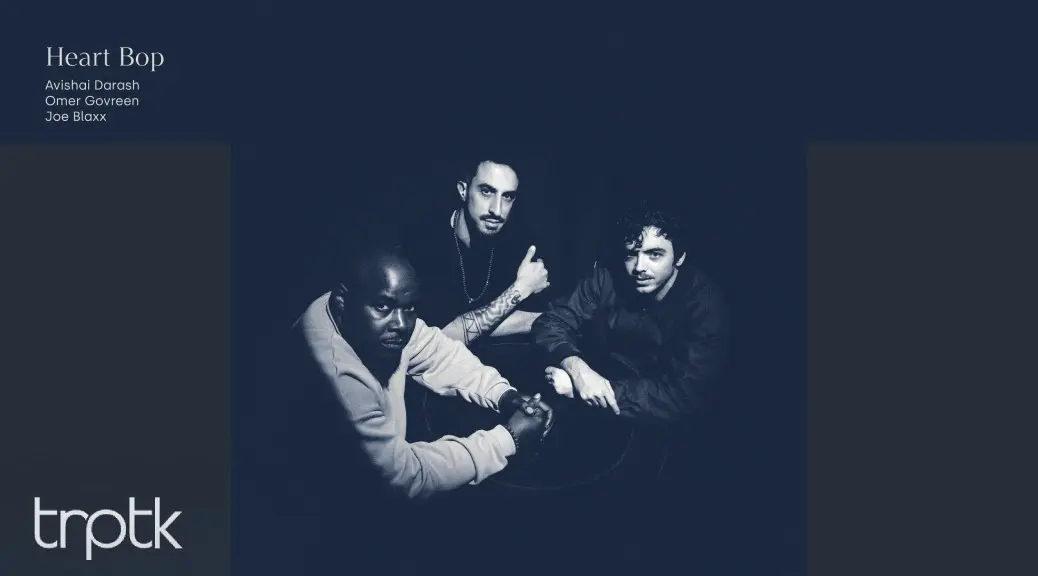
In the realm of contemporary improvised music, the piano-bass-drums format remains the ultimate crucible. Often described as the "art of the trio," this configuration demands a precarious balance of telepathic communication, individual virtuosity, and collective restraint. Few artists in recent years have navigated this complex terrain with the distinct synthesis of emotional vulnerability and technical mastery demonstrated by pianist and composer Avishai Darash. With his latest release, Heart Bop, Darash has delivered a landmark recording that cuts through the academic artifice sometimes associated with modern jazz, offering instead a pure, unforced distillation of rhythm, melody, and shared humanity.
Recorded live-in-studio at the renowned Wisseloord Studios for the audiophile label TRPTK, Heart Bop represents a significant pivot point in Darash’s critically acclaimed career. Eschewing the heavily orchestrated global-fusion aesthetics of his recent projects—which drew deeply from Israeli folk, North African traditions, and Western classical structures—Darash returns here to the foundational jazz vocabulary that first sparked his artistic imagination. Yet, this is no nostalgic exercise. Liberated by a decade of cross-cultural exploration and compositional maturing, Darash sounds invigorated, backed by a newly minted trio featuring bassist Omer Govreen and drummer Joe Blaxx.
This review-analysis explores the genesis of Heart Bop, traces the trajectory of Darash’s decade-long evolution, examines the sonic and structural characteristics of the album’s standout tracks, and evaluates its place within the broader landscape of modern improvised music.
Detailed Chronology: The Evolution of Avishai Darash
To fully appreciate the artistic triumph of Heart Bop, one must trace the winding, adventurous path that led Avishai Darash to this specific creative juncture. Over the past ten years, chronicled closely by contemporary jazz publications like UK Vibe, Darash has systematically dismantled boundaries between genres, building a discography defined by relentless curiosity and emotional honesty.
The Breakthrough: Impermanence (2016)
When Darash released his debut album Impermanence in 2016, it signaled the arrival of a major compositional voice. Even at that early stage, critics noted a maturity that defied his years. The record avoided the common pitfalls of young jazz musicians attempting to prove their technical velocity at the expense of songcraft. Instead, Impermanence balanced intricate harmonic architecture with striking melodic sensitivity. Standout compositions like "The Shepherd of Dreams" revealed an artist capable of introspective storytelling, utilizing the piano not merely as an instrument of percussion, but as a vessel for vocal-like lyricism and narrative depth.
Expanding Horizons: Nomadic Treasures and Samskara
Darash’s restless creative spirit soon pulled him toward wider geographical and cultural landscapes. Nomadic Treasures (A.MA) pushed further into cross-pollinated rhythmic concepts, followed by the towering achievement of Samskara (A.MA). In reviewing Samskara, critics lauded Darash as a tour de force composer who possessed the rare ability to let individual sidemen flourish while maintaining a unified, collective vision.
During this period, Darash seamlessly integrated jazz sensibilities with Israeli folk idioms, North African Gnawa and Andalusian traditions, and Western classical rigor. This trajectory culminated in two major releases: the intoxicating Andalusian Love Song (recorded with the Marmoucha Orchestra) and the beguiling, introspective Between Hope and Despair. Each successive chapter added new colors to his palette, proving that Darash was an artist incapable of standing still.
The Genesis of Heart Bop (2026)
Heart Bop arrives not as a departure from these global explorations, but as a distillation of them. The trio’s formation reads like a textbook example of serendipity over calculation. The collaboration was sparked by a chance encounter between Darash and powerhouse drummer Joe Blaxx at a live concert. The musical connection was instantaneous, characterized by an immediate, unspoken rapport.
To anchor the bottom end, Darash brought in bassist Omer Govreen, a trusted friend and collaborator of over a decade. Despite their long-standing personal relationship, the two had never formally worked together in this specific piano-trio configuration. A single initial rehearsal confirmed that something extraordinary was brewing.
The trio made its live concert debut at Amsterdam’s prestigious Red Light Jazz Festival in June 2026. A rough demo capturing those early workshop sessions was forwarded to Brendon Heinst, founder of the audiophile-centric label TRPTK. Impressed by the raw vitality of the playing, Heinst immediately extended an invitation to record. Entering Wisseloord Studios, the trio made a crucial artistic decision: to record live in the same room, with no subsequent digital overdubbing or heavy post-production mixing, preserving the pristine, unvarnished energy of a shared musical conversation.
Supporting Context & Metrics
The artistic success of Heart Bop is anchored by a combination of deliberate production choices, acoustic metrics, and the unique chemistry of its three primary participants.
Personnel Dynamics & Interplay
A key metric of a great piano trio is the equilibrium of its internal democracy. On Heart Bop, Darash operates with extreme generosity, yielding ample space to his bandmates.
- Avishai Darash (Piano): Continues to exhibit his signature touch—a rare capacity to shift fluidly between cascading, graceful finesse and percussive, spirited melodrama. His harmonic language avoids intellectual posturing; he trusts the emotional weight of his melodies.
- Omer Govreen (Double Bass): Serves as the structural anchor. Govreen provides deep harmonic reassurance while simultaneously weaving melodic counter-lines that propel the music forward without ever crowding the sonic spectrum.
- Joe Blaxx (Drums): Delivers a masterclass in responsive percussion. Blaxx walks a tightrope between propulsive momentum and delicate sensitivity, functioning more as a colorist than a simple timekeeper.
Recording Metrics & Production Philosophy
- Studio Environment: Recorded at the legendary Wisseloord Studios, famous for its world-class acoustic treatment and vintage analog signal chains.
- Acoustic Integrity: By capturing the trio performing simultaneously in a shared acoustic space, TRPTK ensured a binaural and spatial realism that places the listener directly inside the room.
- Post-Production: Eschewing modern multi-track slicing and pitch correction, the album relies on the pure acoustic bleed and natural room reverb, resulting in a warm, intimate, and immediately present soundstage.
Track-by-Track Breakdown: A Journey Through Heart Bop
The 2026 release is structurally paced to guide the listener through contrasting emotional states, from joyful exuberance to haunting introspection.

1. "Everyday"
Setting the tone for the entire album, "Everyday" opens with fluid, swirling keyboard figures that immediately invite a subtle, infectious groove from Govreen and Blaxx. Darash playfully steers the theme into unexpected, luscious harmonic territory, proving right out of the gate that familiar jazz forms can be reinvigorated with fresh life.
2. "The Game"
Injecting a luminous, kinetic energy into the sequence, "The Game" functions as a lively dialogue between all three instruments. The interplay is swift and agile, creating a sense of shared physical movement—a musical dance where every participant leads and follows in equal measure.
3. "It’s Again About Him"
Shifting the pace toward expansive expression, this track features some of the most hauntingly memorable melodies on the album. Darash’s playing here is utterly devoid of affectation, relying on a raw, unfiltered emotional honesty that stops the listener in their tracks.
4. "State of Flow"
Perhaps serving as a meta-commentary on the recording sessions themselves, "State of Flow" embodies effortless momentum. The trio locks into a hypnotic pocket where time seems to stretch and contract organically, resulting in a mesmerizing listening experience.
5. "We Used To Know Each Other"
A deeply affecting piece characterized by profound nostalgia. The ballad structure allows Darash to linger on suspended chords and melancholic voicings, evoking memories of past relationships and distant places with remarkable warmth.
6. "Tribute"
Balancing the wistful mood of its predecessor, "Tribute" offers an intricate architectural design. It highlights the collective technical prowess of the trio, combining complex metric modulation with an underlying sincerity that keeps the composition grounded in the heart rather than the head.
7. "Psilocybin Consciousness"
Venturing into the avant-garde fringes of the album, this track introduces an exploratory, questioning atmosphere. The trio investigates unresolved harmonic spaces, posing musical inquiries that are only half-answered, creating an air of suspended mystery.
8. "The Raven"
Concluding the album with a daring yet deeply emotive statement, "The Raven" provides a powerful bookend. It demonstrates that the trio can navigate darker, more dramatic thematic material without ever overstaying their welcome, bringing Heart Bop to a deeply satisfying narrative close.
Official Statements & Critical Reception
Reflecting on the organic nature of the project, Avishai Darash has emphasized that Heart Bop was never an engineered concept. "This was not a band assembled through careful planning on paper," Darash notes. "It simply came together because the musical gravity between us was too strong to ignore."
Reviewers and critics have been unanimous in their praise, cementing the album as a five-star triumph within Darash’s expanding catalog. Longtime observers of his career, such as Mike Gates of UK Vibe, have noted that the album feels like a homecoming:
"Listening intently to Heart Bop, I get the feeling that Darash has arrived at this music through a lifetime of listening, learning, questioning and exploring. The cultural adventures, the emotional introspection… have all contributed something to this moment. And yet, there is nothing complicated about the pleasure of this album. It sings, it swings, it surprises and it moves me."
Future Outlook
With the release of Heart Bop, Avishai Darash has secured his position not only as an ambitious cross-cultural composer, but as a master of intimate, acoustic jazz performance. The critical acclaim surrounding the TRPTK release—bolstered by its pristine audiophile production—signals an expanding international audience eager for music that prioritizes authentic human connection over clinical perfection.
Looking ahead, the Darash-Govreen-Blaxx trio is slated to take Heart Bop on an extended international tour throughout late 2026 and 2027, bringing their spontaneous, room-shaking chemistry to festival stages and jazz clubs worldwide. For an artist who has spent his career exploring the outer borders of world music and jazz, this return to the core piano-trio format is not a step backward, but a confident leap forward. The art of the trio is, indeed, in exceptionally safe hands.