Executive Overview
The landscape of software-based sound design has taken a significant leap forward with the official release of Lucid, a groundbreaking granular effect plugin developed by Minimal Audio. Known for pushing the boundaries of software instruments and processing tools—such as their acclaimed Current and Rift plugins—Minimal Audio has engineered Lucid to tackle one of the historic hurdles of granular synthesis: musical and harmonic coherence.
Traditional granular effects often turn incoming audio into chaotic, atmospheric clouds of sound that float outside of a project’s key signature. While ethereal and texturally rich, these traditional approaches frequently required meticulous manual editing, pitching, and filtering to sit harmoniously within a structured musical composition. Lucid solves this fundamental limitation by introducing what Minimal Audio proudly terms an industry-first grain scale-locking system.
Designed to operate smoothly within any major Digital Audio Workstation (DAW) as an insert effect, Lucid deconstructs any audio source—be it a vocal line, a drum loop, a guitar sweep, or a simple synth pad—grain by grain in real time. It then reconstructs these microscopic audio snippets so that they remain strictly locked to a user-defined musical scale and key. By bridging the gap between wild, unpredictable sound design and precise harmonic control, Lucid empowers electronic music producers, film scorers, and sound designers to effortlessly generate complex textures, cascading arpeggios, and lush melodic chords from virtually any input source.
Detailed Chronology & Technological Evolution
The Evolution of Granular Synthesis
To understand the significance of Lucid’s release, it is essential to examine the trajectory of granular synthesis. Conceived mathematically by physicist Dennis Gabor in the late 1940s and later applied to musical composition by pioneers like Iannis Xenakis, granular synthesis breaks audio down into thousands of tiny, overlapping segments known as "grains." Ranging typically from 1 to 100 milliseconds in length, these grains can be manipulated, pitch-shifted, time-stretched, and spatially repositioned to create vast sonic landscapes.
For decades, hardware and software iterations of granular processors were championed by experimental musicians and ambient soundscape artists. However, the inherent randomness of grain distribution often made it difficult to integrate these processors into pop, electronic dance music (EDM), or cinematic orchestration without clashing with the underlying key. Producers routinely spent hours bouncing audio, pitching individual chunks, or surgically filtering the output to prevent dissonance.
Minimal Audio’s Development Philosophy
Minimal Audio entered the plugin market with a clear mission: to build modern, high-performance creative tools that bypass the clunky interfaces of legacy software while offering deep, modular control. Their prior flagships, Rift (a multi-mode morphing saturation effect) and Current (an expansive wavetable synth ecosystem), established the company’s reputation for intuitive UI/UX design paired with deep modulation architectures.
The development of Lucid represents the logical evolution of this philosophy. The engineering team sought to address the dissonance inherent in granular processing by marrying real-time micro-sampling with intelligent pitch quantization. Rather than forcing producers to adapt their music to the chaotic output of a granular effect, Lucid adapts the granular output directly to the musical environment of the host session.
Launch and Ecosystem Integration
Upon its release, Lucid arrived with a robust suite of accompanying assets designed to flatten the learning curve and provide immediate utility for working professionals. The launch package includes 350 meticulously crafted presets, complete with searchable tags and performance-ready macro controls. Furthermore, the plugin shares the advanced modulation engine found in Current and Rift, allowing users to cross-pollinate their workflow knowledge and seamlessly map modulation sources across different plugins in the Minimal Audio family.

Supporting Context & Core Features
Lucid is packed with an array of powerful features that elevate it far beyond a standard time-stretching or pitch-shifting utility. Below is an exhaustive breakdown of the technical components driving the plugin.
1. The Core Granular Engine & Scale-Locking
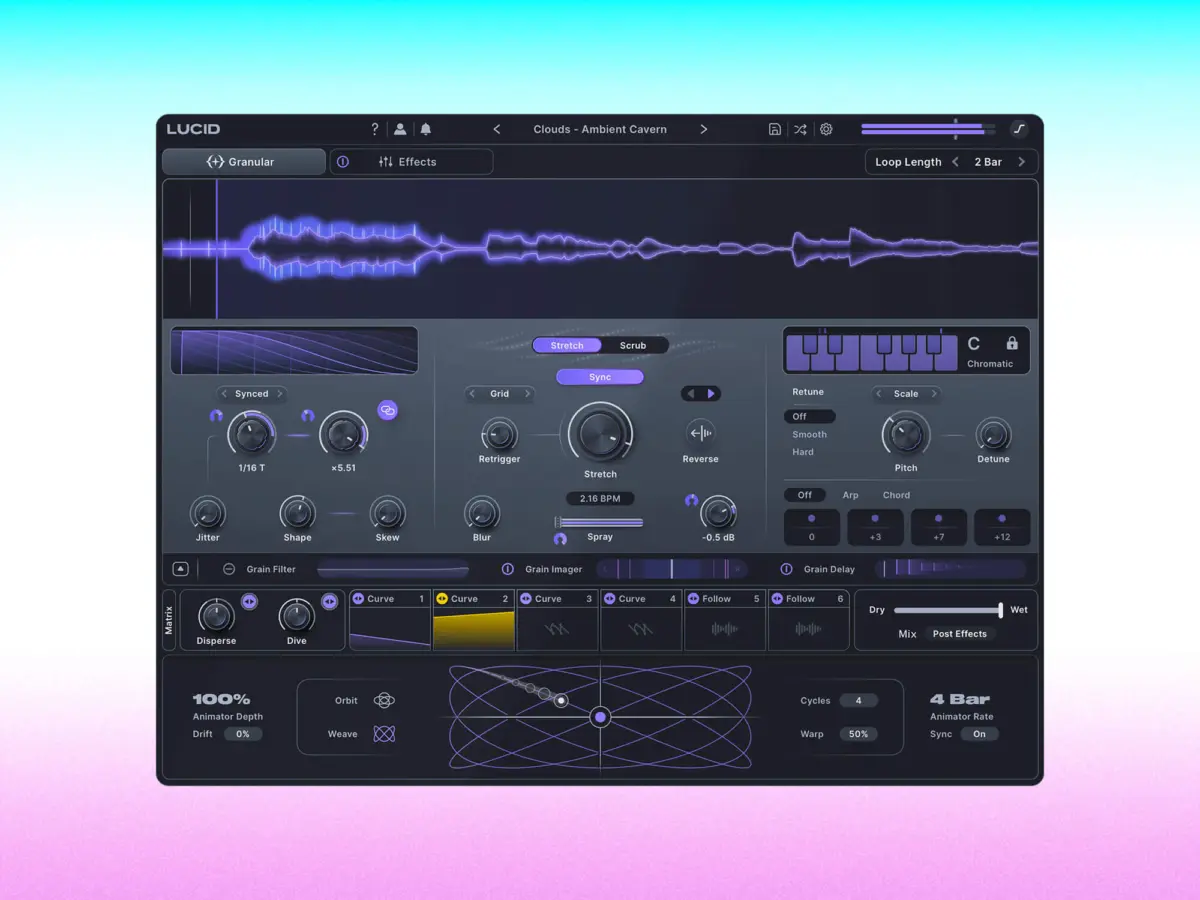
At the heart of Lucid lies a high-resolution granular engine capable of real-time audio reconstitution. Users can manipulate the playback head, grain density, size, shape, and randomization parameters to transform sterile source material into living, breathing textures.
The crown jewel of this engine is the grain scale-locking technology. When activated, Lucid analyzes the incoming audio fragments and forces their pitch data to conform to a user-selected scale and key. This unlocks capabilities previously unattainable in real-time granular effects:
- Harmonic Chords: Turn a single monophonic vocal hum into a rich, polyphonic chord progression that follows your MIDI input or internal scale settings.
- In-Key Arpeggiation: Generate complex, rhythmically locked arpeggios out of non-melodic noise sources like vinyl crackle, percussion transients, or environmental field recordings.
- Pitch-Accurate Stretching: Stretch audio across the timeline without introducing the sweeping, detuned artifacts typical of traditional time-stretching algorithms.
2. Timeline and DAW Synchronization
Granular processing often suffers from drift, where the manipulated audio slowly falls out of time with the host project’s grid. Lucid combats this via comprehensive timeline synchronization. Stretching, freezing, and playback behaviors lock seamlessly to the host DAW’s tempo and transport controls. Whether a track is running at 70 BPM or 174 BPM, Lucid’s internal buffers align with the project grid, ensuring that stutter effects, rhythmic grain clouds, and time-frozen pads land precisely on the beat.
3. The Flexible Effects Rack
Granular sound design rarely exists in a vacuum; it typically requires EQ, spatial processing, and saturation to sit correctly in a commercial mix. To streamline the production workflow, Minimal Audio equipped Lucid with a modular effects rack featuring eight swappable processor modules.
Users can reorder, enable, and disable these effects to sculpt their sound directly inside the plugin window. The rack includes:
- Multi-band Compression: To tame wild dynamics and glue the granular output together.
- Frequency Shifter: For metallic, inharmonic timbres and bell-like overtones.
- Reverb: Lush spatial algorithms to wash out and widen granular textures.
- Distortion & Saturation: Ranging from subtle warmth to aggressive crunch, derived from Minimal Audio’s routing expertise.
- Additional Filters and Modulation-friendly FX: Designed to react dynamically to incoming signal levels.
4. Advanced Modulation Matrix
Borrowing the acclaimed modulation architecture from Current and Rift, Lucid features a drag-and-drop modulation system that places infinite movement at the producer’s fingertips. Parameters throughout the granular engine and effects rack can be modulated using:
- Custom LFOs: Featuring adjustable shapes, free-running or tempo-synced rates, and phase retriggering.
- Envelope Followers: Allowing the incoming audio dynamics to directly control filter cutoffs, grain sizes, or wet/dry mixes.
- Step Sequencers: For rhythmically evolving patterns and stutter programming.
Official Statements & Industry Reception
While Minimal Audio has kept promotional rollout focused on hands-on video walkthroughs and community engagement, early feedback from beta testers, sound designers, and electronic music producers highlights a paradigm shift in how granular plugins are utilized in modern production.

Industry commentators and early reviewers have noted that Lucid effectively removes the intimidation factor traditionally associated with granular synthesis. In a statement accompanying the product launch, representatives from Minimal Audio emphasized the brand’s commitment to bridging complex digital processing with intuitive, musical workflows:
"We wanted to build a granular tool that didn’t feel like an academic experiment. Lucid was designed to give producers absolute creative freedom over time and pitch, ensuring that even the most experimental sound design choices remain inherently musical, rhythmic, and locked to the project at hand."
Early adopters within the electronic music and film scoring communities have praised the plugin’s ability to generate "instant atmosphere." Film composers, in particular, have highlighted the scale-locking feature as a massive time-saver when scoring dark, atmospheric cues that must adhere to strict tonal centers without devolving into atonal noise.
Future Outlook & Market Impact
The launch of Lucid arrives at a critical juncture in music production software. As digital audio workstations become increasingly powerful, producers are no longer satisfied with static effects processors. The demand is shifting toward intelligent, generative, and musically aware plugins that act as creative collaborators rather than simple static tools.
Implications for Music Production and Sound Design
By successfully integrating scale-locking into a real-time granular processor, Minimal Audio has established a new benchmark for software effects developers. Competitors will likely be forced to re-evaluate their own granular offerings to incorporate similar harmonic alignment features.
For the end-user, tools like Lucid democratize advanced sound design. Producers working across genres—from ambient electronica and techno to hip-hop beatmaking and cinematic orchestral scoring—can now incorporate complex granular textures into their arrangements without requiring a degree in acoustic physics or spending hours manually pitching audio fragments.
Availability and Pricing
Lucid is available now in VST, AU, and AAX formats, ensuring compatibility with all major DAWs including Ableton Live, Logic Pro, Pro Tools, FL Studio, and Cubase. To celebrate the launch, Minimal Audio has partnered with digital retailers like Plugin Boutique to offer introductory early-bird discounts.
As producers continue to explore the 350 launch presets, build custom modulation routings, and experiment with grain scale-locking, Lucid is poised to become a staple fixture in modern DAW templates worldwide—redefining how artists perceive, manipulate, and rebuild sound.