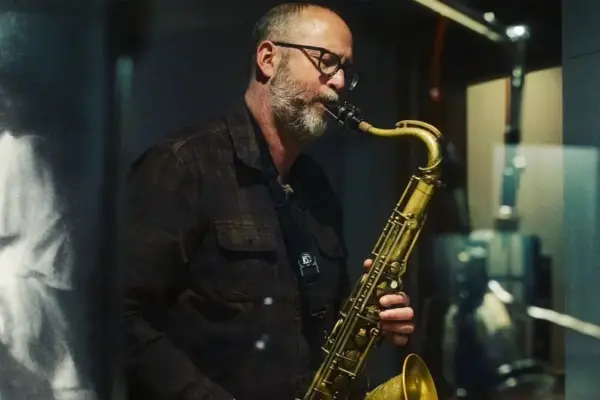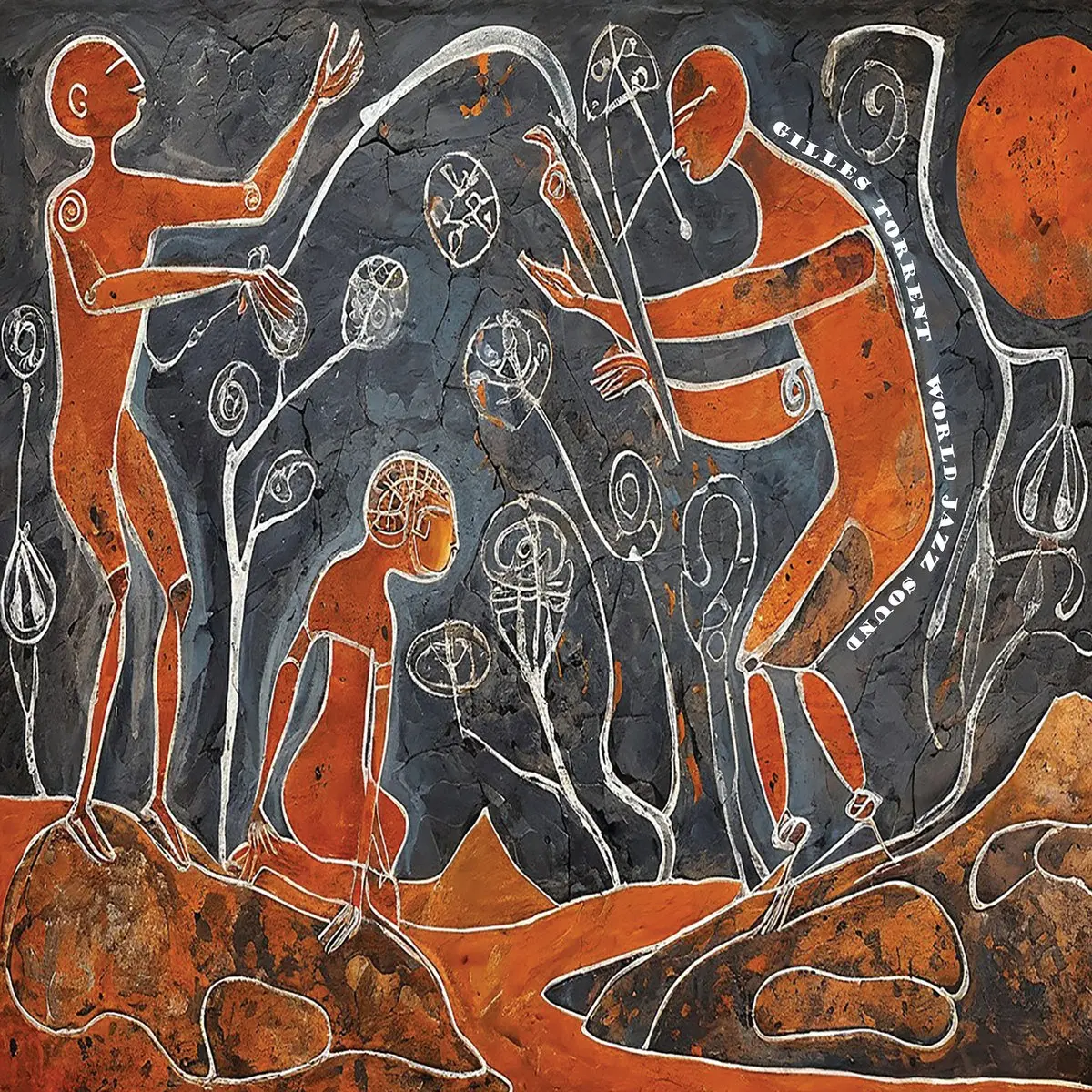
The contemporary vinyl revival has long functioned as more than a simple exercise in nostalgia; it is increasingly an instrument of historical reclamation. In rescuing obscure, geographically isolated master tapes from the archives of small European independent labels, tastemaker imprints routinely rewrite the margins of jazz history. The latest beneficiary of this curatorial impulse is Swiss saxophonist, clarinetist, and visual artist Gilles Torrent.
Long relegated to the status of a footnote in international jazz chronicles—despite a revered cameo on Jazzman’s acclaimed Spiritual Jazz 15: A Tribute to ‘Trane in 2023—Torrent is finally receiving his due on a global scale. Jazzman’s new, full-length vinyl release of World Jazz Sound (originally issued in Switzerland in 2010 as a double-CD titled La Longue Traversée Du Désert under the collective moniker World Jazz Sound) marks the first time this sprawling, cross-cultural masterwork has been pressed onto 180-gram vinyl.
Rooted deeply in the modal philosophies of John Coltrane yet unfettered by dogmatic purism, Torrent’s ensemble bridges the gap between European folk traditions, North African rhythms, Greek modal structures, and spiritual jazz fire. Featuring a non-traditional rhythm section devoid of a standard drum kit, the ensemble relies instead on the organic interplay of the darbouka, lotar, mbira, and percussion, elevated by violin, harp, piano, and voice.
This release does more than dust off a forgotten regional gem; it challenges the traditional Anglo-American hegemony of jazz history. By casting a light on the vibrant, self-sustaining improvised music ecosystems of French-speaking Switzerland, the reissue establishes World Jazz Sound as an essential text for collectors, musicologists, and modern seekers of transcendental sound.
Detailed Chronology
The Genesis of a Swiss Outsider (1986–2010)
Gilles Torrent’s recorded output has historically followed a trajectory defined by quiet dedication rather than commercial pursuit. He taught himself the saxophone at the relatively late age of 21, immersing himself for the following eleven years almost exclusively in the tonal and spiritual concepts of John Coltrane.
In 1986, the Swiss independent label Plainisphare released Terre Engloutie by the Gilles Torrent Jazztet. While the record possessed all the hallmarks of a classic modal jazz session, it remained largely confined to local Swiss collections and international tape-trader networks. Torrent spent the subsequent decades operating primarily within the French-speaking western cantons of Switzerland—specifically Geneva, Lausanne, and Nyon—recording intermittently and avoiding the major-label machinery of Paris, London, or New York.
The Wilderness Years and the 2010 Double-CD Masterpiece
The metaphorical desert long inhabited by Torrent inspired the title of his 2010 double-CD release on the Swiss label VDE-Gallo: La Longue Traversée Du Désert (The Long Journey Through the Desert). Credited to the ensemble World Jazz Sound, the project represented a massive leap forward in Torrent’s compositional scope, replacing standard post-bop formats with a borderless, multi-instrumental acoustic ensemble.
Though widely praised within Swiss circles, the release failed to make significant waves internationally due to the limited distribution networks of independent regional labels. During this period, Torrent also collaborated with legendary avant-garde figures, notably pairing with pianist Bobby Few and master drummer Sunny Murray on the 2004 album Désert de Sel.

Re-emergence and Modern Reassessment (2016–Present)
Torrent’s music began to breach international borders in the mid-2010s. In 2016, the Swiss label Altrisuoni issued two Jazz Inspiration compilation CDs that gathered crucial pieces from his multi-decade sessions, including "Ouannassa," "Ouverture," "Naima," and "Bahia."
The definitive turning point, however, arrived in 2023 when the UK-based tastemaker imprint Jazzman selected the title track of Torrent’s 1986 Terre Engloutie for inclusion in the compilation Spiritual Jazz 15: A Tribute to ‘Trane. Placed alongside heavyweights like Norman Connors, Sonny Fortune, and Brother Jack McDuff, Torrent was suddenly introduced to a new generation of deep-crate diggers.
This momentum led to the 2025 release of Buleria, a retrospective collection drawing from nearly a decade of sessions. Now, with Jazzman’s full vinyl reissue of World Jazz Sound, Torrent’s long spell in the wilderness has officially concluded, bringing his singular vision to turntables worldwide.
Supporting Context & Metrics
The Swiss Jazz Infrastructure
To understand Torrent’s musical ecosystem, one must examine the unique institutional soil of Switzerland’s jazz community. Switzerland occupies a foundational yet frequently overlooked position in European jazz history. In 1967, the Swiss Jazz School opened in Bern—the first institution of its kind in Europe. That same year, Claude Nobs launched the prestigious Montreux Jazz Festival on the shores of Lake Geneva, cementing the country’s status as a continental hub for the genre.
Torrent’s creative home lies in the French-speaking western region, anchored by cultural capitals like Geneva and Lausanne. Crucial to this ecosystem is the AMR (Association pour l’Encouragement de la Musique Improvisée), formed by local musicians in Geneva in 1973. Since 1981, the AMR’s home venue, Sud des Alpes, has served as a sanctuary for uncompromising improvised music, providing a vital stage for artists like Torrent to develop complex, non-commercial repertoires outside the commercial pressures of the mainstream music industry.
Instrumentation and Sonic Architecture
World Jazz Sound stands apart not merely for its geographic and stylistic fusions, but for its radical departure from standard jazz instrumentation. The ensemble deliberately omits a traditional drum kit, replacing the weight of the trap set with an agile, polyrhythmic acoustic pulse.
- Rhythm and Low End: Andrea Von Flüe anchors the rhythmic drive using the darbouka and tambourine, while Tobie Langel provides the low-end foundation on both the electric/acoustic bass and the Moroccan lotar (a traditional lute whose tone bears striking sonic and structural similarities to the Chinese pipa).
- Melodic and Harmonic Textures: Linda Mangeard supplies intricate piano work, and Erida Bega brings a distinct folk-infused melancholia via the violin.
- Vocal Dimension: Jamila Dorner provides both wordless vocalizations and lyrical interpretations, moving effortlessly between Arabic vocal styles and traditional folk phrasings.
- Special Guests: The ensemble also features harpist Julie Campiche, whose subsequent career has seen her become one of the most celebrated voices in modern European jazz, culminating in her receipt of a prestigious Swiss Music Prize in 2025.
- The Leader’s Voice: Gilles Torrent himself navigates the frontline on soprano saxophone and clarinet, while intermittently coloring the arrangements with the sanza (mbira), tambourine, and bells.
Track-by-Track Repertoire Breakdown
The double-CD’s original four-sided architecture has been thoughtfully streamlined for this new double-LP vinyl pressing, preserving the album’s most potent statements without sacrificing sonic fidelity:
- "World Jazz Sound" (Title Piece): Opening the set, the track immediately evokes cross-continental dialogues. Langel’s lotar work mimics the plucked precision of Asian folk forms before Torrent’s soprano saxophone enters smoothly, validating the ensemble’s ambitious moniker.
- "Afro Blue": Mongo Santamaría’s immortal composition—popularized by John Coltrane and featuring Oscar Brown Jr.’s lyrics—is radically re-imagined here. Jamila Dorner sings over mbira and lute before breaking into evocative wordless vocals, followed by Bega’s folk-inflected violin. Midway through, the track pivots sharply into a fierce, Coltrane-esque modal workout.
- "Scarborough Fair": Built upon a surprisingly forward-thinking rhythmic structure that sounds decades ahead of its recording date, the traditional English folk tune is grounded by Torrent’s resonant soprano sax and Dorner’s distinct vocal delivery.
- "Suns Of Africa": A direct nod to free-jazz icon Sunny Murray, originating from his 1970 BYG Actuel album Hommage to Africa. The inclusion of the mbira grounds the piece in African traditional aesthetics while Dorner’s wordless vocals soar above the ensemble.
- "Chant Des Alpes": Arranged by Torrent, this traditional Swiss Alpine song opens with a striking minute of authentic yodelling before exploding into a high-energy spiritual jazz tour-de-force, ultimately cycling back to the yodelled motif.
- Greek Suite ("Osso Varoun Ta Sidhera", "Fridhia Mou", "Paraxipnimata"): The Greek traditional repertoire forms the emotional and structural backbone of the record’s latter half. Drawing on Cretan urban songs and Dodecanese folk melodies, the band leverages the inherent modal flexibility of Greek folk music to merge Latin rhythms, Arabic vocal inflections, and searing Coltrane-school saxophone and clarinet improvisations.
Official Statements
Reflecting on the cultural and historical significance of the release, music critics and archival producers have emphasized the record’s uncanny ability to transcend its era.

Steve Williams, writing in his critical review for UK Vibe, noted the profound emotional resonance of the reissue:
"This record has so many of the elements I look for in the music I cherish most that it was a winner within the first few bars of the first track. To then witness… the balance of the album in all its glory reaffirms my belief that the music Coltrane was making, sometimes to critical disapproval, has transcended its time… First and foremost, a musician needs to trust in their own capabilities before venturing down the Trane path. Here that trust is borne out with skill, the leader’s stamp and the band’s diversity strong enough that it never sounds overshadowed by the book of Trane."
In official liner notes and promotional material, Jazzman Records underscored the mission behind unearthing regional European spiritual jazz:
"Jazzman have a gift for turning up records like this. Having introduced him through a compilation track and a gathering of sessions, they have now gone back to a complete album that shows his reach in full. All credit to them, once again."
Future Outlook
The commercial and critical rehabilitation of Gilles Torrent points toward a broader, increasingly vital shift in modern jazz curation: the decentralization of jazz historiography. For decades, the genre’s narrative has been fiercely guarded by the institutional gatekeepers of New York, Chicago, and London. However, the systematic re-evaluation of European regional scenes—sparked by archival labels like Jazzman, Soul Jazz, and Elemental Music—proves that fertile, world-class exploratory jazz was being cultivated far away from the traditional metropolitan epicenters.
For Torrent, this reissue is accompanied by fresh visual art designed by the artist himself. Torrent, who maintains a parallel career as a painter, regularly exhibits his canvases in pop-up galleries and arts collectives around Lake Geneva and Nyon, timing his gallery openings to coincide with intimate live performances by his modal trio and quartet.
Looking forward, the success of World Jazz Sound on 180-gram vinyl opens the door for further archival excavations of Torrent’s extensive, unreleased private recording vaults. As modern audiences increasingly reject strict genre borders in favor of hybrid, transnational sonic explorations, Torrent’s visionary synthesis of Alpine folk traditions, Mediterranean modes, and Coltrane-inspired spiritual fire feels less like a historical artifact and more like a blueprint for the future of global improvised music.